
What Causes Road Traffic Accidents?
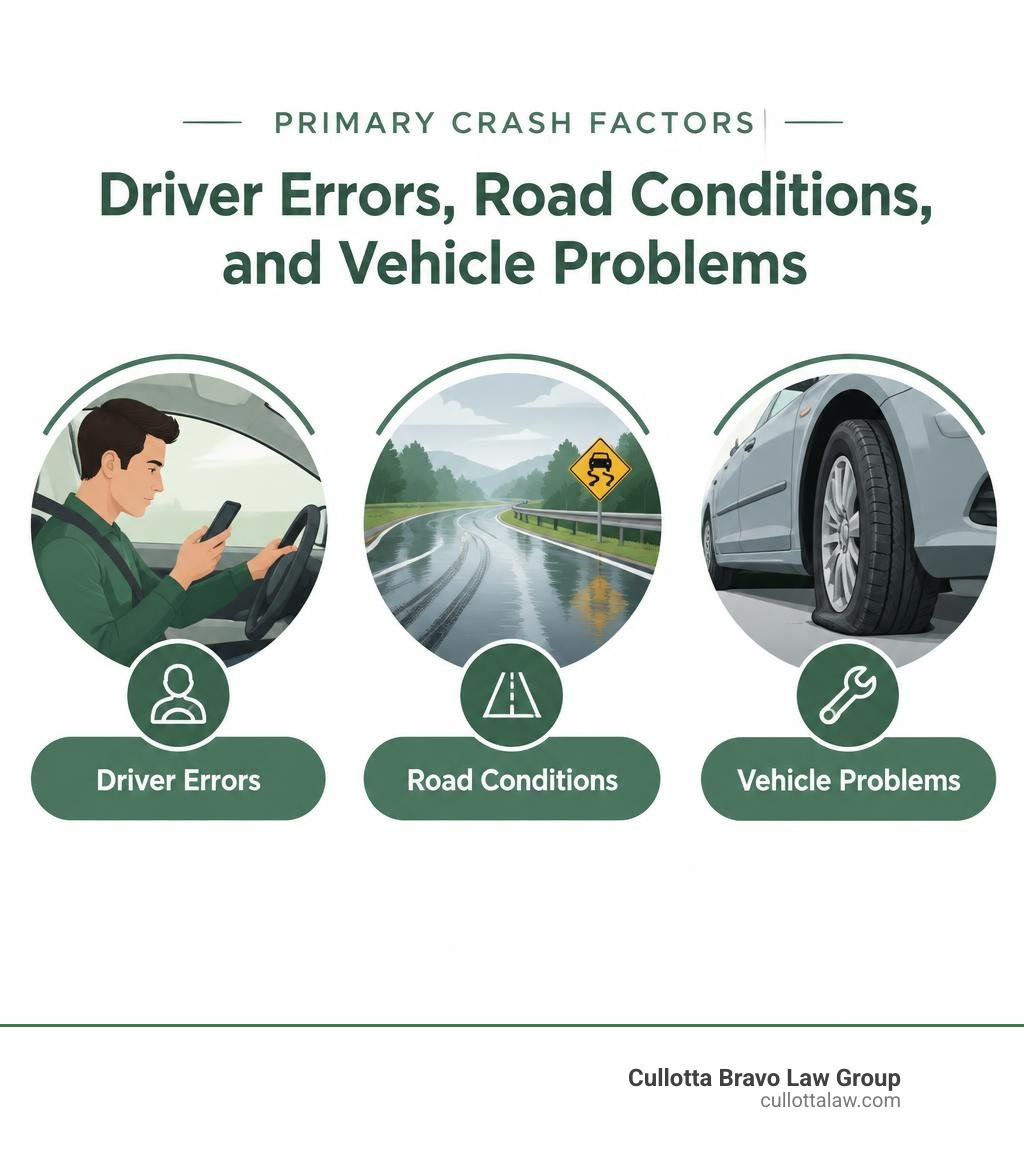
The main road traffic accident causes are driver errors, unsafe road conditions, and vehicle problems. Common triggers include distraction, speeding, impaired driving, slick pavement, poor road design, and worn tires. More than one factor can play a part in the same crash.
That matters when you’re hurt and trying to understand what happened. A driver may lose control on a wet road, but their speed and tire condition may also need a closer look.
I’m Peter Cullotta, founding partner of Cullotta Bravo Law Group, and I’ve represented injured people in the Chicagoland area for over 35 years. In car accident cases, I examine road traffic accident causes to understand the full picture, not just the first mistake that stands out.
Road traffic accident causes terms made easy:
Primary Categories of Road Traffic Accident Causes
Every traffic collision is the result of a complex chain of events. When investigators break down collisions, they evaluate three primary domains: human behavior, the roadway environment, and vehicle mechanics.
Globally, road traffic injuries represent a massive public health challenge. Approximately 1.16 million people lose their lives on the world’s roadways each year, with tens of millions suffering non-fatal injuries. Crashes cost most nations roughly 3% of their annual gross domestic product. In the United States alone, traffic collisions claim over 44,000 lives annually and generate more than $457 billion in medical expenses, property loss, and economic disruption.
To understand why collisions happen, researchers examine the interaction between these pillars. An academic review of accident occurrence factors reveals that crashes rarely happen in isolation; an environmental hazard often triggers a crash only when paired with delayed driver recognition or poor vehicle maintenance. Our detailed legal review offers a comprehensive guide to understanding road accident causes across these interconnected categories.
Critical Human Errors as Road Traffic Accident Causes
Human behavior is by far the single largest contributor to motor vehicle collisions. Data from the National Motor Vehicle Crash Causation Survey (NMVCCS) conducted by federal safety agencies indicates that human error serves as the critical reason in 94% (plus or minus 2.2%) of investigated crashes. When safety analysts break down driver mistakes, they categorize them into distinct operational failures:
- Recognition Errors (41% ± 2.1%): The most common category of driver error. These occur when a motorist fails to perceive a hazard due to internal distractions, external distractions, general inattention, or inadequate surveillance (such as failing to check a blind spot before changing lanes).
- Decision Errors (33% ± 3.7%): These happen when a driver detects a situation but chooses an improper action. Examples include driving too fast for current weather or road conditions, misjudging the speed or distance of oncoming traffic, following too closely, or executing illegal maneuvers.
- Performance Errors (11% ± 2.7%): In these instances, the driver makes the correct decision but executes it poorly, such as overcompensating during a skid, panicking and locking the brakes, or losing directional control.
- Non-Performance Errors (~7%): These involve physical incapacitation, most notably falling asleep at the wheel or suffering a sudden medical emergency.
| Error Category | National Share | Primary Examples | Typical Impact |
|---|---|---|---|
| Recognition Errors | ~41% | Texting, rubbernecking, failing to scan cross-traffic | Delayed braking, rear-end collisions, intersection t-bones |
| Decision Errors | ~33% | Speeding in rain, aggressive passing, misjudging gaps | Loss of control, head-on collisions, run-off-road crashes |
| Performance Errors | ~11% | Oversteering, improper evasive steering, panic braking | Rollovers, spin-outs, secondary collisions |
| Non-Performance Errors | ~7% | Drowsy driving, sleep apnea episodes, medical events | High-speed drift, off-road collisions, head-on impacts |
A landmark NHTSA study on unsafe driving acts found that unsafe driver behaviors were present in 99% of serious crashes analyzed. Driver inattention was identified in 22.7% of crashes, vehicle speed in 18.7%, and alcohol impairment in 18.2%, highlighting how routine behavioral lapses turn catastrophic in fractions of a second.
High-Risk Driving Behaviors and Impairments
Beyond involuntary perceptual errors, deliberate high-risk driving behaviors dramatically raise crash probability and severity:
- Excessive Speeding: Speeding has contributed to approximately one-third of all motor vehicle fatalities for over two decades. Physics dictates that kinetic energy scales with the square of speed. Every 1% increase in mean travel speed produces a 4% increase in fatal crash risk and a 3% increase in serious crash risk. For a pedestrian struck by the front of a vehicle, the risk of death rises by 4.5 times when vehicle speed increases from 31 mph (50 km/h) to 40 mph (65 km/h).
- Alcohol and Drug Impairment: Driving under the influence of alcohol or psychoactive drugs destroys reaction times, depth perception, and cognitive processing. Research shows that motorists operating under the influence of amphetamines face roughly five times the fatal crash risk of unimpaired drivers.
- Mobile Phone Distraction: Using a smartphone behind the wheel—whether texting, browsing navigation, or talking hands-free—increases crash risk approximately fourfold. Taking your eyes off the road for five seconds at 55 mph means traveling the entire length of a football field completely blind.
- Aggressive Driving and Unsafe Lane Changes: Tailgating, weaving through traffic, and failing to yield right-of-way create chaotic road dynamics. Commuters should review standard three-lane highway driving rules to maintain predictable spacing and proper lane discipline.
Environmental and Infrastructure Causes of Road Traffic Accidents
While driver error leads the statistics, roadway and environmental conditions contribute to roughly 45% to 50% of crashes as secondary or primary factors:
- Slick Road Surfaces: Rain, snow, sleet, and ice severely reduce tire traction. Wet pavement contributes to nearly half of all weather-related crashes by inducing hydroplaning, where a layer of water separates the tire from the asphalt.
- Visual Glare and Low Lighting: Direct solar glare at sunrise or sunset and blinding high-beam headlights at night can temporarily blind drivers, obscuring pedestrians, road debris, and stalled vehicles.
- Substandard Infrastructure Geometry: Sharp unbanked curves, narrow shoulders, poorly timed traffic signals, missing guardrails, and inadequate sightlines make roads unforgiving when small driver errors occur.
- External Hazards: Stray animals entering highways, fallen tree limbs, loose gravel, and sudden rockslides require immediate evasive action that can lead to multi-vehicle pileups.

Mechanical Failures and Vehicle Safety Issues
Mechanical malfunctions cause or exacerbate approximately 2% of all motor vehicle accidents. Although modern engineering has improved vehicle reliability, critical failures still occur due to poor maintenance or manufacturing defects:
- Tire Blowouts and Tread Separation: Tires account for approximately 35% of all vehicle-related critical crash causes. Under-inflated tires generate excessive internal heat on highways, leading to sudden catastrophic blowouts.
- Braking System Failures: Worn brake pads, leaking hydraulic fluid, or malfunctioning anti-lock braking systems (ABS) lengthen stopping distances or cause vehicles to pull violently to one side during emergency stops.
- Steering and Suspension Breakdowns: Broken tie rods, failed ball joints, or worn struts prevent drivers from steering clear of hazards.
- Overloading Stress: Carrying cargo beyond manufacturer limits degrades braking efficiency, alters center-of-gravity dynamics, and increases rollover risk. Drivers can check our 10 causes of road accidents guide to identify basic vehicle maintenance oversights before heading out on long trips.
Demographic and Socioeconomic Crash Disparities
Crash risks are not distributed equally across the driving population. Demographic, social, and economic variables heavily influence crash frequency, injury severity, and fatality rates. An evaluation of crash contributing factors shows that human vulnerability intersects directly with road exposure and socioeconomic status.
Age and Gender Vulnerabilities
- Children and Young Adults: Road traffic injuries are the leading global cause of death for individuals aged 5 to 29 years. Young motorists (ages 16–24) have higher crash rates due to inexperience, lower risk perception, and a higher tendency to speed or use mobile devices while driving.
- Older Drivers: Motorists aged 65 and older face increased vulnerability not because they drive recklessly—they typically exhibit high seat belt usage and avoid night driving—but because physiological frailty makes them far more susceptible to severe injury or death when a crash occurs.
- Gender Discrepancies: Globally and nationally, males are approximately three times more likely to die in road traffic crashes than females. This disparity stems from higher overall miles driven, lower seat belt compliance, and higher rates of speeding and driving under the influence.
Global Economic Inequities
A stark imbalance exists in global road safety: roughly 92% of all traffic fatalities occur in low- and middle-income nations, despite those countries possessing only 60% of the world’s registered motor vehicles.
These disparities arise from aging vehicle fleets lacking modern safety features (such as electronic stability control or side-curtain airbags), poorly engineered roadways lacking pedestrian sidewalks or safety barriers, and limited emergency medical response systems. Even within high-income nations, lower-income communities often experience higher pedestrian fatality rates due to wider, high-speed arterial roads cutting through residential zones with inadequate crosswalk infrastructure.
Hidden Risks: Commercial Vehicles and Blind Spot Dangers

Commercial motor vehicles—including 18-wheelers, tractor-trailers, dump trucks, and transit buses—present unique roadway hazards due to their massive size and operating physics. A fully loaded commercial semi-truck can weigh up to 80,000 pounds, requiring up to 40% more stopping distance than a passenger vehicle under identical highway conditions.
According to an EU road safety report on professional drivers, heavy goods vehicles represent only 4% to 5% of police-reported crashes but account for roughly 14% of fatal collisions. Crucially, the vast majority of fatalities in commercial truck crashes are occupants of smaller passenger vehicles or vulnerable road users.
Professional Driver Fatigue and Heavy Loads
Professional drivers face demanding delivery schedules, long hours behind the wheel, and disrupted circadian rhythms. Studies show that driver fatigue contributes to roughly 40% of major commercial traffic accidents. When fatigue sets in, reaction times slow to levels comparable to blood-alcohol intoxication.
Furthermore, improper cargo loading introduces severe mechanical instability. Reviewing overloaded truck accident causes highlights how unbalanced freight shifts during transit, causing sudden jackknife incidents, rollover crashes, and catastrophic brake fade on steep downhill grades.
Navigating Semi-Truck No-Zones and Blind Spots
Large commercial trucks feature extensive blind spots—commonly referred to as “No-Zones”—where passenger vehicles disappear from the driver’s mirrors:
- Front Blind Spot: Extends roughly 20 feet directly ahead of the truck cab.
- Rear Blind Spot: Extends up to 200 feet directly behind the trailer.
- Left Side Blind Spot: Extends along the side of the cab and trailer.
- Right Side Blind Spot: The largest and most hazardous blind spot, spanning across three lanes of traffic.
To protect yourself and your passengers on multi-lane highways, review our guide on understanding semi-truck blind spots to avoid lingering in these high-risk areas.
Prevention Strategies and the Safe System Approach
Traditional traffic safety strategies historically focused almost exclusively on individual driver behavior through enforcement and education. While driver responsibility remains essential, modern traffic management embraces the Safe System Approach.
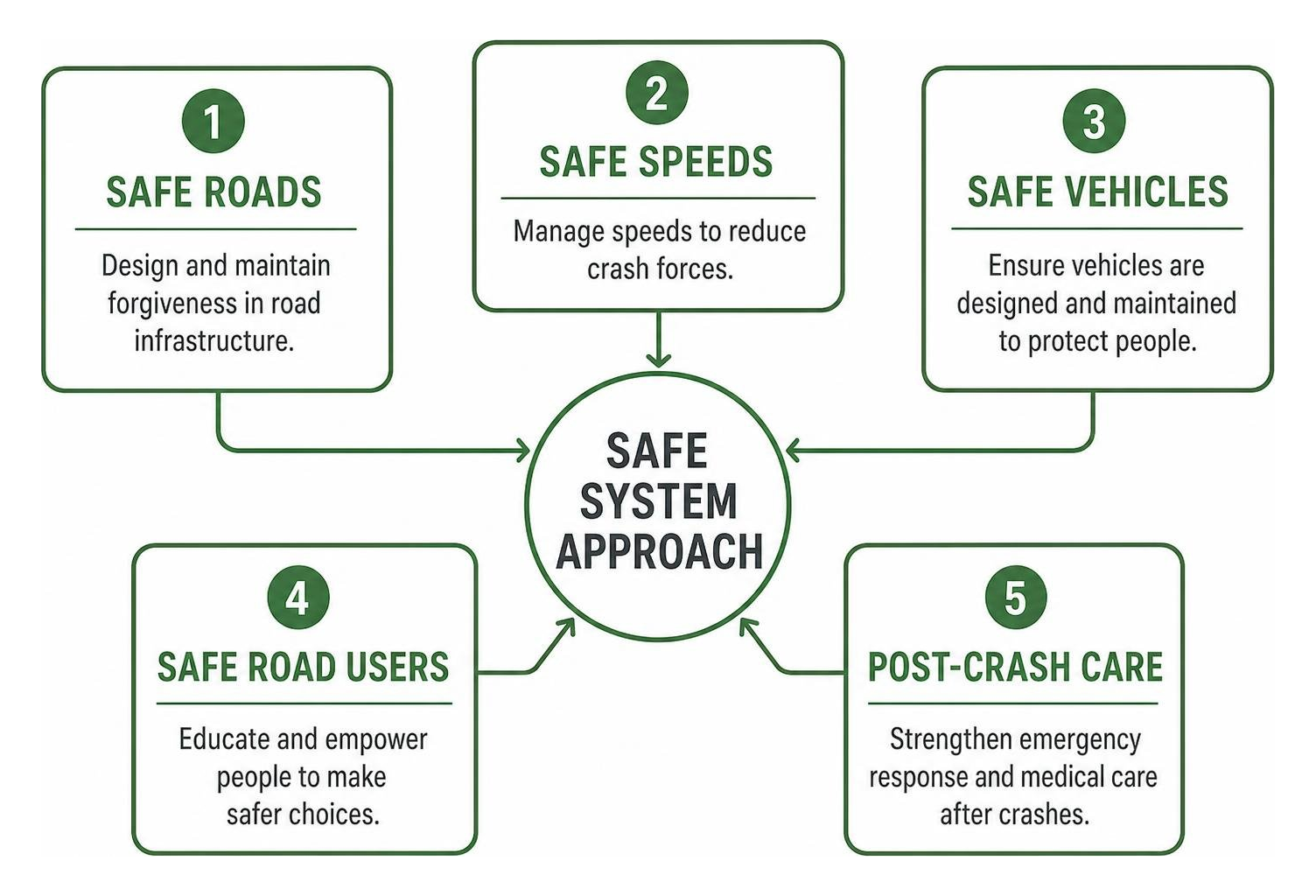
The Safe System framework accepts that human beings are fallible and will inevitably make mistakes. However, road systems should be designed so that those mistakes do not result in fatal or life-altering kinetic forces.
Accommodating Human Fallibility in Road Design
Forgiving infrastructure reduces crash probability and softens the physical impact when collisions do happen:
- Roundabouts and Traffic Circles: Replacing traditional four-way intersections with modern roundabouts eliminates high-speed right-angle (“t-bone”) and head-on collisions, reducing fatal and injury crashes by nearly 80%.
- Complete Streets Design: Providing dedicated, physically separated bicycle lanes and raised pedestrian crossings keeps vulnerable road users out of direct vehicular paths.
- Rumble Strips and Median Cable Barriers: Edge-line and centerline rumble strips alert inattentive drivers before they leave their lane, while high-tension cable barriers prevent out-of-control vehicles from crossing into oncoming highway traffic.
- Context-Sensitive Speed Management: Aligning speed limits with physical road geometry and roadside risk reduces the kinetic energy generated during collisions.
Protective Equipment and Post-Crash Interventions
Proper use of occupant protection systems drastically shifts survival odds when an impact occurs:
- Seat Belts: Wearing a three-point seat belt reduces the risk of fatal injury to front-seat passenger car occupants by up to 50%.
- Child Restraint Systems: Age-appropriate child safety seats reduce fatal crash injury risks by 71% for infants and 54% for toddlers.
- Motorcycle and Bicycle Helmets: Correct helmet use reduces the risk of death in a motorcycle crash by more than six times and cuts the likelihood of traumatic brain injury by up to 74%.
- Rapid Post-Crash Care: Timely trauma triage and rapid emergency medical response within the “golden hour” following a crash prevent survivable injuries from turning fatal.
Frequently Asked Questions About Crash Causes
What is the single most common reason for motor vehicle collisions?
Human error is the leading cause of crashes, serving as the critical reason in roughly 94% of investigated collisions. Within human error, recognition failures—specifically driver inattention, internal distractions like mobile phones, and failing to scan surroundings—account for approximately 41% of all driver-related crash triggers.
How significantly does vehicle speed impact fatal crash probability?
Speed acts as a severe force multiplier. For every 1% increase in average traffic speed, the risk of a fatal crash rises by approximately 4%. In side-impact collisions between passenger cars, the fatality risk for occupants reaches 85% at impact speeds of just 40 mph (65 km/h).
How does the Safe System Approach differ from traditional traffic safety?
Traditional road safety frameworks placed nearly all responsibility on driver behavior, treating crashes as individual moral or technical failures. The Safe System Approach recognizes that humans make mistakes and have biological limits for absorbing crash energy. It designs roadways, speed limits, vehicle standards, and post-crash medical care to cushion those mistakes and prevent fatal trauma.
Conclusion
Road traffic collisions stem from an intricate blend of human perception errors, high-risk driving behaviors, environmental hazards, and vehicle mechanical defects. While modern engineering and forgiving road designs continue to improve safety across Illinois and nationwide, individual vigilance remains your best defense behind the wheel.
When another driver’s negligence, speed, or distraction causes severe harm, understanding the true underlying causes of your crash is essential to securing fair compensation. At Cullotta Bravo Law Group, we have spent over 35 years aggressively advocating for injured victims across Aurora, Chicago, Naperville, and Joliet. We investigate every angle of a collision—from vehicle telematics to road design defects—to ensure your rights are protected.
If you or a loved one has suffered an injury in a collision, contact an experienced car accident lawyer in Aurora today for a free, comprehensive consultation.