

How to Compare Truck Safety Mirrors
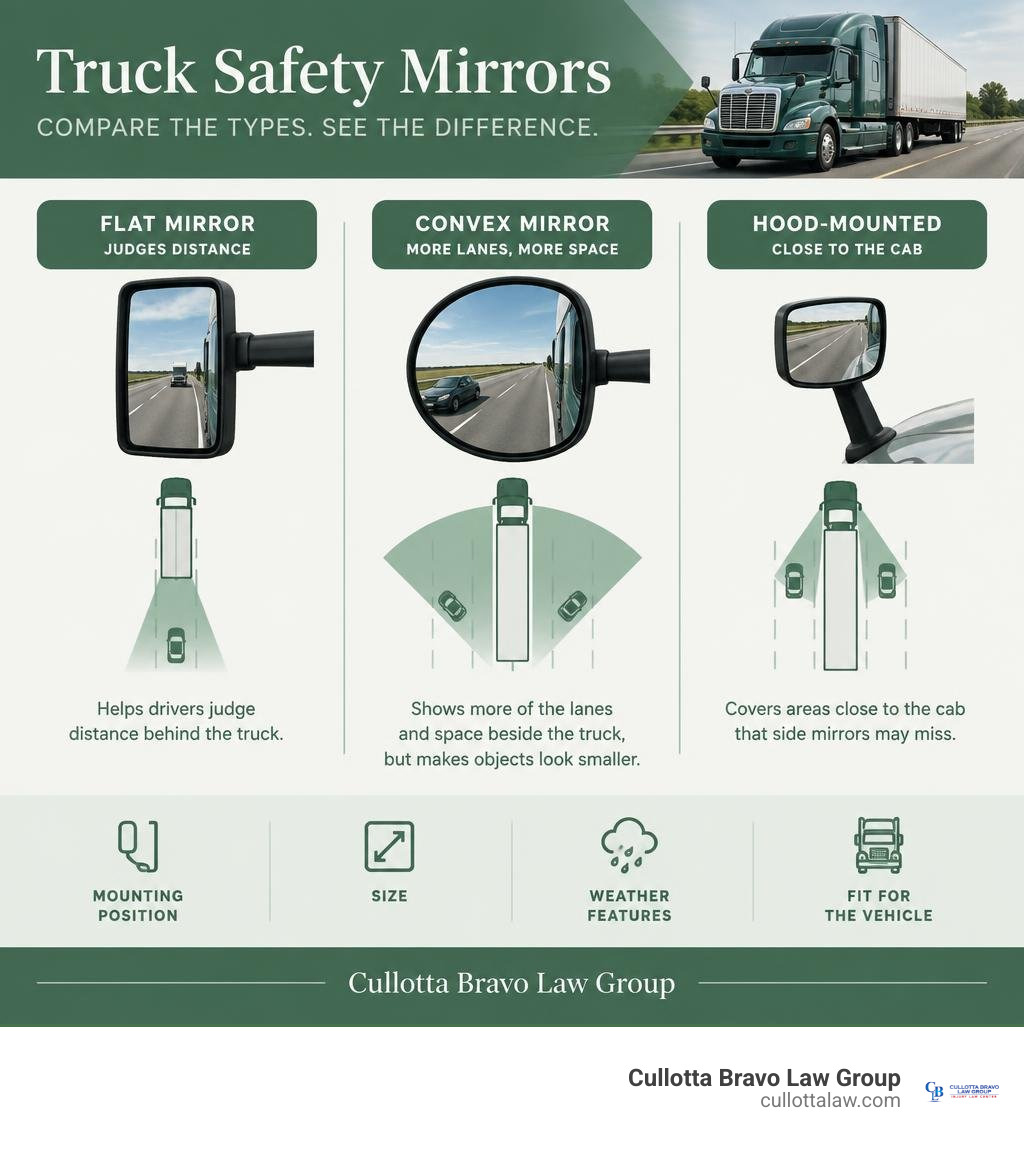
Start with what the driver needs to see. A flat West Coast mirror helps drivers judge distance behind the truck. A convex mirror shows more of the lanes and space beside it, but makes objects look smaller. Hood-mounted and look-down mirrors cover areas close to the cab that side mirrors may miss. When comparing truck safety mirrors, check the mounting position, size, weather features, and fit for the vehicle.
No mirror removes every blind spot. If you were hurt in a truck crash, the truck’s mirrors and how they were positioned may be worth examining.
I’m Peter Cullotta, a trial lawyer with more than 35 years of experience representing injured people. This guide explains how truck safety mirrors work and why visibility can matter after a crash.
Types and Configurations of Truck Safety Mirrors
A commercial semi-truck is an imposing vehicle on our highways, often stretching over 70 feet in total length. Because commercial rigs lack center rearview mirrors and rear cabin glass, the driver relies entirely on an array of external mirrors to build an accurate picture of surrounding traffic. Mastering this view is crucial when navigating the semi trailer blind zone, where smaller passenger vehicles can vanish from sight in seconds.
Modern commercial setups rely on specialized optical designs working together. Understanding how these optics interact allows fleet managers, owner-operators, and safety professionals to configure rigs for maximum visibility.
| Mirror Type | Primary Optical Design | Standard Dimensions | Field of View Focus | Best Placement Location |
|---|---|---|---|---|
| West Coast | Planar (Flat Glass, 1:1 ratio) | 7″ x 16″ | Long-distance trailing lanes, depth judgment | Main door brackets (Left/Right) |
| Convex | Curved Spherical Glass | 7.5″ to 8.5″ Round | Adjacent multi-lane traffic, wheel wells | Lower door bracket or auxiliary arm |
| Look-Down | Electro-chrome Convex | 4″ x 8″ Rectangular | Ground proximity beneath passenger door | Top passenger door frame / cab header |
| Crossview | Quadraspheric / Asymmetrical | 8″ to 8.5″ Round / Oval | Front bumper, right forward blind spot | Front fenders, hood corners |
West Coast Truck Safety Mirrors for Primary Line-of-Sight
The traditional West Coast mirror serves as the anchor of commercial sightlines. Featuring a vertical, planar glass surface, this unit provides a flat 1:1 true-scale reflection. Unlike curved lenses that bend light, flat glass does not distort distance, making it indispensable for tracking trailing vehicles, judging highway closing speeds, and executing precise lane changes.
High-performance models like the Truck-Lite 97822 West Coast Mirror – 7×16 Stainless Steel OEM Style utilize heavy 1/4-inch thick glass stabilized by internal gaskets. Because flat glass creates a narrower viewing cone, it must be paired with auxiliary lenses to prevent hazardous gaps along the vehicle’s flanks.
Wide-Angle Convex Truck Safety Mirrors for Blind-Spot Reduction
Where planar mirrors offer depth perception, convex mirrors deliver panoramic breadth. The outward curvature of a convex lens bends reflected light, achieving up to a 160-degree viewing angle. This extreme angle captures passenger vehicles, cyclists, and obstacles occupying lanes directly adjacent to the drive axles.
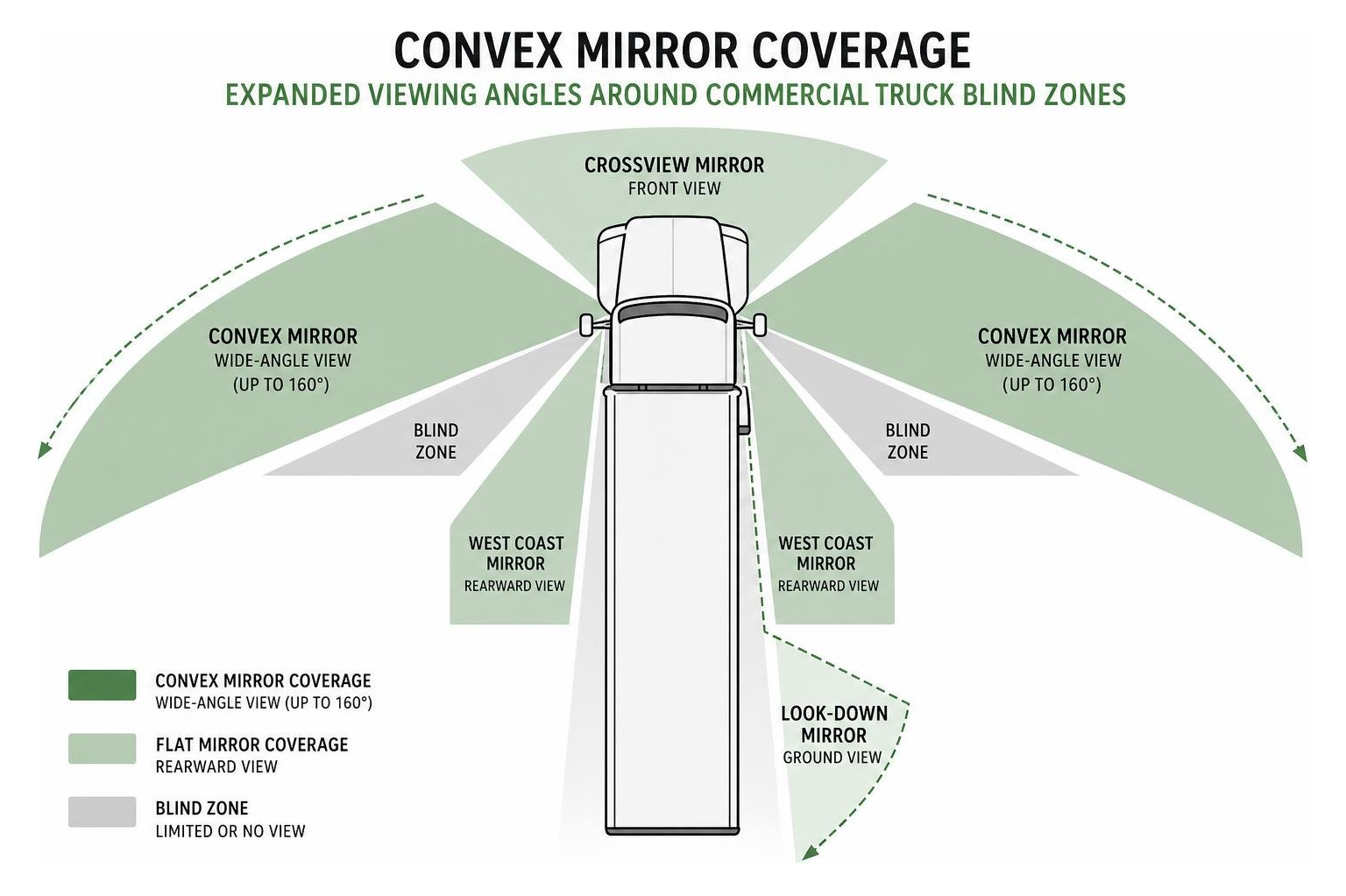
Fender-mounted units, such as the Truck-Lite 97687 8.5-Inch Round Convex Fender Mount Mirror Kit, extend visibility forward and downward around the front tire lanes. Understanding optical curvature is essential for understanding truck blind spots and safety, as convex optics allow operators to spot merging vehicles during wide multi-lane turns without turning their heads away from the forward roadway.
Hood-Mount, Fender, and Look-Down Mirror Assemblies
Cab-over and conventional heavy-duty trucks suffer from severe ground-level blind spots directly in front of the grille and beneath the passenger door sill. Specialized look-down and crossview assemblies resolve these danger zones.
The RETRAC 610868 8 x 4-Inch Stainless Steel Rectangular Look-Down Convex Mirror Assembly, Universal Driver or Passenger Side | Lippert mounts directly over the passenger-side door frame. Angled downward, it reveals pedestrians, curbs, and compact cars hidden beneath the window line. Paired with hood-mounted crossview units, these specialized mirrors ensure full perimeter protection during tight urban maneuvering and loading dock operations.
Key Technical Specifications: Mounts, Materials, and Durability
Commercial trucks operate in punishing environments, enduring severe road vibrations, salt spray, gravel impacts, and extreme seasonal temperatures. A mirror assembly is only as reliable as its housing material and structural mounting hardware.
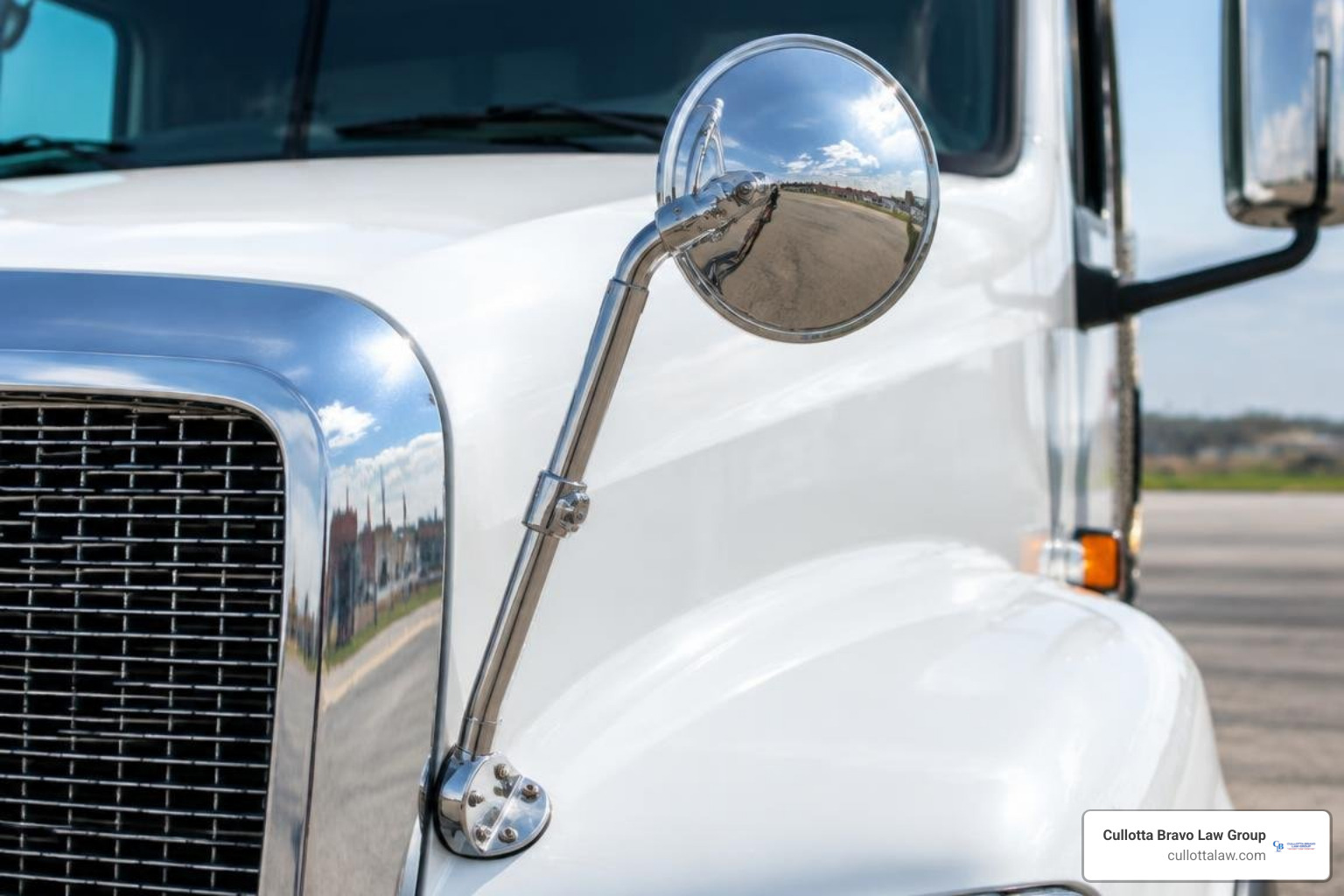
Selecting appropriate specifications prevents optical flutter at highway speeds, resists environmental corrosion, and avoids premature hardware failure.
| Material Type | Corrosion Resistance | Impact Durability | Weight Profile | Common Commercial Application |
|---|---|---|---|---|
| Polished Stainless Steel | Excellent (Rust-proof) | High (Resists rock chips & warping) | Moderate | Long-haul West Coast and hood assemblies |
| Powder-Coated Aluminum | High (Weather-resistant) | Moderate to High | Lightweight | Aerodynamic fleet door mirrors |
| Shatter-Resistant Acrylic | Impervious to moisture | High (Shatter-proof under impact) | Very Light | Industrial, warehouse, and loading dock rigs |
| Molded ABS Composite | High (Chemical resistant) | Moderate (Vulnerable to UV fatigue) | Lightweight | Aerodynamic aerodynamic mirror shells |
Housing Materials and Glass Engineering
Heavy-duty commercial mirrors demand rugged materials. Polished stainless steel remains the gold standard for Class 7 and Class 8 long-haul fleets due to its resistance to corrosive road de-icers. Acrylic alternatives are frequently deployed in tight terminal environments where high impact resistance protects lenses from shattering upon contact with loading bay infrastructure.
Glass quality equally dictates operational safety. Premium systems integrate first-surface electro-chrome treatments to diminish high-beam glare from trailing headlights. Furthermore, heavy-gauge shock-absorbing vinyl gaskets create an airtight barrier around the lens perimeter. These gaskets seal out moisture that causes internal silvering degradation while dampening the harmonic engine vibrations that distort a driver’s rearward field of view.
Bracket Geometry and Mounting Hardware
A pristine mirror lens is useless if the mounting bracket vibrates or loses position under highway wind shear. Fleets rely on rigid hardware configurations:
- Center-Mount Studs: Provide a balanced, compact footprint ideal for standard door assemblies.
- Offset Ball Studs: Extend the mirror housing outward from the mounting bracket, clearing wide trailer walls and cargo tarps.
- Shortened Tripod Brackets: Form a rigid, three-point anchor on aerodynamic front fenders, eliminating flutter on fiberglass hood panels.
- Compression Fittings: Utilize nickel-plated brass compression nuts and heavy L-brackets to maintain factory torque settings across thousands of operating miles.
Advanced Mirror Technologies, Accessories, and Legal Compliance
Commercial vehicle vision systems have evolved far beyond simple glass and chrome. Fleet modernization now merges active electronics, digital sensing, and physical protective hardware to mitigate the rising danger of truck blind spots across bustling interstate corridors.
Heated Elements and Motorized Cab Controls
Winter operating conditions present severe hazards for commercial drivers. Sub-zero temperatures, freezing rain, and road slush quickly coat mirror glass with an impenetrable layer of ice. Modern systems employ Positive Temperature Coefficient (PTC) heating elements embedded directly behind the glass. These intelligent heating grids self-regulate their thermal output, rapidly melting frost and clearing ambient condensation without overheating or damaging surrounding internal gaskets.
Complementing thermal defrosters, motorized internal actuators give drivers complete multi-axis control from inside the cab. Motorized adjustments are particularly vital during blind-side backing maneuvers into tight loading bays, allowing operators to pivot their viewing angles without opening doors or leaning precariously out of the cab. Many fleets also integrate external ambient sensors, such as RoadWatch road-temperature systems, to alert drivers to freezing pavement conditions before visual ice forms.
Integrated Camera Systems and Complementary Safety Gear
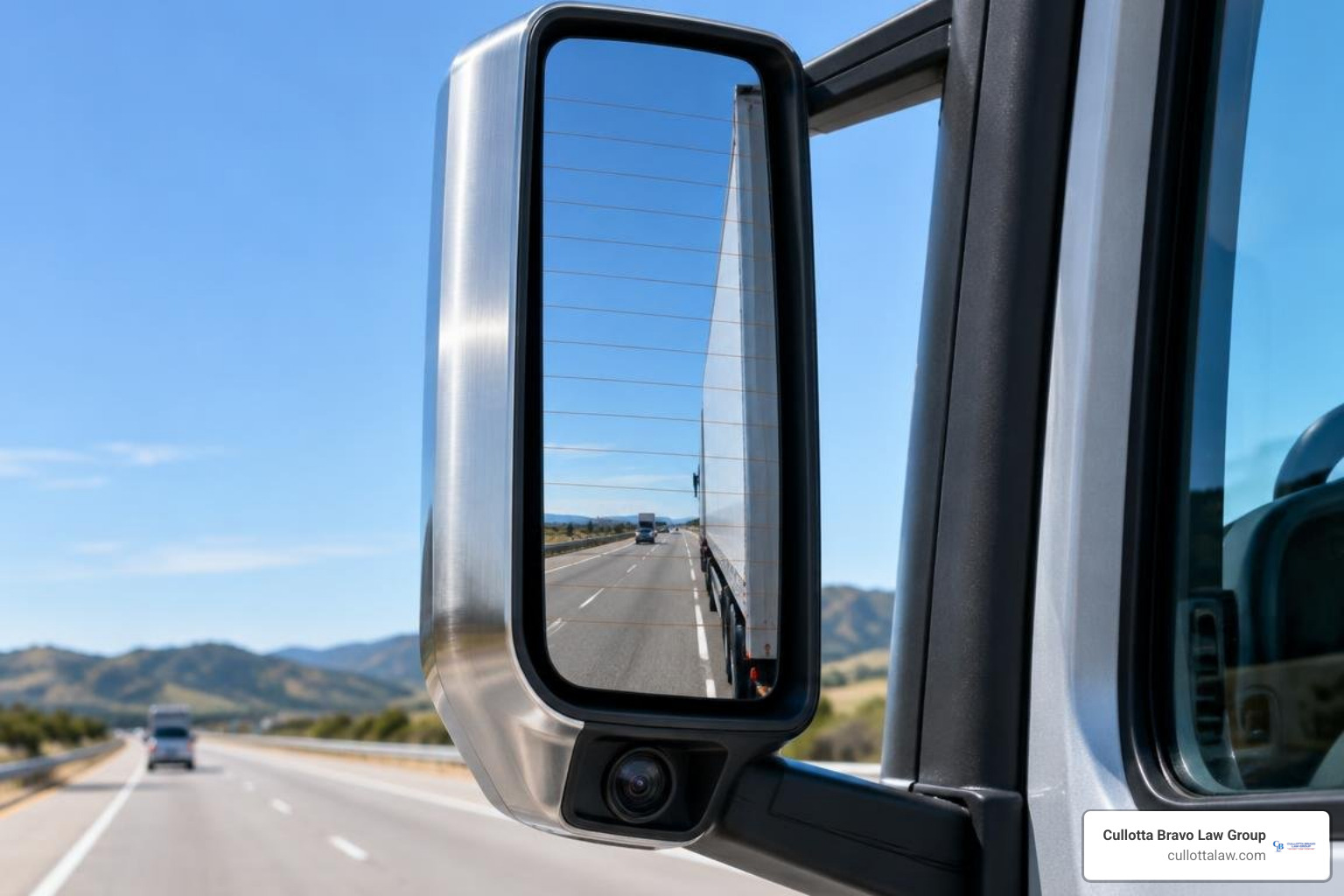
Digital imaging and traditional optics now converge in state-of-the-art cab engineering. Innovations such as the Semi-truck side-view mirror with integral camera (US Patent 12427920) combine half-silvered mirror surfaces with high-resolution digital image sensors. These advanced assemblies link mirror rotation mechanisms directly to the truck’s steering angle sensors. When the vehicle executes a turn or backing maneuver, the internal camera automatically pans to keep the trailer’s tail end clearly visible on in-cab dashboard monitors.
Physical safety accessories offer additional protection in terminal yards. High-visibility padded covers, known as safety mirror mitts, slide over outward-projecting nose and hood mirrors. Built from dense, shock-absorbing PVC foam wrapped in bright nylon mesh, these bright yellow guards protect terminal workers and maintenance crews from severe head and facial lacerations during ground walk-arounds. Given that average workers’ compensation claims for head injuries range from $40,000 to $50,000 according to data from the National Council on Compensation Insurance (NCCI), low-cost protective padding provides substantial risk management value.
Federal Regulations and State Safety Device Mandates
Commercial vehicle vision equipment is strictly regulated under federal and state statutes. Federal Motor Vehicle Safety Standard (FMVSS) 111 establishes baseline requirements for commercial rearward sightlines, mandating specific field-of-view dimensions for all Class 7 and Class 8 commercial motor vehicles.
States and municipalities increasingly impose supplementary requirements to protect vulnerable road users in congested urban environments. For instance, Massachusetts truck safety device standards (under Chapter 358 of the Acts of 2022 and 540 CMR 4.10) mandate that commercial vehicles operating on state-funded projects install comprehensive safety packages, including:
- Lateral Protective Devices (Side Guards): Heavy-duty safety barriers installed along trailer sides. These side guards must allow a maximum ground clearance of 13.8 inches, a maximum top clearance of 13.8 inches, and withstand a minimum perpendicular impact strength of 440 pounds to prevent pedestrians and cyclists from slipping beneath trailer axles.
- Convex Side Mirrors: Door-mounted wide-angle lenses providing panoramic visibility along the entire vehicle flank.
- Crossview Hood Mirrors: Hood- or fender-mounted lenses providing direct line-of-sight to the low-clearance dead zone directly in front of the cab bumper.
- Backup Camera Systems: Rear-mounted camera feeds that cannot be waived or bypassed by alternative means.
Failing to maintain compliant vision systems substantially elevates commercial risk and contributes to the high cost of blind spot crashes across the country.
Frequently Asked Questions About Commercial Truck Mirrors
How do convex mirrors differ from flat West Coast mirrors on commercial trucks?
Flat West Coast mirrors feature planar glass that reflects images at a true 1:1 optical scale, allowing drivers to accurately judge distance, trailing speed, and lane spacing behind the trailer. In contrast, convex mirrors use curved spherical glass that compresses reflected images to provide up to a 160-degree viewing angle. While convex mirrors make objects appear smaller and farther away than they actually are, they expand peripheral coverage to eliminate blind spots alongside drive axles and front wheel wells.
What are the federal FMVSS 111 visibility requirements for heavy-duty trucks?
Federal Motor Vehicle Safety Standard (FMVSS) 111 mandates that commercial trucks, buses, and multipurpose passenger vehicles possess a rearward field of view capable of monitoring adjacent driving lanes along both sides of the vehicle. For heavy-duty commercial motor vehicles, the regulation specifies the minimum reflective surface area, stable mounting standards, and specific mirror positioning requirements to ensure operators can detect passing traffic and road hazards without major head movement.
How do heated and motorized mirrors improve safety in winter conditions?
Heated mirrors incorporate self-regulating PTC electric elements behind the glass that swiftly dissolve frost, ice, and road grime condensation in sub-zero weather. Motorized controls enable drivers to adjust vertical and horizontal mirror angles electronically from switches inside the cab. This eliminates the need for drivers to exit the vehicle on icy road shoulders or hang out of cabin windows during blind-side docking maneuvers, maintaining continuous visibility in adverse weather.
Conclusion
Truck safety mirrors are foundational components of commercial fleet safety, transforming high-risk driving environments into manageable, fully monitored spaces. Investing in durable stainless steel housings, vibration-dampening brackets, self-defrosting heating elements, and integrated convex systems protects commercial drivers, surrounding motorists, and pedestrians alike. Ensuring your fleet is properly equipped with compliant hardware is the first step toward incident-free operations, and fleet owners should regularly evaluate options for semi-truck blind spot mirror upgrades to maintain the highest visibility standards on our shared roads.