
Truck Blind Spot Stats Show a Serious, Often Hidden Road Risk
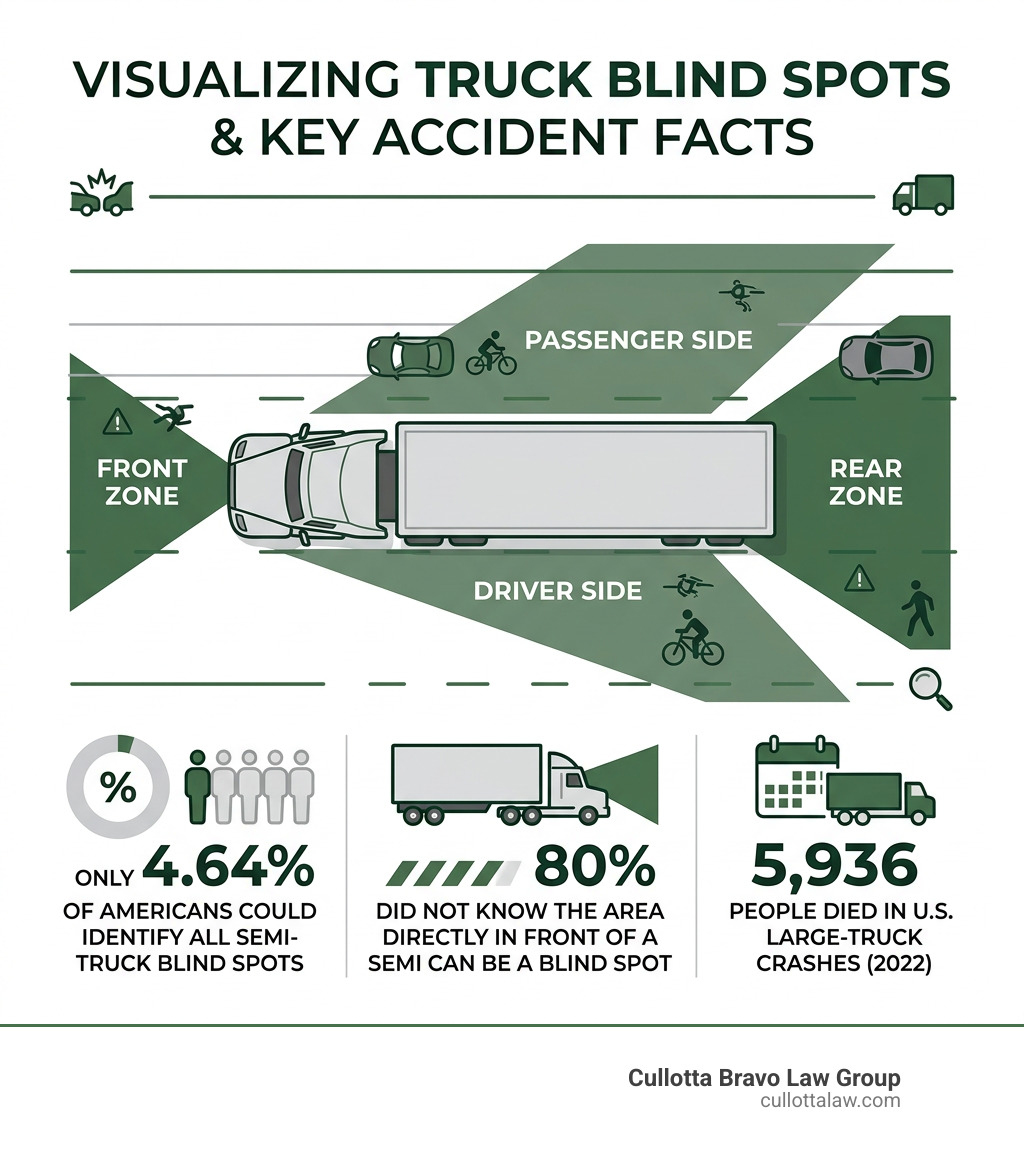
Truck blind spot stats point to a clear safety problem: large trucks have major no-zones in front, behind, and especially along the passenger side, where a car, cyclist, or pedestrian can disappear from the driver’s view. Recent awareness research found that only 4.64% of surveyed Americans could identify all semi-truck blind spots, while 80% did not know the area directly in front of a semi can be a blind spot.
These gaps matter because large-truck crashes are often severe. In 2022, 5,936 people died in U.S. large-truck crashes, according to federal crash data cited in driver-safety research. Blind spots can contribute to sideswipes, unsafe lane-change crashes, wide-turn collisions, and rear-end or backing crashes. The people outside the truck usually face the greatest physical risk.
If you were hurt in a collision involving a truck, blind-spot evidence may matter. Photos, dash-camera footage, truck mirror and camera records, driver logs, vehicle inspection records, and witness accounts can help show whether the truck driver had a safe opportunity to see and avoid you.
I am Peter Cullotta, a trial lawyer with more than 35 years of experience representing injured people in complex personal injury cases. In reviewing truck blind spot stats, the key lesson is simple: a blind spot may explain how a crash happened, but it does not automatically excuse unsafe driving or poor fleet safety practices.
Easy truck blind spot stats word list:
Critical Truck Blind Spot Stats and Accident Trends
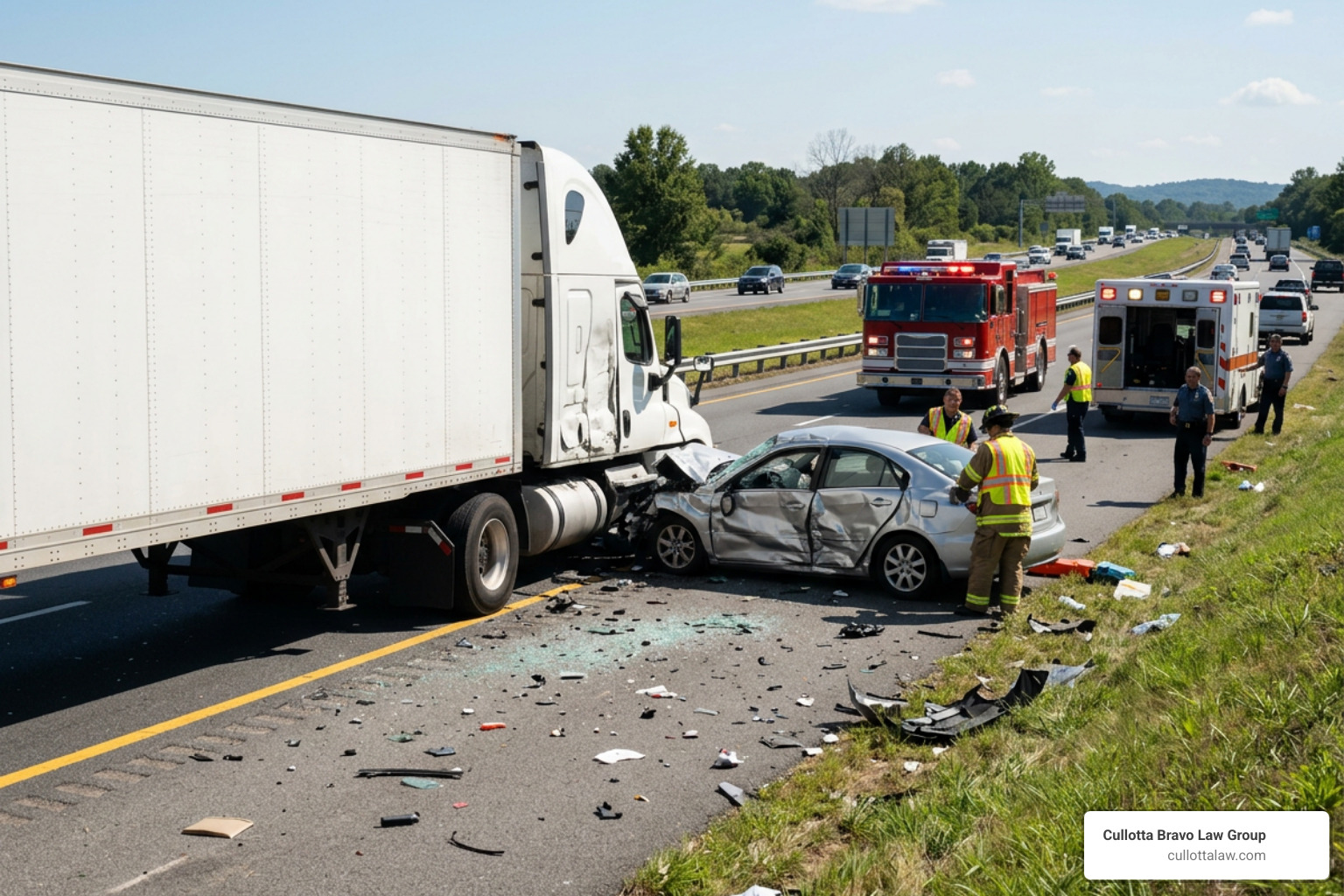
When examining commercial freight volume alongside passenger vehicle interactions, the accident data reveals an urgent public safety challenge. Industry data highlighted in Blind Spot Accident: 2026 Verified Stats & Trends demonstrates that blind spot-related incidents account for roughly 9% of all annual vehicle crashes in the United States, producing approximately 1.2 million collisions each year across all vehicle types. However, when large commercial vehicles are involved, the physical dynamics shift dramatically.
Commercial trucks operate with immense mass and extensive physical dimensions. Nationwide, roughly 30% of all large-vehicle crashes involve a vehicle hidden within a blind spot. In fact, field crash evaluations demonstrate that in 1 out of every 3 big-rig collisions, the truck driver never saw the adjacent vehicle prior to contact.
| Truck Blind Zone | Relative Risk Level | Typical Hazard Distance | Primary Crash Mechanism |
|---|---|---|---|
| Right Side (Passenger Side) | Extreme | Up to 3 lanes wide, full trailer length | Sideswipes during lane changes, right-turn pinch points |
| Left Side (Driver Side) | Moderate–High | Extends 1–2 lanes, cab to mid-trailer | Merging collisions, cut-ins |
| Front Cab Zone | High | Up to 20 feet ahead of the hood | Rear-end impacts when cars merge too closely |
| Rear Trailer Zone | Extreme | Up to 30–200 feet behind trailer | Underride crashes, backing collisions |
The overall economic impact of blind-zone crashes is staggering, generating roughly $150 billion in annual economic losses across property destruction, medical expenditures, and lost productivity. With the average injury cost exceeding $45,000 per incident, the personal and financial fallout is often life-altering.
Annual Fatalities and Truck Blind Spot Stats
The most tragic dimension of commercial freight collisions involves the loss of life. Fatality figures from the Federal Motor Carrier Safety Administration (FMCSA) reveal that large-truck crash fatalities have climbed roughly 40% over the last decade, with more than 5,000 lives lost annually in heavy truck collisions. Approximately 300 to 400 annual deaths are directly linked to large truck blind spot crashes where visibility failure was the primary catalyst.
Because commercial trailers sit higher off the ground than standard passenger cars, blind spot failures regularly lead to catastrophic underride collisions. When a commercial hauler changes lanes into an unseen passenger car, the smaller vehicle can be forced underneath the trailer chassis, crushing the passenger compartment. When families face these unthinkable tragedies, an experienced fatal truck accident attorney must rigorously examine maintenance logs, mirror configurations, and onboard telematics to uncover the truth.
Demographics and Driver Awareness Truck Blind Spot Stats
A significant factor in blind-spot collisions is the widespread lack of public awareness regarding heavy truck visibility. According to the FinditParts driver recognition survey, an overwhelming 95% of motorists do not understand the true dimensions of commercial semi-truck blind spots.
Key findings from awareness and demographic analyses highlight:
- The Front Blind Zone Gap: 80% of drivers are completely unaware that an elevated tractor-trailer cab creates a blind spot extending up to 20 feet directly ahead of the front bumper.
- Driver Education Shortfalls: 30% of motorists feel that their formal driver’s education courses failed to prepare them for sharing the road with multi-axle freight vehicles.
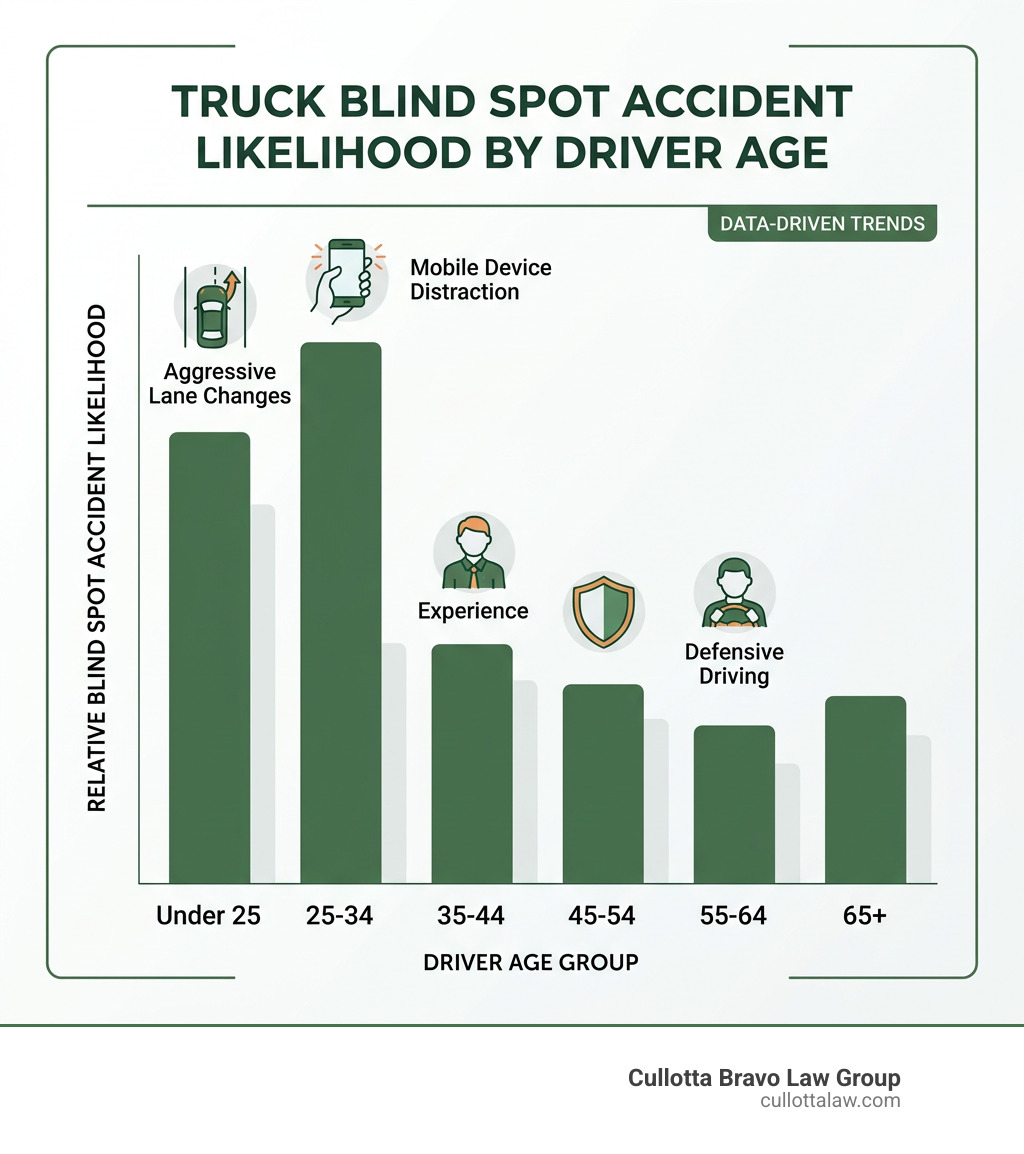
- Demographic Disparities: Statistical records indicate that male drivers account for 68% of at-fault motorists in blind-spot collisions. Furthermore, drivers aged 25 to 34 are 2.5 times more likely to be involved in blind-spot incidents compared to middle-aged cohorts, largely due to higher rates of aggressive lane maneuvering and mobile device distraction.
Understanding the Four Major Commercial Vehicle No-Zones
Tractor-trailers do not possess simple rear-view mirror fields; they operate inside four distinct “No-Zones” where visibility vanishes entirely. Reviewing visualizing danger semi truck blind spot diagrams clarifies why standard mirror checks frequently fail to capture adjacent traffic.
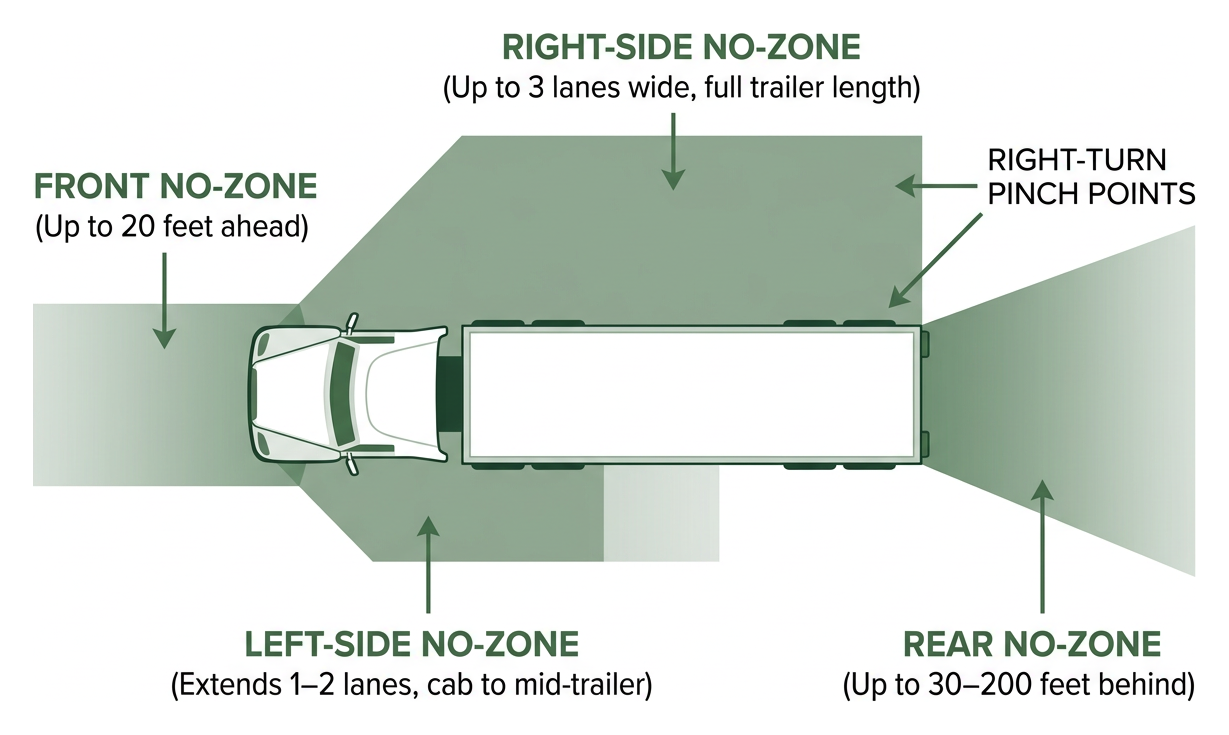
- The Front No-Zone: Elevated commercial cabs sit several feet above standard car rooflines. A hood extending forward can obscure an entire sedan or motorcycle traveling within 20 feet of the front grille.
- The Right-Side (Passenger) No-Zone: This is the most dangerous zone on the rig. It spans up to three highway lanes and extends backward along the entire length of the trailer. Right-side lane-change collisions occur 4.5 times more frequently than left-side incidents.
- The Left-Side (Driver) No-Zone: Although smaller than the passenger side, the blind spot still spans one to two full lanes beneath the driver’s window, extending backward past the tractor drive axles.
- The Rear No-Zone: Commercial trailers lack rear-window sightlines. The rear blind zone extends anywhere from 30 to 200 feet behind the trailer, completely obscuring following vehicles.
Vulnerability of Pedestrians, Cyclists, and Passenger Cars
Vulnerable road users face severe danger around heavy vehicles in urban environments. When a semi-truck executes a wide right turn at a busy intersection, the driver often swings left first to clear the curb. Cyclists and pedestrians positioned at the curb line frequently enter the truck’s deep passenger-side blind zone.
When the rig completes its turn, the trailer “off-tracks” inward, creating a tight pinch point that can pull vulnerable users under the wheels. The resulting injuries bring the high cost of hitting the no zone, requiring comprehensive medical rehabilitation and long-term care planning.
Common Collision Types Caused by Blind Zones
Blind-zone incidents manifest in several high-impact collision types:
- Sideswipes and Lane-Change Forced Exits: When a trucker initiates an unsignaled or rapid lane change into an occupied blind zone, the passenger car is pushed into guardrails, concrete barriers, or oncoming traffic lanes.
- Rear-End and Cut-In Impacts: Smaller vehicles that merge tightly ahead of a truck often disappear within the front 20-foot blind zone, leaving the truck driver unable to judge safe stopping distances.
- Secondary Jackknife Events: When a commercial trucker suddenly detects a vehicle hidden in their blind spot and jerks the steering wheel, the violent weight transfer can trigger devastating jackknife crashes during sudden evasion maneuvers.
These directional stability issues are exacerbated when cargo is improperly distributed or exceeds weight limits, highlighting the dangerous realities of overloaded cargo truck accidents.
Safety Technologies and Regulatory Gaps in Freight Transport
Investigative reports, such as those highlighted in Unseen: Truck blind spot crashes on the rise as regulations lag behind safety solutions, document how technological innovation continues to outpace modern administrative regulations.
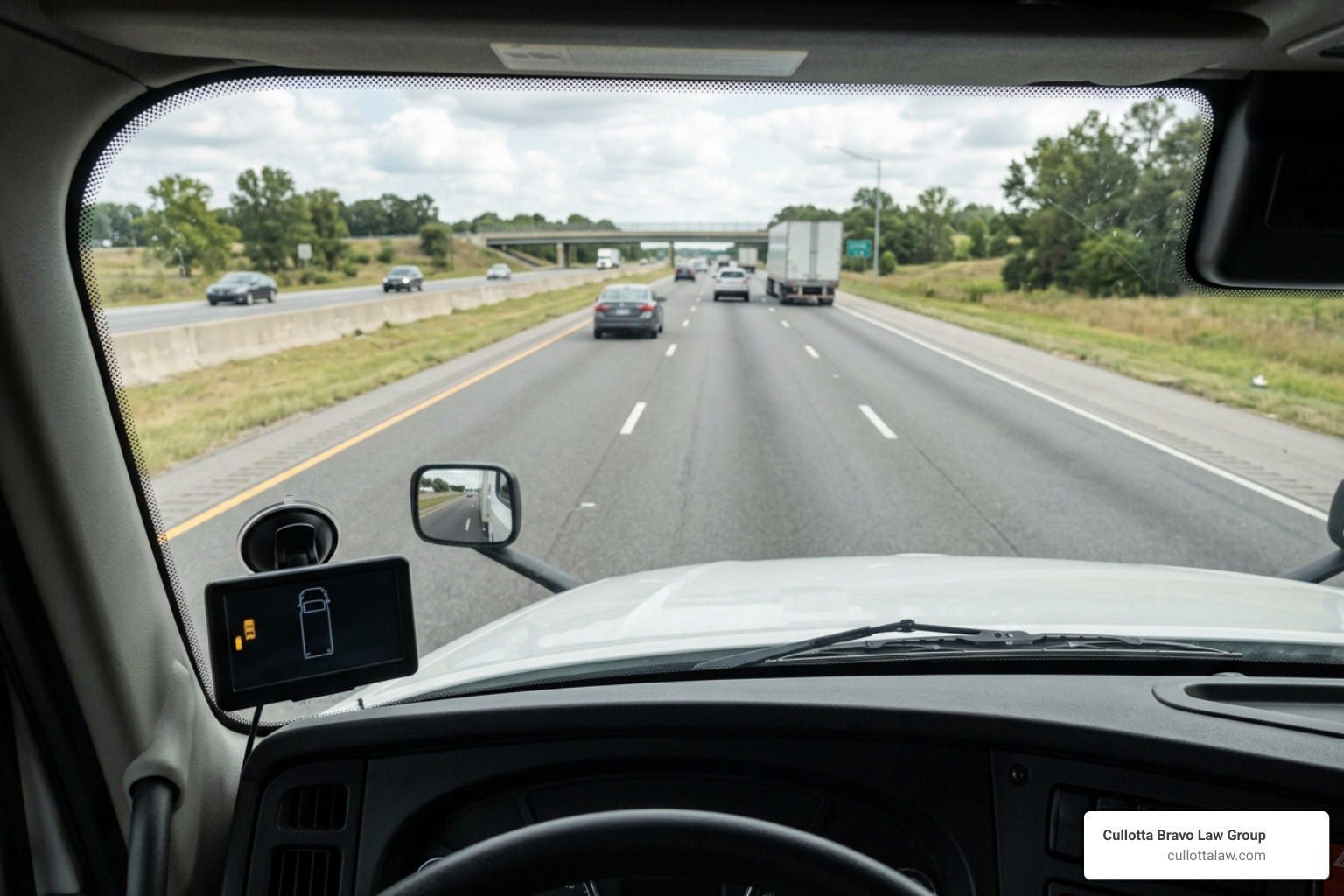
According to tests conducted by the Insurance Institute for Highway Safety (IIHS), commercial Blind Spot Monitoring (BSM) systems can reduce lane-change crashes by approximately 50%. Federal safety projections suggest that universal deployment of advanced driver-assistance systems (ADAS) equipped with blind-spot sensors could prevent up to 39,000 commercial crashes every year.
Modern Sensor Systems Versus Mirror Enhancements
While radar, ultrasonic, and camera-based ADAS units provide high-tech active alerts, retrofittable physical mirror solutions offer immediate, practical visibility gains. Fleet evaluations demonstrate that installing specialized wide-angle mirrors, such as hood-mounted convex mirrors or advanced reflective systems, can reduce collision insurance claims by roughly 30%.
Motor carriers actively upgrading commercial fleet blind spot mirrors give their drivers continuous visual coverage of lateral blind spots without waiting for electronic system retrofits.
Federal Regulations and Fleet Safety Standards
Despite clear statistical evidence supporting auxiliary safety hardware, current federal motor carrier safety standards remain focused on basic, traditional side mirrors. The regulatory lag leaves adoption of auxiliary mirrors, 360-degree camera arrays, and blind-spot radar systems entirely up to voluntary motor carrier initiatives.
When safety features are overlooked to save corporate costs, victims need dependable truck accident legal advice to evaluate whether a motor carrier failed to maintain industry-standard safety practices.
Defensive Driving Strategies to Avoid Semi-Truck Blind Spots
Preventing blind-spot collisions requires defensive habits from motorists sharing the road with commercial haulers. Practicing proven techniques for navigating semi-trailer blind zones dramatically reduces crash risks.
- Apply the Mirror Rule: If you cannot clearly see the truck driver’s face reflected in their side-view mirror, the driver cannot see you.
- Pass Decisively on the Left: Always overtake a commercial vehicle on the driver’s left side, where the blind zone is considerably smaller. Signal early, pass at a steady speed, and never linger alongside the trailer.
- Maintain Generous Following Buffers: Keep at least a four- to five-second following cushion when traveling behind a semi-truck. If the trailer blocks your forward sightline, you are riding directly inside the rear no-zone.
- Allow Safe Re-Entry Clearance: When completing a pass and returning to the truck’s lane, ensure you can see the entire front cab and tires in your rearview mirror before merging back over.
Frequently Asked Questions About Truck Blind Spots
Where is the largest blind spot on a semi-truck?
The largest blind spot on a commercial semi-truck is located along the right-hand (passenger) side of the vehicle. Due to the driver’s seated position on the far left side of the elevated cab, the passenger-side blind zone extends across up to three full lanes of traffic and runs the entire length of the tractor-trailer, continuing several feet past the rear bumper.
How many truck accidents are caused by blind spots each year?
Blind spots contribute to hundreds of thousands of vehicle collisions nationally each year. In large-truck crashes specifically, blind-spot visibility failures are involved in roughly one-third of all collisions, causing an estimated 300 to 400 fatalities and tens of thousands of severe injuries across the country annually.
Who is legally liable in a truck blind spot collision?
Liability in a truck blind-spot accident depends on the specific facts of the collision, applicable state negligence laws, and comparative fault principles. While truck drivers have a legal duty to check mirrors, signal intentions, and ensure lanes are clear before executing maneuvers, motorists who linger in known no-zones or cut trucks off may share comparative fault.
Navigating multi-party liability involving drivers, motor carriers, and equipment manufacturers requires reviewing an authoritative truck accident lawyer guide to protect your rights.
Conclusion
Understanding commercial vehicle visibility limitations is essential for staying safe on multi-lane highways and urban corridors. While passenger vehicle drivers must practice defensive driving and steer clear of known no-zones, commercial motor carriers and their drivers bear a heavy legal responsibility to operate multi-ton rigs with reasonable care, proper equipment, and constant vigilance.
At Cullotta Bravo Law Group, we have dedicated over 35 years to fighting for accident victims across Illinois. If you or a family member suffered serious injuries in a collision with a commercial freight hauler, contact our dedicated Illinois truck accident attorney team today for aggressive legal advocacy and trusted counsel.