
Who Is Liable When an Aftermarket Truck Mirror Fails?
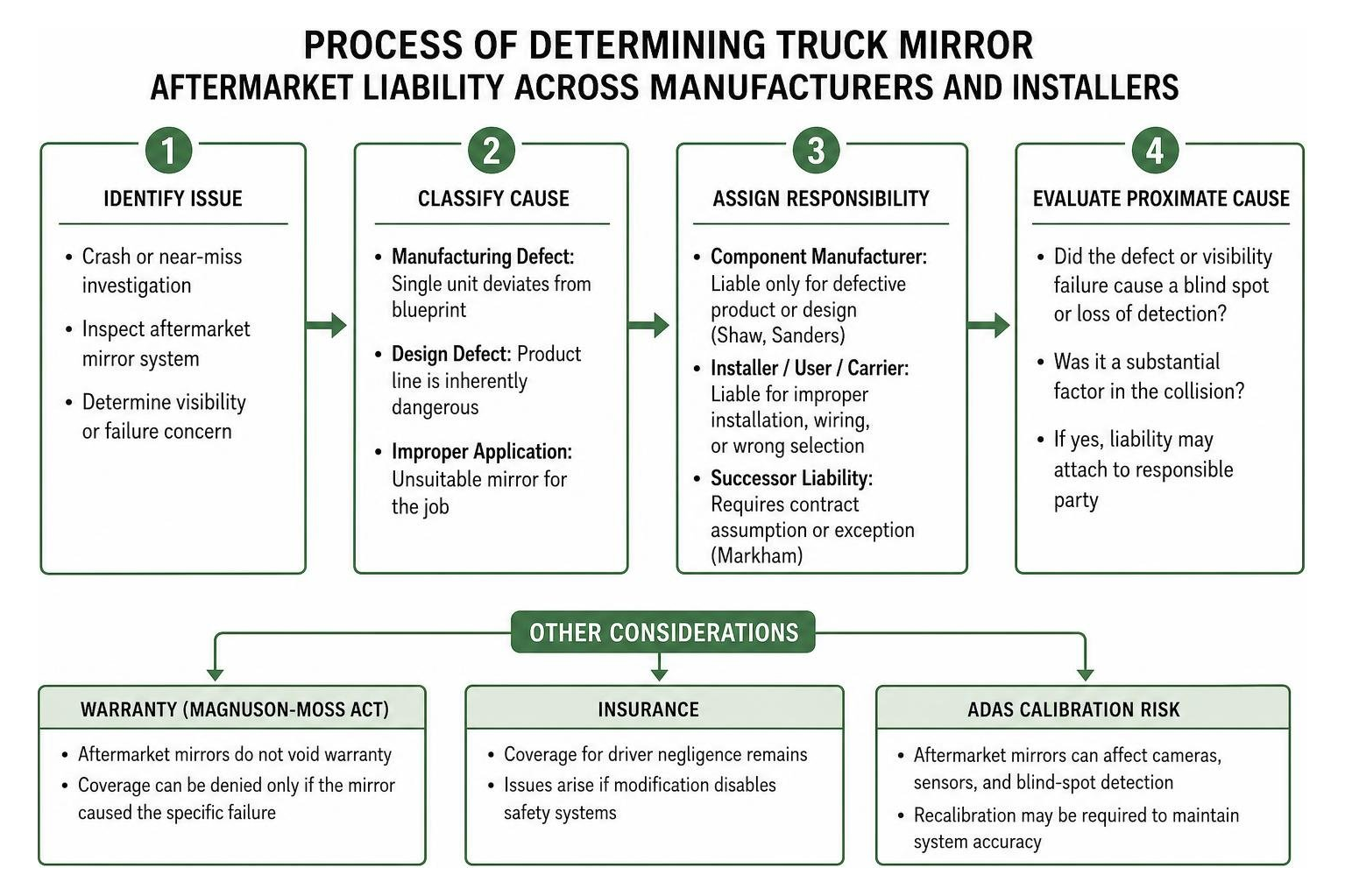
Liability depends on what went wrong and whether it contributed to the injury. A mirror maker may be responsible for a defective product; an installer may be responsible for poor fitment or for disabling a safety feature. A mirror that fails to give the driver a clear view may also matter, even if it did not cause the crash by itself. An investigator must connect that failure to the collision or the harm that followed. Simply installing aftermarket mirrors does not automatically void a truck’s warranty or cancel its insurance.
I’m Peter Cullotta, founding partner of Cullotta Bravo Law Group, and I’ve spent more than 35 years representing injured people and handling insurance disputes. That experience guides my approach to truck mirror aftermarket liability: find out what failed, who was responsible, and how it affected the injury.
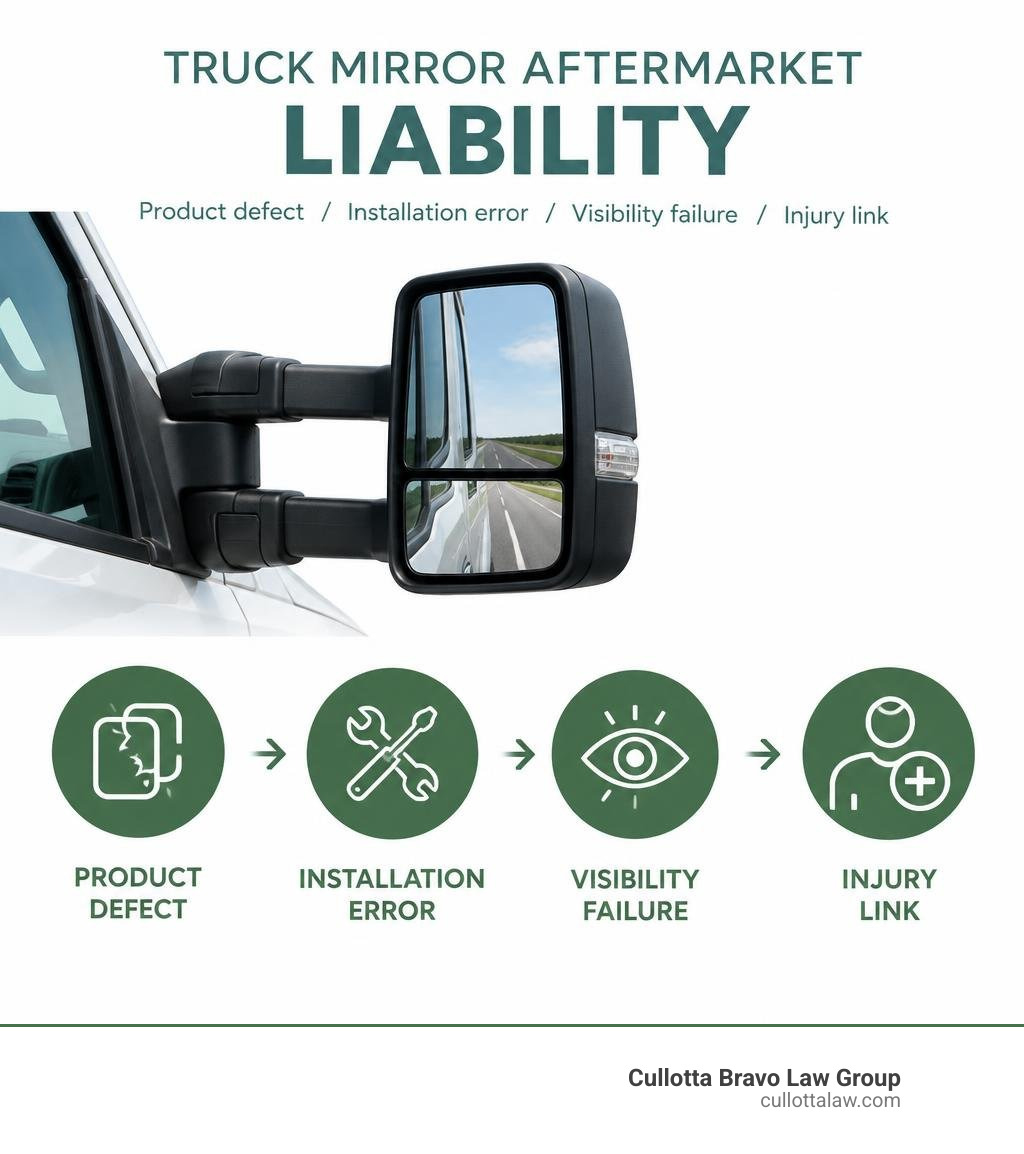
Basic truck mirror aftermarket liability vocab:
Understanding Truck Mirror Aftermarket Liability: Federal and State Standards
When a commercial semi-truck or a heavy-duty pickup undergoes modifications, changing the factory side mirrors is often near the top of the list. Drivers want wider views, heated elements, or integrated turn signals. However, replacing factory equipment introduces strict federal standards and state negligence laws. If an aftermarket mirror assembly fails to provide the sight lines required by law, or if it detaches and strikes another motorist, the resulting collision triggers complex questions of product design, installer negligence, and regulatory noncompliance.
Both commercial operators and aftermarket parts manufacturers must navigate a dual system of federal regulations and state roadway mandates. While federal agencies set performance benchmarks for new vehicles, state traffic safety laws dictate how vehicles must operate on public roads. Understanding how these rules intersect is crucial when investigating a severe crash.
FMVSS No. 111, FMCSA 200-Foot Rule, and the NHTSA Self-Certification Framework
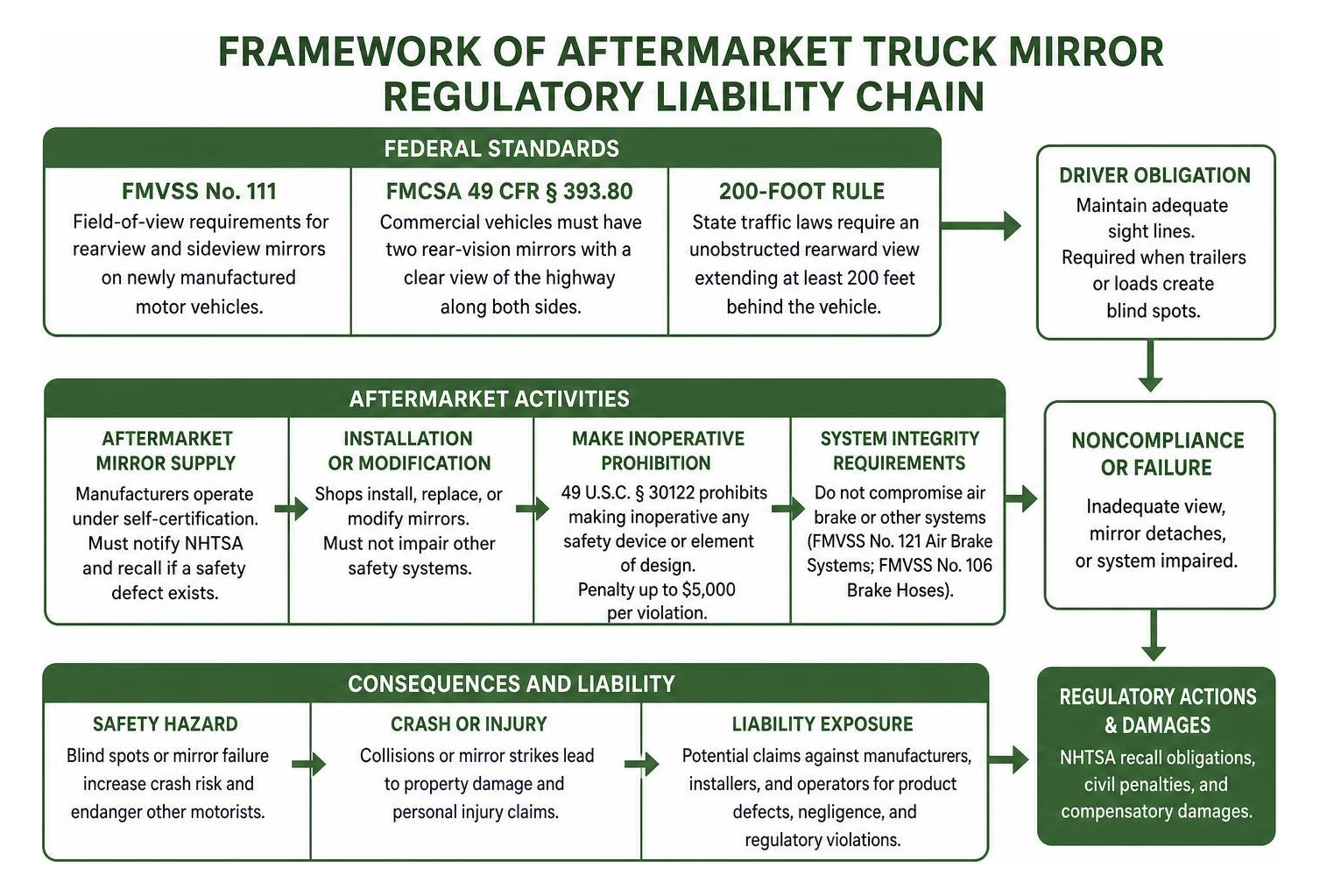
Federal Motor Vehicle Safety Standard (FMVSS) No. 111 establishes baseline field-of-view requirements for rearview and sideview mirrors on newly manufactured motor vehicles. Under federal law, original equipment manufacturers (OEMs) must ensure that standard mirrors allow drivers to monitor traffic alongside and behind the cab. However, as clarified in NHTSA safety interpretation guidelines, FMVSS No. 111 applies directly to completed, newly manufactured vehicles rather than standalone aftermarket components sold individually in retail boxes.
Even though standalone aftermarket mirrors are not individually certified under FMVSS No. 111 at the factory, component manufacturers remain strictly bound by National Highway Traffic Safety Administration (NHTSA) defect notification and recall mandates. Manufacturers operate under a “self-certification” model. This means the manufacturer self-certifies that its products are safe for their intended use. If an aftermarket mirror contains a structural flaw—such as weak mounting brackets that snap under wind shear—the manufacturer is legally obligated to notify NHTSA and issue a safety recall.
On the operational side, the Federal Motor Carrier Safety Administration (FMCSA) enforces visibility standards through 49 CFR § 393.80. This rule requires commercial motor vehicles to possess two rear-vision mirrors positioned to reflect a clear view of the highway along both sides of the vehicle. In Illinois and most other states, traffic safety statutes require drivers to maintain an unobstructed rearward view extending at least 200 feet behind the vehicle.
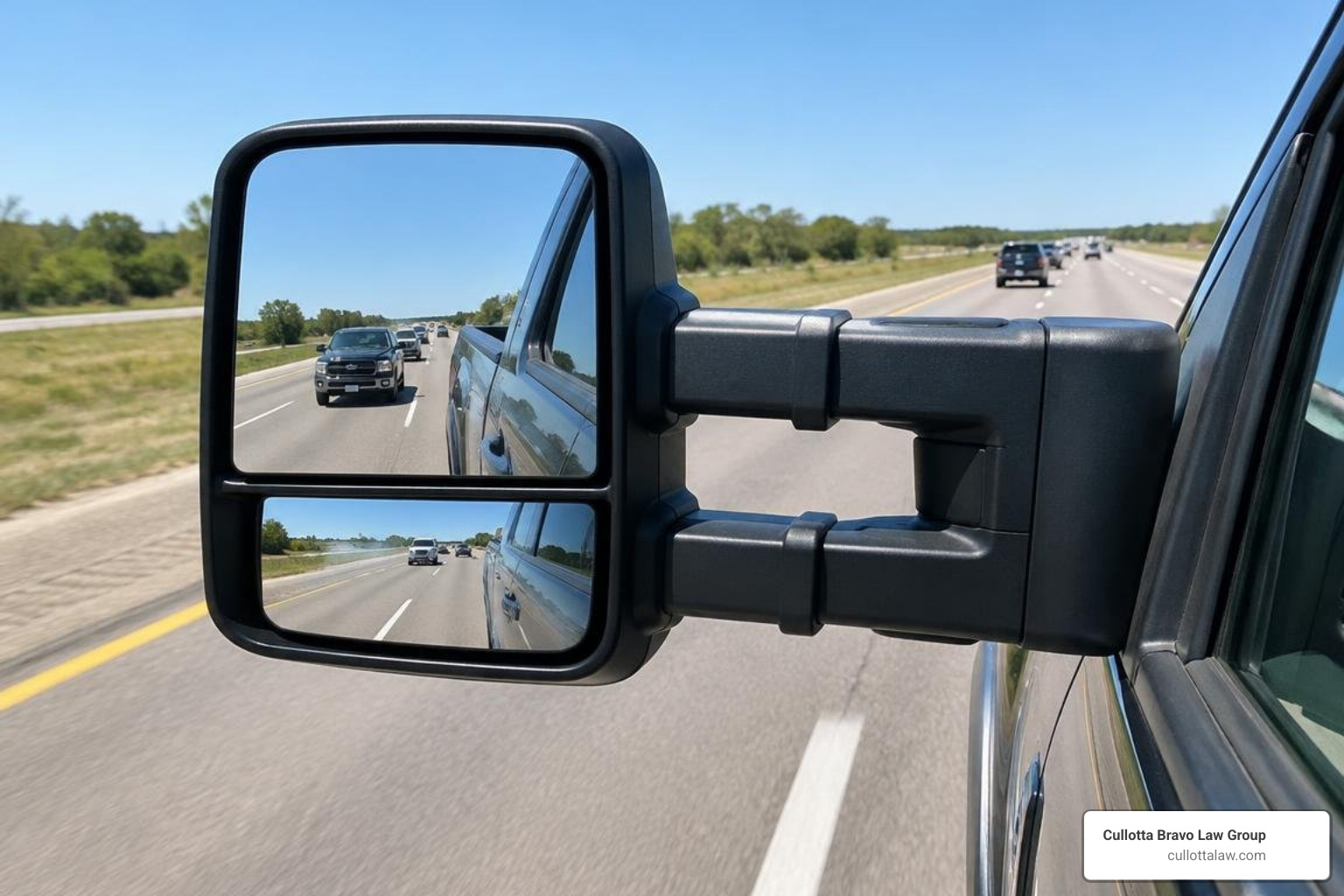
When a standard full-size truck (measuring 6.5 to 7 feet wide) hitches to a commercial trailer or enclosed camper exceeding 7 to 8 feet in width, factory mirrors become blind. Drivers must install extended towing mirrors to maintain that mandatory 200-foot view. Failure to maintain adequate sight lines creates an immediate safety hazard, which you can see illustrated across various truck blind spot diagrams.
The 49 U.S.C. § 30122 Make Inoperative Prohibition in Truck Mirror Aftermarket Liability
A critical federal regulation governing aftermarket installations is the “make inoperative” prohibition codified at 49 U.S.C. § 30122. Under this federal statute, a motor vehicle manufacturer, distributor, dealer, or commercial repair business is strictly prohibited from knowingly making inoperative any safety device or element of design installed on a vehicle in compliance with an applicable FMVSS standard. Violating this provision exposes commercial shops to civil penalties of up to $5,000 per violation.
In practical terms, if a repair shop in Chicagoland removes a truck’s factory mirror equipped with defrosting elements, integrated turn signals, or Advanced Driver Assistance Systems (ADAS) sensors, and replaces it with a cheap, manual aftermarket unit, the business has violated federal law. The installer has made safety equipment inoperative.
This issue becomes even more serious in custom commercial rigs. Some heavy-duty mirror assemblies incorporate pneumatic positioning or heating systems tied into auxiliary lines. If an installer taps into the truck’s air brake reservoir to power custom mirror accessories, they risk compromising the pneumatic pressures regulated under FMVSS No. 121 (Air Brake Systems) and FMVSS No. 106 (Brake Hoses). If brake response lags because an aftermarket mirror caused air pressure leaks, the installing business faces immense liability for any catastrophic collision that follows.
Product Defects vs. Improper Application in Mirror Accident Claims
When an aftermarket mirror is tied to a crash, personal injury lawyers must distinguish between a genuine product defect and user or installer error. A mirror can be built flawlessly yet still prove dangerous if it is fitted to the wrong vehicle or applied incorrectly for the task.
| Feature / Factor | Clip-On / Strap-On Tow Mirrors | Full Bolt-On Replacement Mirrors |
|---|---|---|
| Typical Retail Cost | $20 – $80 per pair | $100 – $400+ per pair |
| Primary Failure Risk | High-speed detachment, wind vibration | Wiring mismatch, improper sensor calibration |
| Field-of-View Stability | Moderate; prone to shifting or slipping | High; rigid structural mount |
| OEM Feature Retention | Poor; blocks heated glass and puddle lights | High; preserves heating, power glass, signals |
| Common Defect Allegation | Defective strap tension, brittle plastic clips | Defective mounting studs, poor internal glass bonding |
| Common Installer Allegation | Failure to verify fitment, improper tensioning | Miswired harness, missing torque specifications |
Manufacturing defects occur when a single mirror unit deviates from the manufacturer’s blueprint—such as glass that distorts reality like a funhouse mirror or a mounting stud with microscopic metal fatigue. Design defects, on the other hand, involve an entire product line that is inherently dangerous, such as an extendable mirror arm that oscillates uncontrollably at 65 mph, making blind-spot traffic impossible to identify.
Conversely, “improper application” happens when an equipment dealer or driver uses a mirror that is simply inadequate for the job. For example, using small clip-on mirrors to tow a massive 102-inch-wide commercial flatbed trailer creates massive blind spots. While the clip-on mirror itself might not break, it fails to provide the required 200-foot view. In these situations, liability often falls on the motor carrier or the technician who selected and installed unsuitable equipment, especially when evaluating side mirror collision damage.
Proximate Cause and Field-of-View Failures in Crash Litigation
In any personal injury lawsuit stemming from a truck collision, the injured plaintiff must prove proximate cause. It is not enough to show that an aftermarket mirror was missing an amber safety reflector or vibrated slightly. The plaintiff must demonstrate that the mirror’s defect or visibility failure was a substantial factor in causing the collision.
When a semi-truck or heavy hauler changes lanes and crushes an adjacent passenger vehicle, the core issue is almost always a blind spot failure. If the truck driver testifies, “I checked my mirrors, but there was a massive blind zone I couldn’t see,” investigators must inspect the aftermarket mirror system. If the aftermarket mirror failed to capture the mandatory field of view, or if excessive vibration blurred the approaching car, the mirror’s design or installation directly links to the crash.
Drivers have an affirmative duty to understand how to properly clear the semi trailer blind zone. When an aftermarket mirror prevents them from doing so, the legal claims expand from simple driver inattention to include negligent installation and strict product liability.
Component Manufacturer vs. Installer Responsibility Under Case Precedent
When an aftermarket part fails, courts look closely at the division of responsibility between the company that fabricated the component and the party that bolted it to the chassis. Decades of strict liability case law shape how judges handle these multi-party disputes:
- Shaw v. General Motors Corp. (Colo. App. 1986): In Shaw v. General Motors Corp., an injured worker sued GM because a cab-and-chassis unit was delivered without an audible backup alarm. The court held that a component manufacturer is not strictly liable when it delivers a safe, non-defective foundational part, placing the responsibility on the final assembler (the City, which added a custom dump bed) to install application-specific safety devices. Applied to mirrors, an aftermarket mirror maker who builds a standard, non-defective mirror head is generally not liable if an installer mounts it to a wide-body trailer rig where an extended bracket was clearly required.
- Sanders v. Ingram Equipment, Inc. (Ala. 1988): In Sanders v. Ingram Equipment, Inc., the court reaffirmed that a component maker (a garbage packer mechanism) is not liable for structural defects in the underlying truck chassis that it did not build, sell, or modify. If an installer attaches an aftermarket mirror using incorrect fasteners that puncture electrical harnesses or crack the door sheet metal, the blame rests with the installer, not the mirror manufacturer.
- Markham v. Prutsman Mirror Co. (Ind. App. 1991): Corporate asset sales add another wrinkle to mirror defect litigation. In Markham v. Prutsman Mirror Co., an individual injured on an exposed truck mirror bracket attempted to sue the successor company that bought the mirror manufacturer’s corporate assets. The court held that acquiring business assets does not automatically transfer tort liability for previously sold defective products unless the purchase contract explicitly assumes those liabilities or meets narrow exceptions like a de facto merger.
Warranty, Insurance, and ADAS Calibration Risks for Truck Owners
A common myth among truck owners is that installing aftermarket towing mirrors immediately voids their truck’s factory warranty or forfeits insurance coverage. Under the federal Magnuson-Moss Warranty Act, an automaker cannot void a bumper-to-bumper vehicle warranty simply because an owner installed aftermarket parts. To deny a warranty claim, the dealership or manufacturer must prove that the aftermarket mirror assembly directly caused the specific mechanical or electrical failure (such as an aftermarket puddle light shorting out the central body control module).
Similarly, auto insurance policies cover driver negligence on the highway regardless of whether the truck uses factory or aftermarket mirrors. However, serious complications arise if an unapproved modification disables onboard active safety systems.
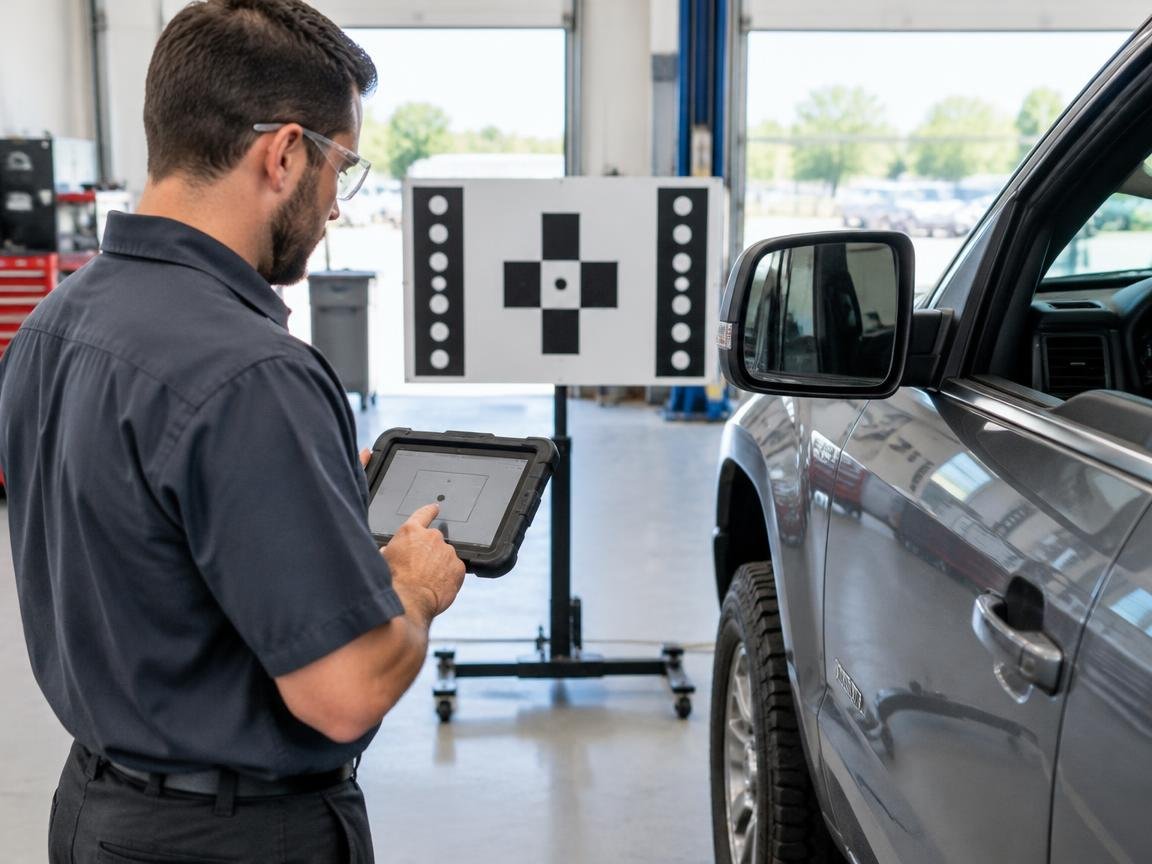
Modern commercial trucks and passenger pickups rely heavily on Advanced Driver Assistance Systems (ADAS). Blind-spot monitoring radars, lane-keep assist cameras, and 360-degree surround-view cameras are often housed directly inside the exterior side mirror housings.
When an aftermarket towing mirror is installed without proper ADAS recalibration, the vehicle’s blind-spot alert may fail to detect a vehicle traveling alongside. If a crash occurs because a collision avoidance system failed after a mirror replacement, the repair shop that skipped sensor calibration faces severe liability. Our trucking company liability lawyers frequently uncover cases where shops performed mirror modifications without following mandatory OEM calibration steps, directly causing sensor blindness.
Evaluating Evidence and Forum Posts in Truck Mirror Aftermarket Liability Claims
In modern product defect litigation, evidence extends far beyond the physical wreckage. Online enthusiast forums, consumer review portals, and fleet maintenance message boards have become key resources for establishing notice of a defect.
If dozens of truck owners have posted on popular forums stating that a specific aftermarket mirror bracket consistently fractures at highway speeds, those threads can help demonstrate that the manufacturer had constructive notice of a dangerous design defect. If the manufacturer was aware of recurring structural failures yet continued selling the product without issuing warnings, updates, or a NHTSA recall, plaintiffs can seek punitive damages for willful and wanton conduct.
However, consumer protection claims regarding product features must still meet legal thresholds of materiality and causation. In Duane Young v. Toyota Motor Sales, U.S.A., the Washington Supreme Court addressed a lawsuit involving an inaccurate window sticker description regarding an outside temperature gauge display in a rearview mirror. The court found that a minor $10 equipment discrepancy was financially immaterial to a multi-thousand-dollar purchase and did not establish the required causation under state consumer protection laws. In personal injury litigation, the threshold is even clearer: minor feature discrepancies do not create liability unless they directly lead to visibility failure or physical harm.
Risk Mitigation and Compliance Best Practices for Installers and Fleets
To protect motorists and limit legal liability, commercial fleets, repair facilities, and aftermarket accessory upfitters should follow strict operational protocols:
- Follow OEM Repair & Replacement Procedures: Always obtain the factory technical service bulletins for the exact VIN before removing or replacing mirror assemblies containing ADAS electronics or heating elements.
- Perform Documented ADAS Calibrations: Never release a truck to a customer after a mirror swap without performing dynamic or static ADAS sensor recalibration and saving the digital completion certificate in the permanent vehicle file.
- Verify State and Federal Sight Lines: Check that the newly installed mirror assembly satisfies the 200-foot rearward view requirement when attached to the customer’s intended trailer width.
- Adhere to Torque Specifications: Use calibrated torque wrenches on all mounting studs and brackets to prevent sheet metal fatigue or loose brackets from vibrating at highway speeds.
- Provide Clear Consumer Warnings: Give the vehicle owner written documentation detailing the mirror’s operational limits, blind spot adjustments, and maintenance intervals for manual extension mechanisms.
If an uncalibrated or defective mirror installation contributes to a highway collision, consulting an experienced Illinois truck accident attorney is critical to securing the electronic control module (ECM) data, repair invoices, and maintenance logs before evidence is altered or destroyed.
Frequently Asked Questions About Aftermarket Truck Mirror Claims
Does installing aftermarket towing mirrors automatically void my vehicle warranty?
No. Under the federal Magnuson-Moss Warranty Act, an automotive manufacturer cannot void your entire vehicle warranty simply because you installed aftermarket equipment. The automaker or dealership must prove that the aftermarket mirror or its wiring directly caused the specific malfunction you are attempting to repair under warranty.
Can an installer be held liable if an aftermarket mirror vibrates or falls off?
Yes. Commercial mechanics and repair shops owe a duty of reasonable care to install vehicle components securely. If an installer uses incorrect fasteners, fails to torque mounting bolts properly, or mounts an incompatible mirror that shakes violently or detaches on the highway, the installer can be held liable for resulting property damage and personal injuries.
What is the 200-foot rearward visibility rule for towed trailers?
Most state vehicle codes require a driver to have a clear, unobstructed view of the highway extending at least 200 feet behind their vehicle or combination of vehicles. If your trailer is wider than your truck’s cab and blocks your standard side mirrors, you are legally required to use extended towing mirrors to maintain this sight line.
Conclusion
Truck safety relies heavily on visibility. When an aftermarket mirror breaks, shakes loose, or blocks vital sight lines, the resulting highway collisions can be devastating. Holding the right parties accountable requires a detailed investigation into component design, manufacturer notices, technician installation practices, and federal safety compliance.
At Cullotta Bravo Law Group, we have over 35 years of experience fighting for injured victims across Aurora, Chicago, Naperville, and Joliet. We aggressively investigate complex truck accident claims to ensure negligent manufacturers, careless repair shops, and commercial carriers are held accountable. If you want to learn more about maintaining safe sight lines on commercial rigs, explore our guide on commercial truck blind spot mirror upgrades or contact our legal team for a comprehensive case evaluation.