
What Makes a Truck Mirror Witness Statement Useful?
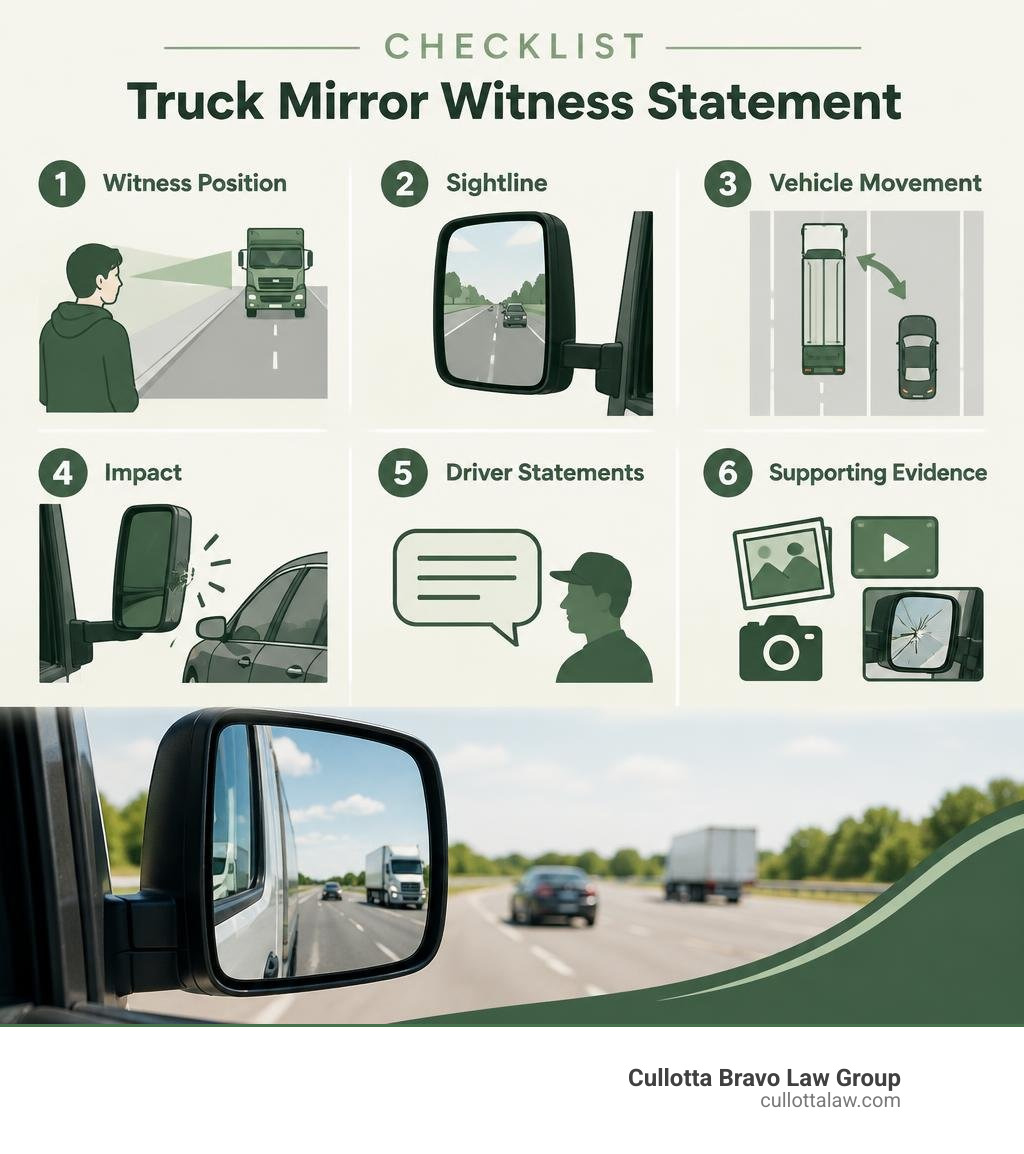
A truck mirror witness statement is most useful when it records what the witness actually saw, not what they think happened. Write it down as soon as possible. Include where the witness stood, what they could see, each vehicle’s position and movement, any signal or mirror check they noticed, and what happened at impact. Record the witness’s exact words about anything the driver said. Photos, mirror damage, and video can help test whether the account fits the evidence.
A mirror strike may look minor, but the details matter. A witness who saw the truck drift across a lane may help explain fault; a witness who only heard the impact cannot say which driver crossed the line.
I’m Peter Cullotta, founding partner of Cullotta Bravo Law Group in Aurora. After more than 35 years representing injured people, I know a clear truck mirror witness statement is strongest when it can be checked against the physical evidence.
Glossary for truck mirror witness statement:
How to Evaluate a Truck Mirror Witness Statement in Serious Collision Claims
Evaluating witness statements in commercial vehicle collisions requires a disciplined focus on objective facts. In our legal practice across Aurora, Chicago, Joliet, and Naperville, we often see how a single statement can change the entire direction of a lawsuit. Establishing liability is not just about who speaks first; it involves determining who had the clearer view and whether their observations align with fundamental rules of the road.

A commercial driver has a continuous legal obligation to maintain a proper lookout. Under long-standing legal precedents such as Wingate Taylor-Maid Transp., Inc. v. Baker, a motorist’s duty of ordinary care extends to monitoring what is occurring behind and beside their vehicle before executing turns or lane changes. When evaluating a claim, we analyze whether the witness observations clarify if the trucker checked their mirrors effectively or simply maneuvered blindly. For complex wrecks, understanding who pays when a side mirror strike causes severe damage begins by closely assessing witness reliability against surrounding roadway sightlines.
Key Components of a Credible Truck Mirror Witness Statement
A legally durable statement must establish several precise factors:
- Exact Witness Position and Vantage Point: Where was the witness located relative to the semi-truck and the other vehicle or pedestrian? Were they in an elevated position, traveling behind, or standing on a sidewalk?
- Unobstructed Line of Sight: Was the witness’s view blocked by highway signs, bridge pillars, adverse weather, or other traffic?
- Vehicle Speed and Trajectory: Did the witness observe sudden acceleration, hard braking, or steady cruising prior to the mirror contact?
- Lane Drift and Signal Indicators: Did the truck drift over solid lane markers, straddle lanes, or fail to activate turn signals before initiating a maneuver?
- Contemporaneous Driver Statements: Any spontaneous remark made by the truck driver immediately after stepping out of the cab (such as “I never saw you in my mirror”) carries substantial evidentiary weight as an admission against interest.
Reconciling Conflicting Testimony with Physical Evidence
Eyewitness accounts can naturally vary based on perspective and memory. To resolve disputes between conflicting statements, we match witness testimony directly against the hard physical evidence collected from the scene.
| Physical Evidence Element | What Eyewitness Testimony May Claim | What Engineering & Forensic Data Reveals |
|---|---|---|
| Mirror Glass Fracture Patterns | “The truck struck the car at highway speeds.” | Radial cracks and localized shattering confirm direct contact points and relative closing speed. |
| Stalk Bracket Integrity | “The cab violently rocked and folded completely.” | Intact ball-and-socket mounts or unbroken brackets show the actual kinetic energy transferred. |
| Abrasion & Rub Marks | “The truck pushed the car across two full lanes.” | Paint transfer depth and shallow scuffs establish whether contact was a glancing swipe or a heavy impact. |
| Pavement Skid Marks | “The driver slammed on the brakes before the turn.” | Straight-line tire friction marks prove exact braking locations, reaction timing, and lane boundaries. |
In cases like WATTS v. DOMINO PIZZA (2026), appellate review highlighted that when a witness claims a violent, cab-rocking collision occurred, but physical inspection reveals only superficial mirror glass cracking and intact mounting stalks, courts give greater weight to objective physical facts. This is why our team meticulously reconciles witness statements with structural damage assessments.
How Impact Physics and Accident Reconstruction Test Mirror Strike Causation
Evaluating a commercial truck mirror strike involves analyzing vehicle physics. Heavy commercial tractor-trailers weighing up to 80,000 pounds interact with external forces differently than standard passenger cars.

Commercial truck cabs are equipped with specialized cab suspension dampers, air-ride mounting systems, and pneumatic seats engineered to absorb road vibration and minor lateral impacts. Consequently, a minor mirror-to-mirror swipe might generate only minimal movement inside the truck’s cab while delivering a violent, localized shock to an adjacent smaller passenger car, motorcyclist, or pedestrian.
When serious injuries occur, such as those evaluated in truck mirror amputation claims and what victims need to know, accident reconstruction experts evaluate vehicle mass ratios, closing speeds, and biomechanical forces to confirm injury causation. Gaining a full perspective on these dynamics is essential, and what you cant see can hurt you understanding semi truck blind spots helps illustrate the vast spatial areas where commercial drivers easily lose visual tracking.
Overcoming the No-Zone and Comparative Fault Defense
Trucking companies and their insurers frequently assert the “No-Zone” defense, arguing that an injured motorist or pedestrian was lingering in a truck’s blind spot and is therefore comparatively at fault.
A standard 18-wheeler has substantial blind spots:
- Up to 30 feet directly in front of the front bumper
- Approximately 20 feet directly behind the trailer
- Across two full traffic lanes on the right (passenger) side
Federal Motor Carrier Safety Administration (FMCSA) regulations require commercial operators to properly adjust all rear-vision and convex mirrors to minimize these blind areas before driving. Simply claiming an individual was in a blind spot does not excuse a driver from their fundamental duty to clear lanes and yield the right of way.
In pedestrian collisions, courts have firmly upheld this principle. For example, in D.R. v. Santos Bakery, Inc. (2024), a federal court upheld a $2,280,000 jury verdict for a pedestrian struck by a commercial truck’s protruding side mirror. Even though the defense argued the pedestrian was negligent for not checking both directions before crossing, the jury found the driver’s failure to maintain a proper lookout and yield was the substantial proximate cause of the severe cranial trauma.
Establishing Gross Negligence Through In-Cab Distraction and Drowsy Driving Statements
Eyewitness observations of erratic behavior leading up to a mirror impact are critical for establishing reckless conduct or gross negligence.
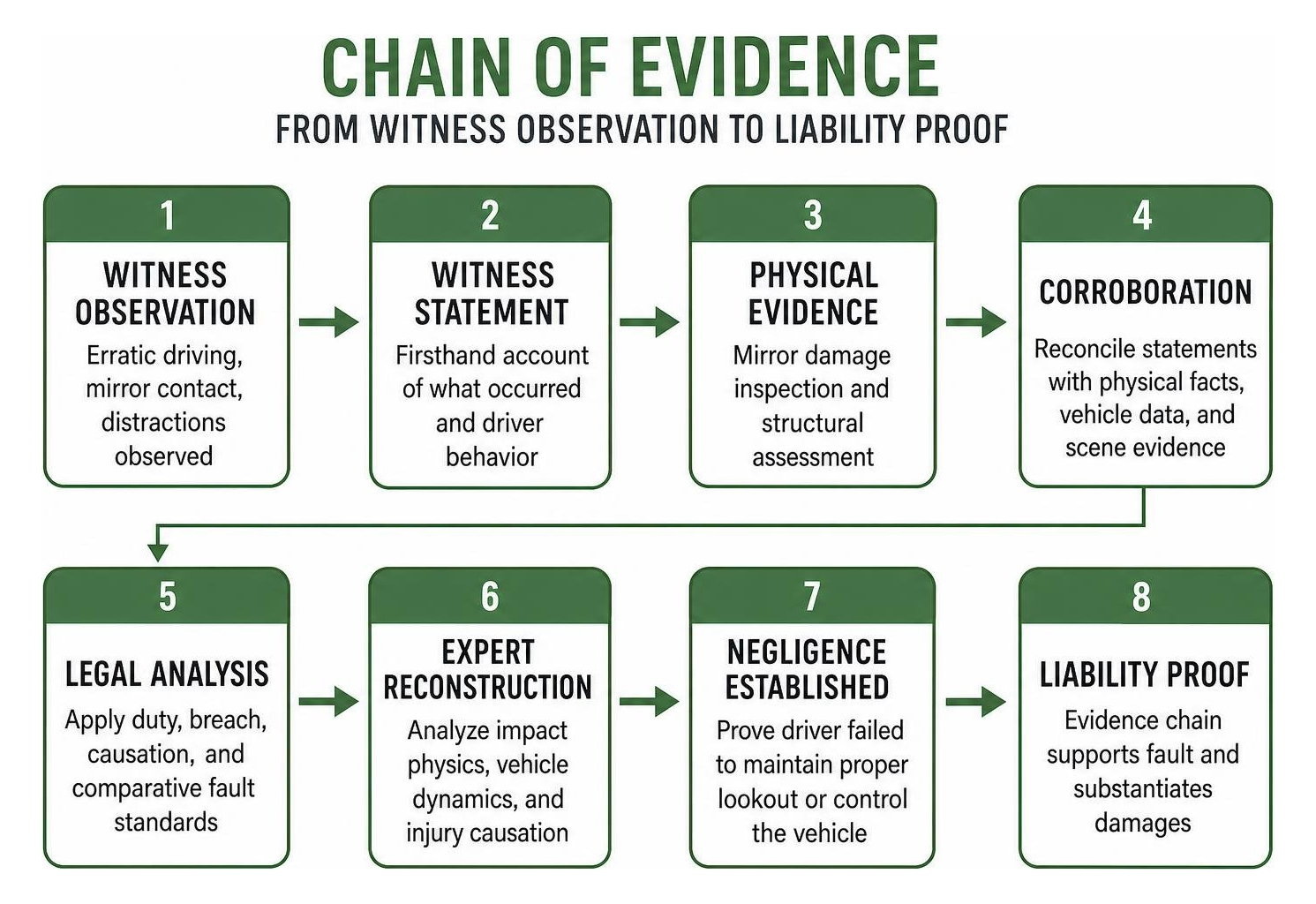
In Skidmore v. State (2005), witness testimony establishing that an oncoming vehicle was swerving and had clipped a side mirror prior to a major head-on collision provided vital proof that the driver ignored obvious warning signs of severe drowsiness, justifying a finding of gross negligence. Similarly, in Cooper v. Miller (1974), third-party witness testimony regarding a truck driver’s admissions of looking into a mirror while distracted inside the cab established actionable negligence for failure to maintain a proper lookout.
Step-by-Step Guide to Preserving Crucial Evidence Before It Disappears
When investigating a truck mirror collision, time is critical. Commercial trucking carriers move rapidly to protect their interests, and vital electronic data can be lost without immediate legal intervention.
- Serve a Comprehensive Spoliation Letter: Issue a formal legal notice compelling the trucking company, its maintenance contractors, and insurers to preserve all physical, mechanical, and electronic records related to the collision.
- Download Electronic Control Module (ECM) Data: The truck’s engine control module records critical telematics, including vehicle speed, throttle position, brake application, and steering input in the seconds before impact.
- Capture On-Board Video Footage Fast: Many commercial dashcams record over existing video on a 30- to 72-hour continuous loop. Securing this footage immediately provides visual verification of mirror adjustments, lane positioning, and turn signals.
- Audit Pre-Trip Inspection Records: FMCSA rules mandate that drivers inspect and adjust all mirrors and visibility equipment before operating. Examining maintenance logs reveals whether missing, broken, or loose mirror brackets were ignored.
- Conduct Rule 30(b)(6) Corporate Depositions: Deposing the carrier’s safety director allows our attorneys to expose systemic failures in mirror safety training, fleet maintenance, and negligent route dispatching. Reviewing our guide on illinois truck crashes and federal safety rules the legal action guide provides additional clarity on how state and federal standards work together.
How to Gather an Effective Truck Mirror Witness Statement Fast
Capturing an accurate witness account requires systematic steps:
- Conduct On-Scene Bystander Interviews Promptly: Speak with pedestrian bystanders, workers at nearby businesses, and other motorists before their memories fade or external narratives influence them.
- Record Vehicle Occupant Statements: Secure independent accounts from all passengers, noting whether they felt the vehicle shift, heard impact noises, or noticed erratic maneuvers.
- Inspect Mirror Glass and Eye-Contact Angles: Witnesses can often confirm whether a driver was paying attention. In critical investigations, like the witness testimony in the Santaquin semitruck case, eyewitnesses noted direct eye contact with the driver reflected through the side mirror just before a maneuver occurred.
- Verify Equipment Specifications: Confirm whether the vehicle used factory-standard equipment or non-compliant modifications by reviewing aftermarket truck mirrors and accident liability explained.
Proving Future Damages and Long-Term Medical Necessity
A severe mirror collision can cause extensive facial trauma, traumatic brain injuries, cervical fractures, and permanent nerve impairment. To secure full and fair compensation, legal claims must clearly distinguish between speculative figures and provable future damages.
Courts evaluate future pain and suffering by looking at:
- Actuarial Life Expectancy Tables: Quantifying permanent daily impairment over the victim’s projected lifespan.
- Expert Life Care Plans: Documenting the objective cost of anticipated future reconstructive surgeries, physical therapy, and prescription medications.
- Vocational Economic Projections: Establishing diminished future earning capacity caused by long-term disability.
Avoiding unexpected expenses is crucial during recovery, and learning how you dont get sideswiped by legal fees after a no zone collision ensures you understand how contingency fee structures protect your financial security while pursuing maximum compensation.
Frequently Asked Questions About Commercial Truck Mirror Accidents
Can a minor truck mirror collision cause compensable personal injuries?
Yes, but medical causation must be supported by objective evidence. While commercial truck cabs have heavy-duty suspension systems that dampen minor impacts for the truck driver, the force transferred to a pedestrian, bicyclist, or smaller vehicle can be substantial. When an impact causes cracked mirrors or minor rub marks, proving compensable injuries requires prompt medical evaluations, objective imaging (such as MRIs or CT scans), and expert biomechanical testimony demonstrating how the kinetic forces produced the physical trauma.
What happens when an eyewitness statement contradicts dashcam or ECM data?
Objective digital evidence—such as ECM engine downloads, GPS telematics, and high-definition dashcam video—generally takes precedence over conflicting witness recollections in court. Human memory can be affected by vantage point limitations, stress, and visual obstructions. However, if the trucking company fails to preserve digital logs after receiving a formal demand, courts can impose severe spoliation sanctions, including adverse jury instructions that presume the missing evidence would have proven the truck driver’s fault.
Does a truck driver admitting they checked their mirror prove liability?
Not automatically. A driver checking their mirror is evidence of attempting a proper lookout, but the legal issue is whether they executed the maneuver safely. If a driver looked in their mirror, failed to perceive a vehicle or pedestrian with the right of way, and proceeded to change lanes or turn, that admission can establish that the driver failed to maintain an effective lookout under the circumstances. Proximate cause remains a determination for the jury based on all roadway evidence.
Conclusion
A well-documented, timely witness statement can be the deciding factor in a complex commercial trucking case. At Cullotta Bravo Law Group, our legal team brings over 35 years of aggressive litigation experience to hold negligent trucking carriers, drivers, and corporate insurers accountable. We act immediately to secure dashcam footage, download black-box telematics, interview critical eyewitnesses, and protect your right to full financial recovery. If you are an operator looking to improve commercial visibility, you can upgrade your view with these semi truck blind spot mirrors. If you or a loved one has suffered an injury in a collision across Aurora, Chicago, Joliet, or Naperville, reach out to our team today for dedicated, client-centered representation.