
What to Do After a Truck Mirror Amputation Injury
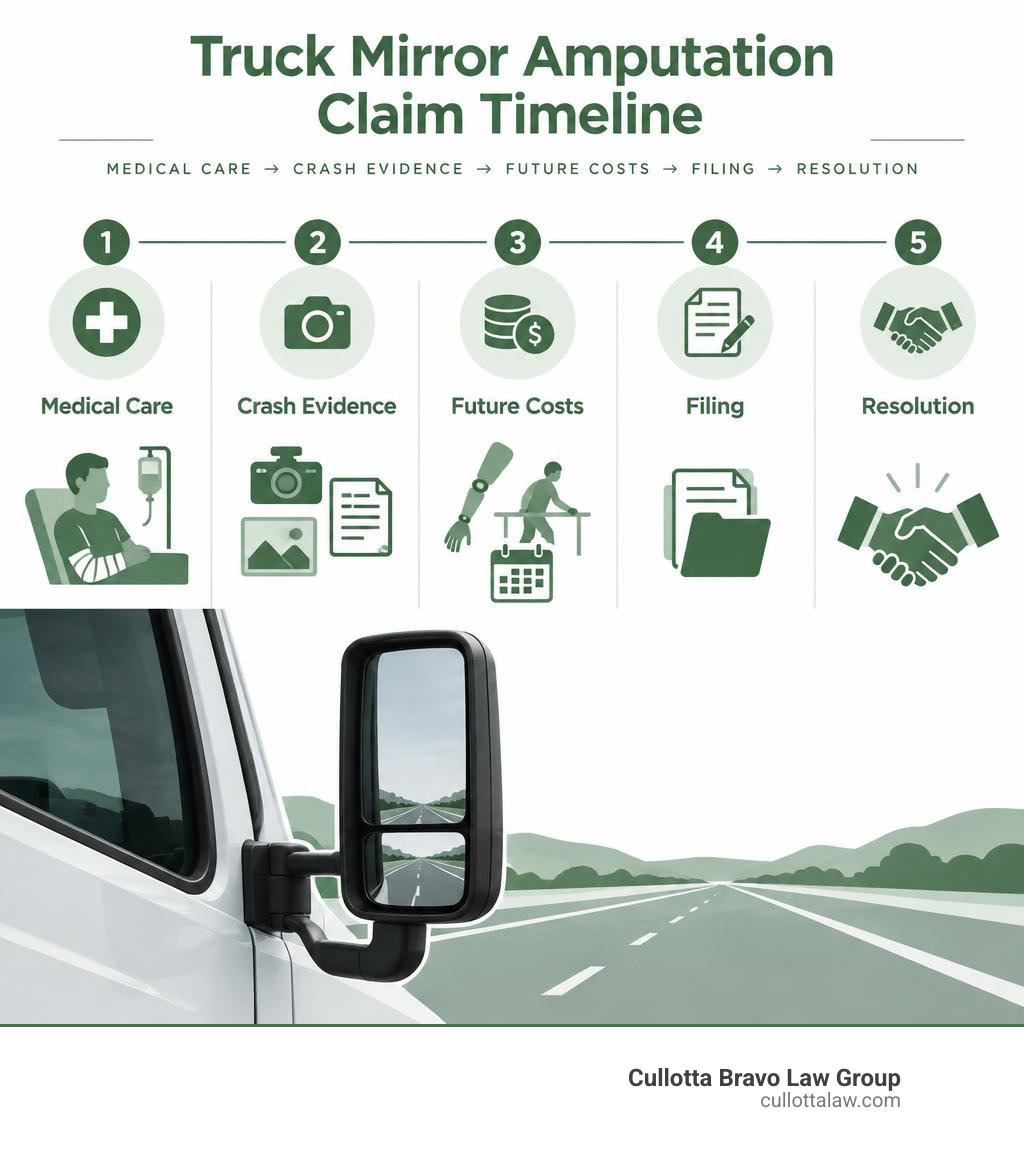
To protect a truck mirror amputation claim, get medical care, report the crash, and keep photos, witness details, and medical records. Ask that the truck, damaged mirror, dashcam footage, and electronic crash data be preserved. Before accepting a settlement, account for future prosthetics, rehabilitation, lost income, and pain—not just today’s bills.
A mirror strike may injure someone outside the truck. In a rollover, a broken mirror and side window may also play a role in an occupant’s injury. The way the crash happened shapes which driver, company, or manufacturer may be responsible.
I’m Peter Cullotta, founding partner of Cullotta Bravo Law Group. For more than 35 years, I’ve represented injured people in Illinois; that experience guides how I approach the evidence and long-term losses in a truck mirror amputation claim.
Easy truck mirror amputation claim glossary:
How Truck Mirror Collisions and Rollovers Lead to Traumatic Amputations
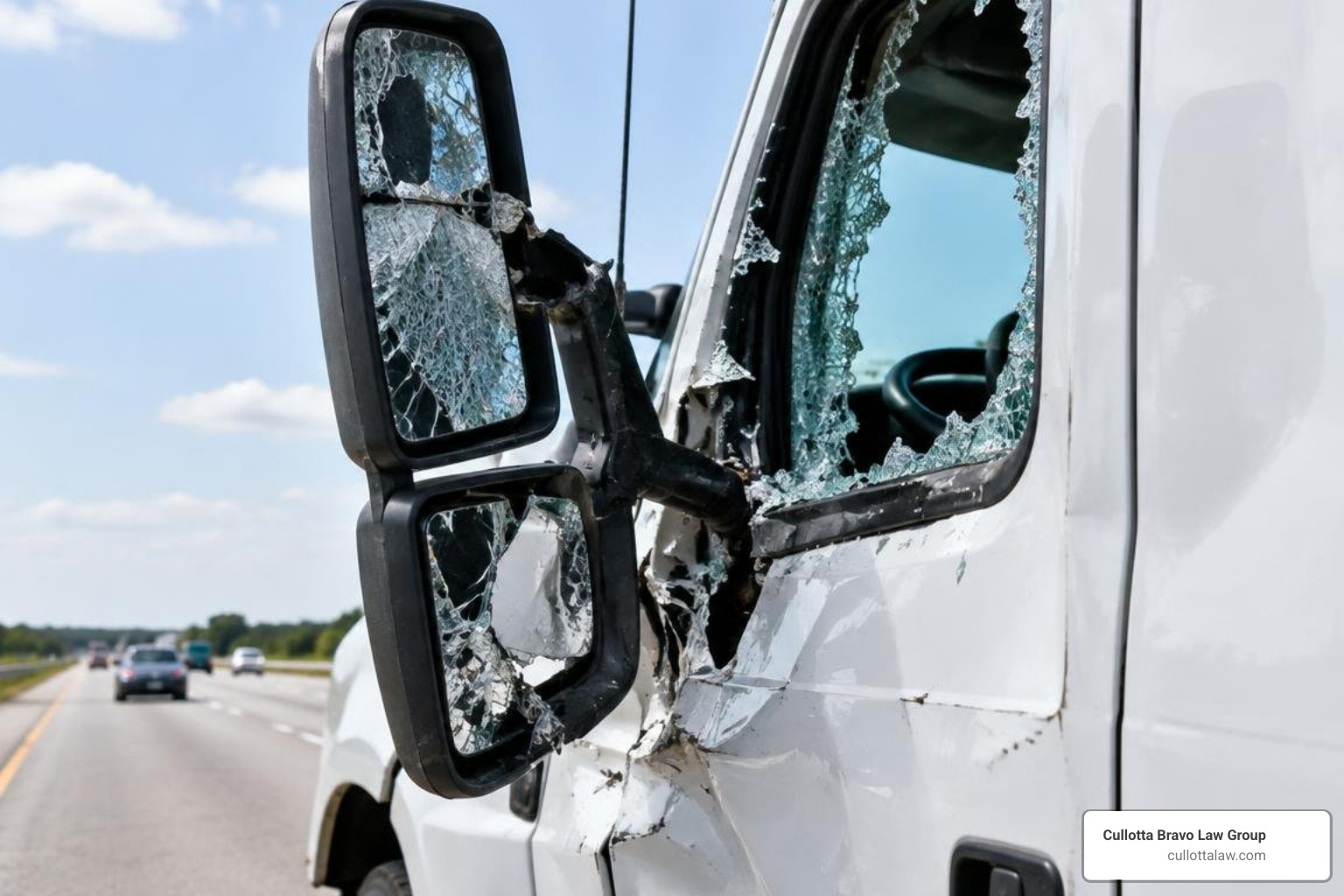
When an 80,000-pound commercial vehicle collides with a smaller vehicle, motorcycle, or pedestrian, the sheer physics involved are catastrophic. Heavy-duty commercial side mirrors extend significantly beyond the truck’s cab to provide visibility along lengthy 53-foot trailers. While necessary for safe navigation, these protruding metal and reinforced-glass assemblies become rigid, blunt-force weapons during side-impact collisions, lane-change sideswipes, and rollover accidents.
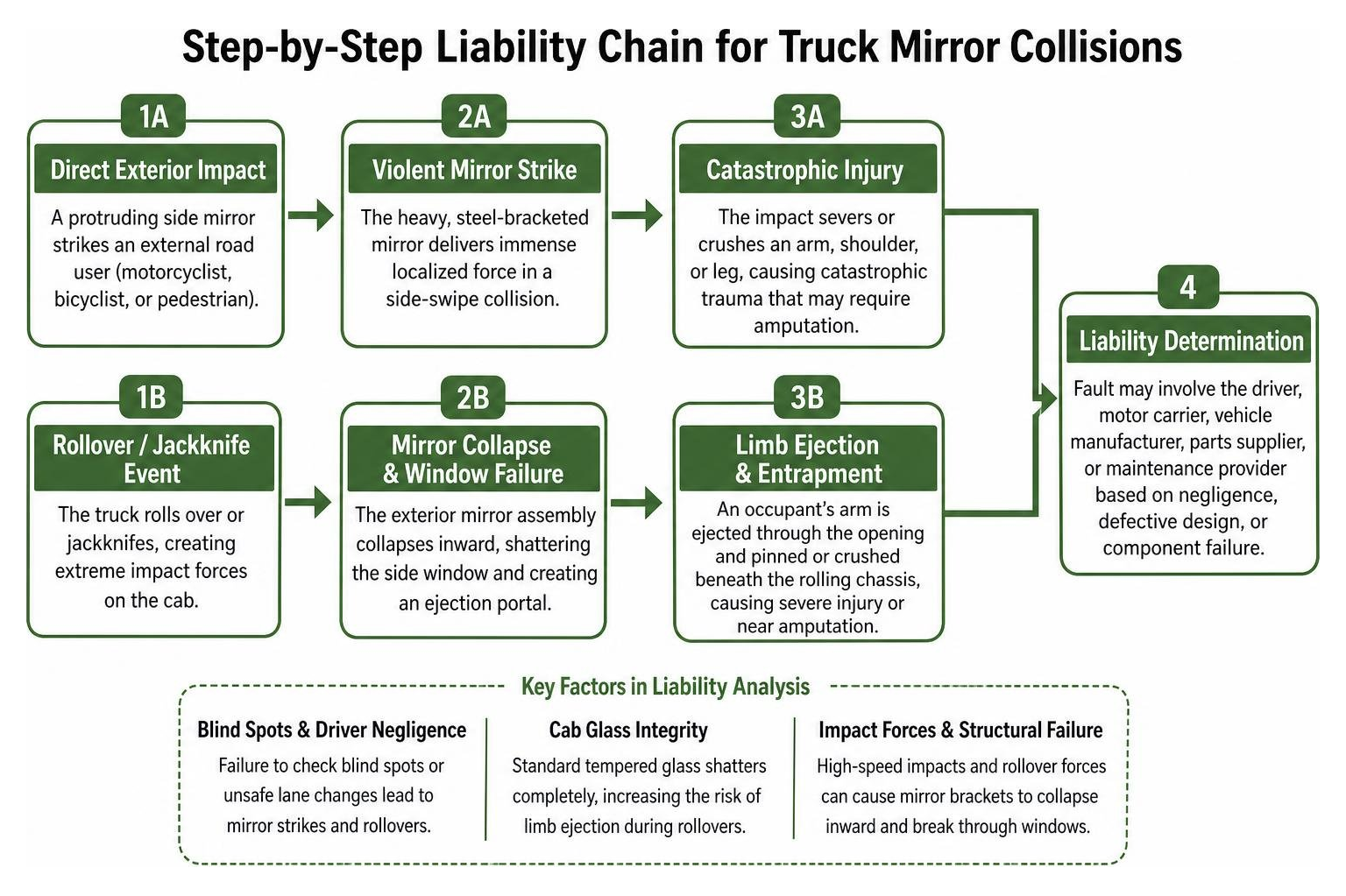
Traumatic amputations involving semi-truck mirrors generally occur through two primary crash mechanisms:
- Direct Exterior Impact: A protruding side mirror strikes an external road user (such as a motorcyclist, bicyclist, or pedestrian) with immense localized force, severing or crushing an arm, shoulder, or leg upon impact.
- Rollover and Cab Intrusion Dynamics: During a truck rollover or jackknife wreck, the massive exterior mirror assembly collapses inward, shattering the driver’s side tempered window glass. This failure creates an ejection portal, allowing the occupant’s upper extremity to pass outside the protective shell of the cab where it is pinned or crushed beneath the rolling chassis.
Understanding how vehicle blind spots, cab glass integrity, and impact forces interact is critical to proving fault under state traffic laws and vehicle safety codes.
Blind Spots, Impact Dynamics, and Side Window Failure
Commercial trucks have massive blind spots along their front, rear, and sides—often referred to as the “No-Zone.” Navigating these areas safely requires drivers to monitor their surroundings vigilantly. Reviewing semi-truck blind spot diagrams makes it clear why sudden lane changes into adjacent traffic cause devastating side-swipe collisions.
When a commercial driver fails to check their blind spot and drifts into an adjacent lane, the heavy steel-bracketed side mirror is often the initial point of violent contact. For vulnerable road users, such as motorcyclists riding alongside the trailer, a mirror strike can deliver catastrophic crush trauma. In high-speed collisions, the impact can shear soft tissue and fracture bone instantly, necessitating immediate surgical amputation.
In cab-over or conventional tractor rollovers, the side mirror’s structural failure presents another severe hazard. Standard tempered glass on side windows shatters completely upon heavy impact. If a mirror bracket buckles into the window opening during a rollover, the driver or passenger’s arm can be violently ejected. In traumatic rollover cases, an occupant’s arm can become trapped between the pavement and the cab frame, resulting in a near-shoulder traumatic amputation. Clarifying who pays when a side mirror strike causes severe damage requires a deep technical investigation into how the structural collision unfolded.
Product Liability and Vehicle Design Defects
Proving liability in an amputation wreck does not always stop with driver error. Automotive crashworthiness standards require vehicle manufacturers to design cabs and mirror assemblies that minimize unreasonable injury risks during predictable collisions and rollover events.
When side-mirror mounting assemblies fail catastrophically or break through cab glass during moderate rollover forces, the manufacturer may face strict product liability claims for defective design. In modern crashworthiness litigation, legal battles frequently center on whether the manufacturer should have utilized:
- Advanced Laminated Window Glazing: Laminated glass bonds a plastic interlayer between glass sheets, resisting complete blowouts during impacts and preventing occupant limb ejection.
- Side-Curtain Ejection-Mitigation Airbags: Deployable inflatable curtains that prevent limbs and heads from exiting the window opening during multi-stage rollovers.
- Breakaway Mirror Brackets: Assemblies engineered to shear cleanly away from the cab upon exterior impact rather than crushing inward through the side window.
A notable example of these complex legal arguments appears in the federal case Ali v. Trans Lines, Inc. (trial court document), District Court, E.D. Missouri, 2024, where the court scrutinized expert engineering testimony regarding side window integrity and alternative safety designs following a traumatic upper-limb ejection and shoulder-level amputation in a semi-truck rollover. Defective brackets, insufficient glazing, or substandard aftermarket replacements can create overlapping liability across drivers, fleet mechanics, and parts suppliers. For this reason, evaluating aftermarket truck mirror safety and liability is essential when investigating component failures.
Proving Liability in a Truck Mirror Amputation Claim

Securing full financial recovery after a life-altering limb loss requires establishing clear liability against every responsible party. Commercial trucking operations are governed by strict state negligence laws and the Federal Motor Carrier Safety Regulations (FMCSRs). Proving that a commercial driver or fleet operator breached their duty of care demands immediate action to secure critical electronic and physical evidence.
Critical Evidence Required for a Truck Mirror Amputation Claim
Unlike standard passenger car crashes, commercial truck collisions produce extensive technical data that must be preserved immediately before the motor carrier overwrites or disposes of it:
- Electronic Control Module (ECM) and “Black Box” Data: Records vehicle speed, braking inputs, throttle position, engine RPM, and steering angles leading up to and during the collision.
- In-Cab and Exterior Dashcam Footage: Multi-angle video provides objective visual evidence of driver distractions, blind spot monitoring failures, lane positioning, and mirror impact sequences.
- Electronic Logging Devices (ELDs) and Driver Logs: Documents driving hours to reveal hours-of-service (HOS) violations, driver fatigue, and improper rest intervals.
- Fleet Inspection and Maintenance Records: Proves whether side mirrors, bracket hardware, and cab safety systems were properly maintained, adjusted, or neglected.
- Post-Crash DOT Inspection Reports: Law enforcement commercial vehicle inspections detailing mechanical failures, brake issues, or illegal mirror configurations at the scene.
We send formal spoliation letters immediately after being retained to legally compel the trucking company and its insurance adjusters to preserve all physical truck parts, digital logs, and maintenance files.
Identifying All Negligent Parties in Commercial Vehicle Crashes
Traumatic amputation claims frequently involve multiple liable corporate defendants, which expands the available insurance coverage needed to fund lifetime medical care:
- The Commercial Truck Driver: Liable for careless driving, distracted operation, failing to check blind spots, or operating while fatigued.
- The Motor Carrier / Trucking Company: Holds direct liability for negligent hiring, improper driver training, and demanding illegal schedules, as well as vicarious liability for its employees’ negligence. Our dedicated team works directly as a trucking company liability lawyer to hold reckless carriers fully accountable.
- Cargo Loading Contractors: Improperly balanced or overloaded freight can cause dynamic load shifts that induce sudden trailer sway or rollovers, driving the mirror assembly into nearby lanes.
- Third-Party Maintenance Providers: Liable if negligent repairs, improper mirror installation, or worn bracket hardware contributed to structural failure during an impact.
- Vehicle and Component Manufacturers: Strictly liable for design or manufacturing defects in side-mirror housing assemblies, structural door pillars, or side window glazing.
Calculating Long-Term Damages and Lifetime Prosthetic Costs
Limb loss is a catastrophic, permanent injury that irrevocably alters every aspect of a person’s daily life. Compensation in a traumatic truck mirror amputation claim must extend far beyond emergency room care and initial surgical amputation procedures. A fair settlement must account for decades of specialized medical intervention, recurring device replacements, vocational losses, and intense non-economic suffering.
In serious injury cases, securing justice means understanding the full scope of damages:
- Pecuniary (Economic) Damages: Initial trauma surgeries, revision surgeries, hospital stays, inpatient rehabilitation, life-care plans, home accessibility remodeling, specialized vehicle hand controls, and past and future lost earnings.
- Non-Pecuniary (Non-Economic) Damages: Physical pain, phantom limb sensations, severe emotional distress, post-traumatic stress disorder (PTSD), permanent physical disfigurement, loss of bodily integrity, and loss of consortium.
Life-Care Planning, Prosthetic Replacement Cycles, and Earning Capacity
Modern prosthetics offer remarkable mobility and function, but their lifetime costs are substantial. Advanced myoelectric prosthetic arms and bionic microprocessor-controlled legs frequently cost over $100,000 per unit for the hardware and software fittings alone.
Prosthetic devices are not a one-time purchase. Because of mechanical wear, material degradation, socket breakdown, and anatomical changes in the residual limb (such as volume fluctuations and bone spurring), prostheses must be replaced every 3 to 5 years throughout the victim’s life.
Consider the lifetime replacement cycle for an amputation victim:
- Initial Fitting and Alignment: Post-surgical sockets, temporary diagnostic limbs, and permanent preparatory devices during the first 12 to 18 months.
- Recurring Device Replacements: New myoelectric hardware, microprocessor joints, and specialized activity attachments purchased every 3 to 5 years.
- Ongoing Maintenance and Consumables: Replacement silicone liners, socket adjustments, vacuum suspension sleeves, and harness repairs needed multiple times per year.
- Physical and Occupational Therapy: Lifelong therapy routines to maintain core balance, prevent muscle contractures, and master functional prosthetic control.
In addition to direct medical care, limb loss frequently destroys or severely curtails a worker’s future earning capacity. When calculating these losses, courts and legal teams utilize proven economic frameworks to quantify diminished lifetime earnings. For example, courts have long utilized the multiplier method—as demonstrated in the landmark injury compensation ruling in Arvind Kumar Mishra Vs New India Assurance Co. Ltd. and Another—to project annualized wage loss against life expectancy multipliers.
Similarly, tribunal awards in severe multi-victim truck collisions, such as the major compensation decision reported in the Motor Accident Tribunal awards Rs 1.79 crore to Govandi family in 2018 Bihar truck crash | Mumbai News – The Times of India, highlight the necessity of factoring ongoing five-year prosthetic replacement cycles directly into the recovery amount. Building these comprehensive economic models is central to how we secure multi-million dollar accident settlements for catastrophically injured clients.
The Critical Role of Expert Witnesses in Proving Future Losses
Commercial insurers fight aggressively to minimize amputation payouts by challenging the necessity of high-end prosthetics and long-term care plans. Defeating these tactics requires a coordinated team of qualified expert witnesses whose methodologies withstand rigorous scrutiny under Federal Rule of Evidence 702 and Daubert standards:
- Certified Prosthetists: Clinical prosthetists detail specific socket requirements, component lifespans, custom hardware costs, and future replacement timelines tailored to the victim’s residual limb health.
- Certified Life-Care Planners: Medical specialists who construct a comprehensive, line-item projection of all future surgeries, therapy sessions, home care assistance, prescription medications, and adaptive living equipment.
- Biomechanical Engineers: Crash mechanics experts who analyze how mirror protrusions, vehicle velocity, and cab structural failures generated the specific forces that caused the traumatic limb loss.
- Forensic Economists: Financial experts who calculate inflation adjustments, wage growth projections, and present-value discount rates to establish the true lifetime economic loss.
Having experienced trial lawyers ready to present these experts before a jury is often the deciding factor in obtaining full value for a catastrophic claim. Knowing why having a seasoned personal injury trial attorney in your corner matters gives you leverage during complex settlement negotiations.
Critical Pitfalls and Legal Timelines in Commercial Truck Litigation
The period immediately following a traumatic amputation is emotionally overwhelming for victims and their families. Unfortunately, commercial trucking insurers take advantage of this vulnerability to limit their financial exposure. Protecting your legal claim requires avoiding several critical mistakes.
Avoiding Mistakes That Can Undermine a Truck Mirror Amputation Claim
- Accepting an Early Settlement Offer: Insurance adjusters frequently offer quick cash settlements before the victim finishes initial surgeries or is evaluated for long-term prosthetics. These early offers rarely cover more than a fraction of lifetime medical costs. Signing a release forever bars you from seeking additional funds.
- Giving Recorded Statements to the Trucking Insurer: Adjusters use carefully worded questions to get victims to downplay pain, admit partial fault, or make inaccurate statements about speed and visibility while in shock or on pain medication.
- Failing to Document Phantom Limb Pain: Phantom limb pain is a very real, often debilitating neuropathic condition where the brain transmits excruciating pain signals from the missing limb. Failing to report these sensations to physicians leaves an evidentiary gap that insurers will exploit to minimize non-economic damages.
- Posting on Social Media: Insurance defense investigators routinely monitor victims’ social media profiles for photos or comments they can twist to claim your physical limitations or emotional suffering are exaggerated.
- Gaps in Medical and Rehabilitation Care: Missing prescribed physical therapy sessions, occupational training, or prosthetic fitting appointments gives the defense ammunition to argue that your condition has fully stabilized or that you failed to mitigate damages.
Navigating Statutes of Limitations and Government Claims
In Illinois, standard personal injury claims are generally subject to a two-year statute of limitations from the date of the collision. Failing to file a lawsuit within this strict statutory window forever forfeits your right to compensation.
However, deadlines can be substantially shorter depending on who owns and operates the truck:
- Municipal and Government Entities: If the truck involved is a municipal vehicle, public works truck, or state road maintenance vehicle, strict formal notice-of-claim deadlines apply (often requiring notice within one year or even six months, depending on the municipality).
- Private Commercial Fleets: While the two-year deadline applies to private carriers, critical black box data and video footage can be legally overwritten within 30 to 90 days under federal retention guidelines if an attorney does not intervene with formal preservation demands.
Early legal investigation ensures all notices are filed properly and critical vehicle evidence is safely preserved before it disappears.
Frequently Asked Questions About Amputation Claims Involving Commercial Trucks
How often do prosthetic limbs need to be replaced over a lifetime?
Most prosthetic limbs must be replaced every 3 to 5 years. Functional wear and tear, material fatigue in microprocessor joints, and anatomical changes in the residual limb (such as volume loss or skin changes) make regular replacements necessary. A comprehensive life-care plan accounts for these multi-year replacement cycles, along with recurring annual socket adjustments, liners, and physical therapy.
Can I file a claim against the truck manufacturer if the side mirror broke the cab glass?
Yes. If an improperly designed side mirror assembly shattered the cab’s side window during a collision or rollover, allowing your limb to be ejected and crushed, you may have a valid product liability claim against the vehicle manufacturer. These claims focus on crashworthiness, asserting that laminated window glazing, breakaway mirror brackets, or side-curtain airbags should have been used to prevent occupant ejection.
What is phantom limb pain, and can it be compensated in an amputation settlement?
Phantom limb pain is a documented medical condition where severe burning, twisting, or aching sensations feel as though they originate from the amputated limb. It is caused by mixed signals between the spinal cord and brain. Phantom limb pain is fully compensable under non-economic damages, covering physical pain, emotional distress, and loss of life enjoyment, provided it is consistently documented by your medical providers.
Conclusion
A traumatic amputation caused by a commercial truck side mirror or rollover collision changes your life forever. Navigating the road ahead requires more than just medical treatment—it requires strong legal representation to hold negligent truck drivers, motor carriers, and manufacturers accountable for every dollar of your future medical care, lost income, and pain.
At Cullotta Bravo Law Group, we bring over 35 years of dedicated personal injury experience to fighting for catastrophically injured victims across Aurora, Chicago, Naperville, and Joliet. We provide aggressive representation while treating you and your family with the personal dignity and compassion you deserve.
If you or a loved one has suffered an amputation injury in a commercial truck wreck, contact our team today for a free consultation. To learn more about modern commercial vehicle mirror safety and visibility standards, explore our guide on upgrading safety with semi-truck blind spot mirrors.