

How to Subdivide Your Land Without the Legal Headache
What a Property Subdivision Lawyer Does — And When You Need One
A property subdivision lawyer helps landowners, investors, and developers navigate the legal process of splitting one parcel of land into two or more separate, legally recognized titles. Here is a quick overview of what they do and when you need one:
- Prepares legal documents — subdivision plats, easements, transfer documents, and title applications
- Handles government approvals — submits applications to planning boards and represents clients at public hearings
- Coordinates with surveyors, planners, and lenders — keeps the project moving between all parties
- Resolves financial hurdles — negotiates with mortgage lenders for partial lien releases or refinancing
- Flags legal risks early — identifies easements, restrictive covenants, HOA rules, and zoning conflicts before they become costly problems
Subdividing land sounds straightforward — you own it, so you should be able to split it, right?
Not quite.
The reality is that property subdivision is one of the most legally complex things you can do with real estate. You are dealing with zoning ordinances, municipal planning boards, title registrations, mortgage lenders, and sometimes environmental regulations — all at the same time. Miss a step, and your project can stall for months or fall apart entirely.
The full process from planning application to registered titles can take anywhere from six to eighteen months. That timeline depends heavily on local council response times, surveyor availability, lender approvals, and whether your property has existing liens, easements, or HOA restrictions.
Getting the legal side wrong is not just a paperwork problem. Selling lots from an unapproved subdivision can be illegal. Subdividing mortgaged land without lender consent can trigger a loan default. And failing to account for easements or deed restrictions can invalidate the entire plan.
This guide walks you through exactly what the legal process involves, what can go wrong, and how the right legal support makes the difference between a smooth project and an expensive headache.
I’m Peter Cullotta, founding partner at Cullotta Bravo Law Group, and with over 35 years of legal experience across Illinois, Arizona, and Wisconsin — including complex property and real estate matters — I have seen how the right property subdivision lawyer can protect landowners from costly mistakes at every stage of the process. Whether you are splitting a residential lot or planning a larger development, the legal guidance you get early on shapes everything that follows.
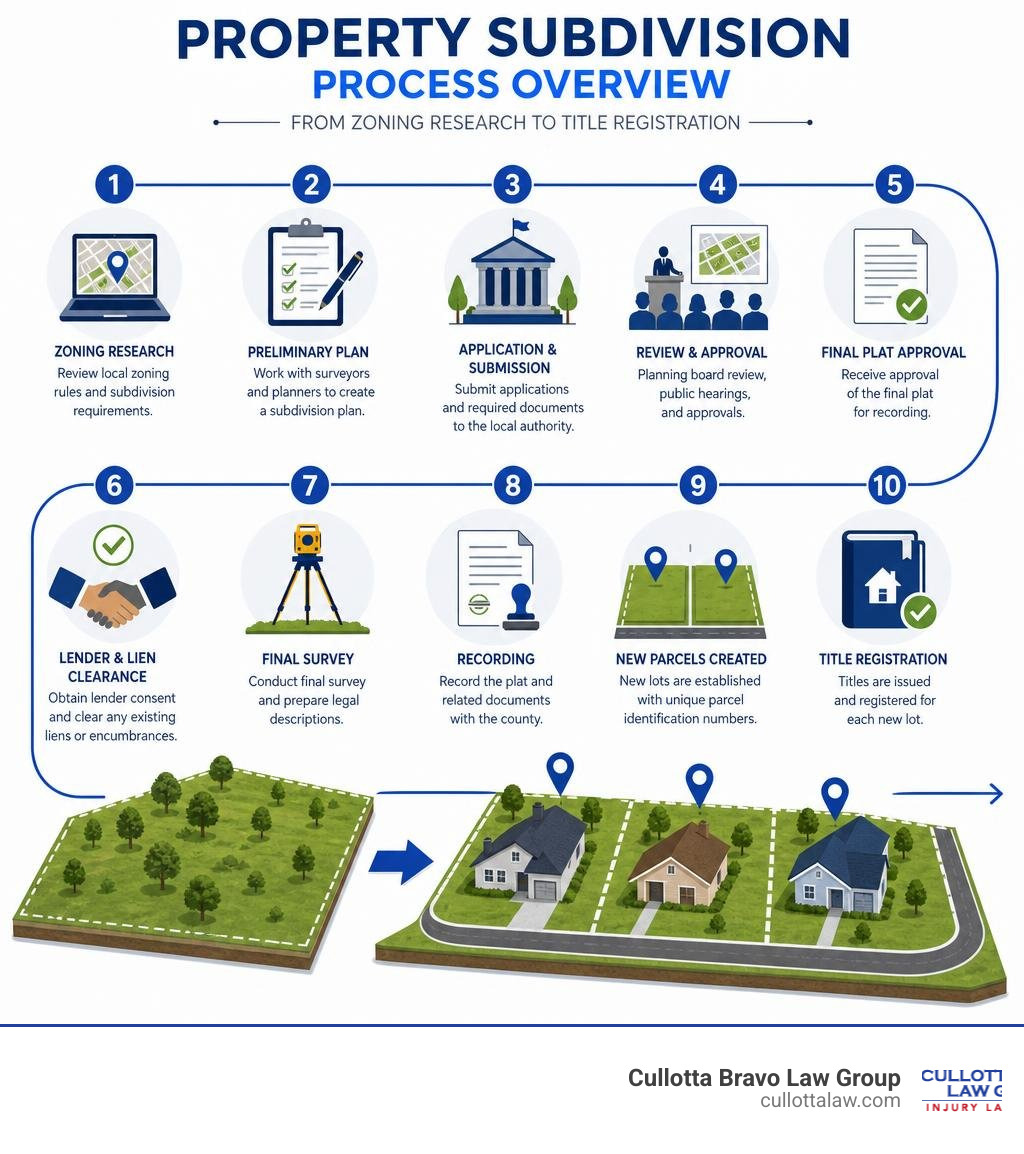
Property subdivision lawyer terms to know:
Why You Need a Property Subdivision Lawyer
When you decide to split a piece of land, you are not just drawing a line down the middle of a map. You are creating entirely new legal entities. This means you must comply with a mountain of local, state, and federal regulations.
Without professional guidance, you might find yourself stuck in a bureaucratic loop, paying fees for applications that get rejected because they do not meet highly technical municipal standards. A specialized land-use attorney acts as your project manager, legal shield, and guide through local government halls.

If you want to understand how these services fit into broader property management, you can find More info about real estate services on our dedicated practice page.
What Does a Property Subdivision Lawyer Do?
A property subdivision lawyer provides comprehensive legal support for property developers and individual homeowners alike. Their role goes far beyond simply filing forms. They manage the entire regulatory lifecycle of your development, which includes:
- Contract Preparation & Review: Drafting purchase agreements, joint venture contracts, and development agreements.
- Preparing Supporting Documentation: Crafting the legal language for easements, restrictive covenants, and homeowners’ association (HOA) rules.
- Negotiation and Amendments: Working with municipal planning boards, neighboring property owners, and utility companies to resolve boundary or access disputes.
- Managing Approvals & Title Registration: Ensuring that once the local government approves your plan, the new land titles are properly registered with the county recorder.
- Risk Management: Identifying historical preservation rules, environmental overlays, or hidden liens that could halt construction.
Subdivision Lawyer vs. General Real Estate Attorney
While any licensed real estate attorney can draft a standard purchase contract, a specialized subdivision or land-use lawyer possesses highly targeted expertise.
General real estate attorneys typically focus on transactional work—such as reviewing closing documents, facilitating title transfers, and drafting leases. They are excellent at getting you “from contract to keys,” but they may not be familiar with the granular, physical requirements of local land development.
In contrast, a subdivision lawyer regularly practices before municipal zoning boards, planning commissions, and environmental protection agencies. They understand the specific physical infrastructure requirements mandated by local codes, such as:
- Mandatory sidewalk placement and street frontage width.
- Requirements for underground wiring and utility connections.
- Aesthetic mandates, including landscaping, screening, and signage.
- Stormwater management and drainage plans.
If your project requires a zoning variance or an amendment to a local land-use plan, you need a lawyer who knows how to present technical arguments to local officials and represent your interests before judicial tribunals.
Key Legal Steps in the Subdivision Process
The path to turning one parcel of land into multiple independent lots is highly structured. Every step must be executed in a specific order to avoid legal and financial setbacks.

Before you begin, you must establish a clear baseline of what you actually own. You can learn more about this crucial step in our guide, know your lines a guide to property title searches and boundary surveys.
Researching Zoning Laws and Local Regulations
The first step in any subdivision project is thorough due diligence. You must determine if your local municipality’s zoning laws even allow you to divide the property. Every municipality has a comprehensive land-use plan and a set of zoning ordinances that dictate:
- Minimum Lot Size: The smallest allowable acreage or square footage for a legal lot in your specific zone. If your current lot is 1.5 acres and the zone requires a 1-acre minimum, you cannot split it into two equal lots without a variance.
- Density Limits: The maximum number of dwelling units allowed per acre of land.
- Setback Requirements: How far a building must be situated from the front, rear, and side property lines.
- Street Frontage: The minimum width of the lot that must border a public road to ensure emergency vehicle access.
If your proposed division does not meet these criteria, your attorney will need to apply for a variance or a special use permit, which requires proving that the current zoning rules impose an unnecessary hardship on your property.
Surveying, Plat Recording, and Municipal Approvals
Once you confirm that your plan is legally viable under local zoning codes, the physical and administrative work begins. This phase requires close collaboration between your legal counsel and a registered land surveyor.
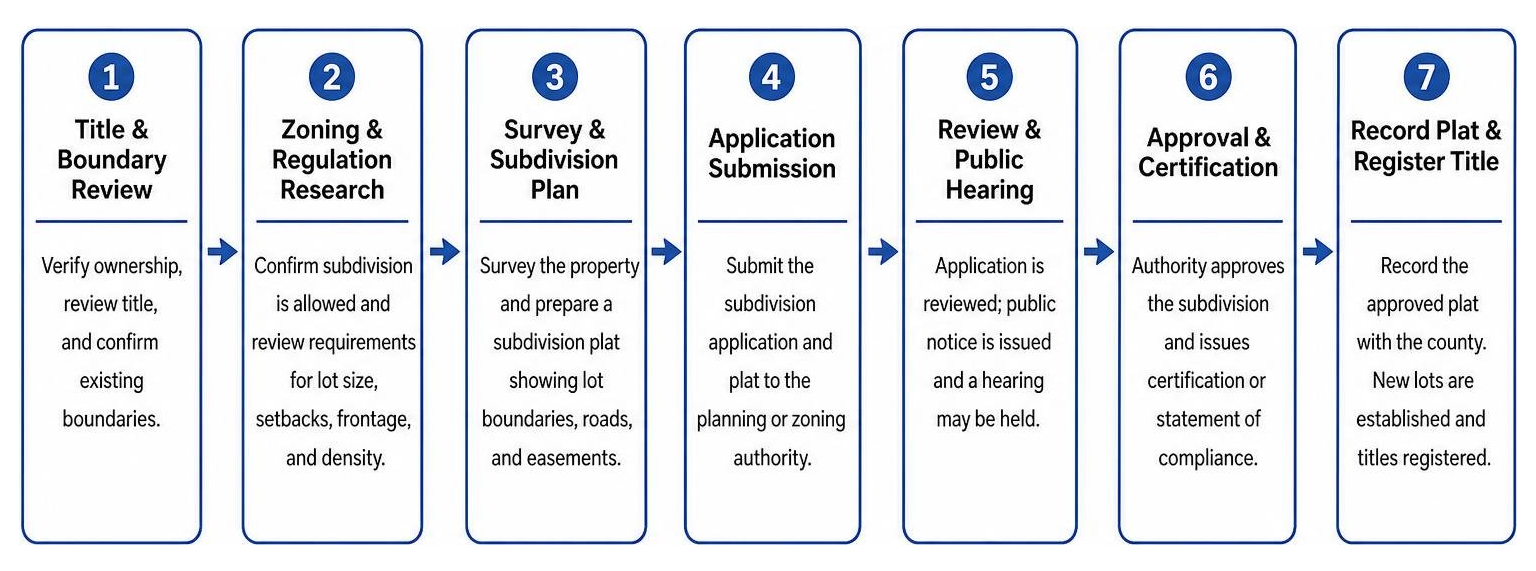
First, the surveyor will conduct a physical survey and create a highly detailed document called a subdivision plat. This plat maps out the exact boundaries of the new lots, the locations of any planned roads, and the designated areas for utility easements.
Next, your attorney will submit the formal subdivision application along with the plat to the local planning commission or zoning board. This step often triggers a public hearing process. Neighboring property owners are notified of your plans and given the opportunity to voice concerns regarding traffic, drainage, or changes to the neighborhood’s character.
If the board approves your application, they will issue a formal certification or Statement of Compliance. Finally, your lawyer will record the approved subdivision plat with the county clerk or recorder of deeds. This step officially retires the old property description and establishes the new individual lots.
If you are looking to acquire more land to start this process, check out our guide on how to find and buy vacant land for sale near you.
Overcoming Financial and Structural Hurdles
Even if the local government is fully on board with your subdivision, you still have to deal with the financial institutions and private organizations that hold a legal interest in your land.
Securing your investment also requires protecting your new titles from future challenges. Make sure to read our breakdown of why title insurance is a non-negotiable part of this process.
Subdividing Property with an Active Mortgage or Liens
Can you subdivide a property if you still owe money on it? Yes, but it is highly complicated.
When you took out your mortgage, your lender recorded a lien against the entire parcel of land as collateral for the loan. If you split that land and try to sell off a piece of it, you are reducing the value of the lender’s collateral. Doing this without their permission is a breach of your mortgage contract and can trigger an immediate foreclosure.
To proceed legally, your property subdivision lawyer must negotiate a partial lien release with your bank. This process typically involves:
- A New Appraisal: The bank will require a professional appraisal of both the portion of the land you are keeping and the portion you plan to sell or develop.
- LTV Calculations: The lender must verify that the remaining property retains a safe Loan-to-Value (LTV) ratio to secure the outstanding debt.
- Principal Reduction: In many cases, the bank will only grant a partial release if you agree to pay them a significant lump sum from the sale of the subdivided lot to reduce your principal loan balance.
- Refinancing: Alternatively, you may be forced to refinance the existing mortgage into two entirely new, independent loans.
For a deeper dive into managing these complex transactions, check out from contract to keys the buyers guide to legal support.
Navigating Easements, Covenants, and HOA Rules
Before you can build on or sell your new lots, you must address any existing private restrictions. Your property may be subject to easements—such as shared driveways, utility access lines, or drainage pathways—that prevent you from building on certain sections of the land.
Furthermore, if your property is located within a planned development or a community governed by a Homeowners’ Association (HOA), you must review the Declaration of Covenants, Conditions, and Restrictions (CC&Rs). HOA bylaws frequently contain strict prohibitions against subdividing lots to maintain uniform density and property values.
An experienced attorney will review these covenants early in the process. If necessary, they can assist you in negotiating amendments or representing your interests before the HOA board. For board members or developers looking to understand these dynamics, our guide on navigating hoa legal representation what every board member should know offers valuable insights.
Regional Differences in Subdivision Laws
Subdivision regulations are highly localized. While federal laws govern broad environmental and interstate land sales, the actual mechanics of dividing land are dictated by state statutes and municipal ordinances.
| Jurisdiction | Key Governing Authority / Statute | Major Local Requirements & Thresholds |
|---|---|---|
| Illinois (Aurora / Collar Counties) | Illinois Plat Act (765 ILCS 205/) | Plat required for divisions under 5 acres; county/municipal zoning board approvals. |
| Arizona | Arizona Department of Real Estate (ADRE) | State approval required for 6+ lots under 36 acres; requires 100-year assured water supply in AMAs. |
| California | Subdivision Map Act | State law overrides conflicting HOA covenants; highly stringent environmental reviews. |
| Victoria, Australia | Land Use Victoria / SPEAR System | Digital lodgement via SPEAR; Section 173 agreements; Owners Corporation required for shared common property. |
| New South Wales, Australia | Environmental Planning and Assessment Act 1979 | Local Environmental Plans (LEPs); Development Applications (DA) or Complying Development. |
Subdivision Regulations in Illinois and the US
In Illinois, the primary state law governing land division is the Illinois Plat Act. Under this act, any time you divide a parcel of land into two or more parts, any of which is less than 5 acres, you must have a registered land surveyor prepare a plat of subdivision, which must be approved by the local municipality or county board before it can be recorded.
Local municipalities in Northern Illinois—including Aurora, Naperville, Joliet, and Chicago—have their own strict subdivision control ordinances. For example, in the collar counties (such as Kane, DuPage, and Will counties), local rules often impose strict requirements regarding:
- Soil and Drainage Assessments: Ensuring that new lots can support septic systems if municipal sewers are unavailable, and that runoff does not flood neighboring properties.
- Eminent Domain and Takings: If a municipal zoning change or easement demand effectively strips your property of its utility, your attorney may need to challenge it as a regulatory taking to secure fair market value compensation under eminent domain principles.
If you are navigating these local boards, working with a localized advocate like an Aurora real estate attorney is critical to managing county-specific expectations.
International Subdivision Frameworks
If you look at international real estate hubs, the administrative layers are just as dense. In places like Victoria, Australia, developers must use the digital SPEAR (Surveyors Applications Collaborating Electronically) system to coordinate approvals between surveyors, local councils, and Land Use Victoria.
Furthermore, Victorian law utilizes Section 173 agreements—which are legally binding contracts between the landowner and the local council that place permanent restrictions on how the land can be used.
Similarly, in New South Wales (NSW), subdivisions are heavily regulated by the Environmental Planning and Assessment Act 1979 and must align perfectly with local planning instruments. These international frameworks highlight a universal truth: no matter where you are in the world, dividing land requires navigating a highly technical, multi-agency legal system.
Common Legal Pitfalls, Timelines, and Costs
Because subdivision projects involve so many moving parts, they are highly susceptible to delays and unexpected expenses. Knowing what to expect can help you budget both your time and your money effectively.
Common Causes of Delays:
- Lender Unresponsiveness: Waiting for a mortgage bank to approve a partial lien release can take anywhere from 2 to 6 weeks.
- Zoning Disputes: If neighbors object to your subdivision at a public hearing, resolving the dispute can add months to your timeline.
- Incomplete Title Records: Discovering unrecorded judgments, old utility easements, or unresolved estate issues (such as a deceased family member still listed on the deed) can halt your application.
- Environmental Obstacles: Identifying protected wetlands, floodplains, or historical preservation zones on your property.
Project Timelines:
- Initial Research & Surveying: 1 to 3 months.
- Municipal Review & Public Hearings: 2 to 6 months.
- Lender Approvals & Legal Document Prep: 1 to 2 months.
- Final Title Registration: 4 to 8 weeks after municipal certification.
- Total Expected Timeline: 6 to 18 months.
Estimated Costs:
- Surveying & Engineering Fees: $3,000 to $10,000+ (depending on acreage and complexity).
- Municipal Application & Recording Fees: $500 to $3,000.
- Legal Fees: Many firms offer flat-rate structures for simple two-lot subdivisions, while larger development projects are billed hourly.
How to Choose the Right Property Subdivision Lawyer
When hiring a lawyer to guide you through this process, you should look for someone who possesses both deep technical knowledge of land-use law and strong relationships within your local community.
An attorney who regularly represents clients before your local zoning board will understand the unwritten preferences and procedural quirks of local officials, which can save you weeks of back-and-forth negotiations.
If you are operating on a budget but still require top-tier representation in Northern Illinois, we recommend reading our resource on the best real estate lawyers in aurora on a budget to help you make an informed decision.
Frequently Asked Questions about Property Subdivision
How long does the subdivision process typically take?
The entire process—from your initial consultation and boundary survey to the final registration of your new land titles—generally takes between six and eighteen months. Simple two-lot divisions with no mortgage or easement issues sit on the shorter end of this spectrum, while larger developments requiring public hearings and utility extensions can easily take over a year.
What permits and approvals are required to subdivide land?
At a minimum, you will need a certified Subdivision Plat Approval from your local planning commission. Depending on your location and the scope of your project, you may also need:
- Environmental and stormwater runoff permits.
- Utility connection and road access permits.
- Zoning variances or special use permits.
- A public disclosure report (required in states like Arizona for developments of 6 or more lots).
Can I subdivide my property to pass it down to family?
Yes, subdividing land is a common strategy for family succession planning. You can split a large family estate into smaller parcels to gift or sell to your children.
However, you must still comply with all local zoning and minimum lot size requirements. Additionally, you should consult with a specialized attorney to manage the transfer tax and inheritance implications.
To learn more about structuring these transfers correctly, read our guide on passing it on finding the right property inheritance lawyer.
Conclusion
Subdividing property is an excellent way to unlock the financial value of your land, but it is not a project you should tackle alone. Between navigating the strict rules of the Illinois Plat Act, negotiating with stubborn mortgage lenders, and presenting your plans to local zoning boards, the legal hurdles can quickly become overwhelming.
At Cullotta Bravo Law Group, we bring over 35 years of legal experience to the table. We believe in providing aggressive, high-quality legal representation while treating every client with the dignity and respect they deserve. Whether you are dealing with complex land-use permits, commercial transactions, or residential property disputes, our team is equipped to help you protect your investments and secure your financial future.
If you are ready to take the next step in your property development journey without the legal headaches, we are here to help. Protect your property investments with Cullotta Bravo Law Group by scheduling a comprehensive legal consultation with our team today.