

How a Workers Compensation Impairment Rating Affects Your Claim
A workers compensation impairment rating is a doctor’s estimate of lasting physical or functional loss, usually given as a percentage after you reach maximum medical improvement (MMI). To understand your rating, check which condition the doctor evaluated, what medical findings support the percentage, and how your state’s rules turn that rating into benefits. A rating is not the same as a disability finding: it measures impairment, while disability can involve your ability to work.
I’m Peter Cullotta, founding partner of Cullotta Bravo Law Group, and I’ve represented injured people in workers’ compensation matters for over 35 years. I help workers understand how a workers compensation impairment rating fits into their claim; the steps below show what to check along the way.
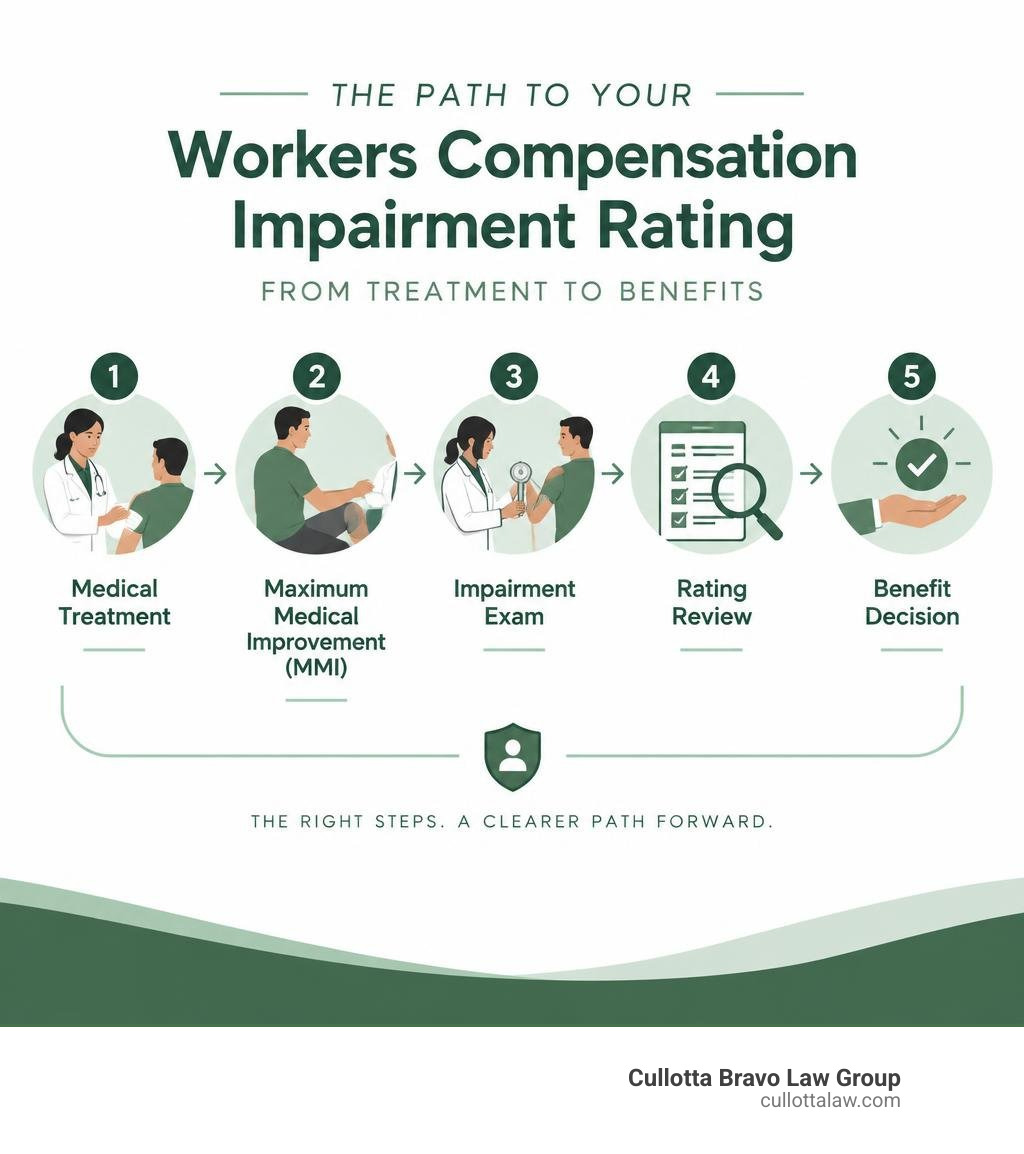
Workers compensation impairment rating basics:
- good workers compensation lawyer
- how to file workers compensation
- occupational disease workers compensation
What Is a Workers Compensation Impairment Rating and How Does It Work?
When you suffer a serious injury on the job, your primary goal is healing. But what happens when you reach the end of your medical treatment and your body still does not function the way it used to? That remaining, permanent deficit is measured through a formal medical assessment known as an impairment rating.
An impairment rating is an objective, physician-assigned percentage that reflects anatomical loss, structural alteration, or permanent functional limitation in your body. It quantifies how much of your normal bodily capacity has been permanently lost due to your work injury. In workers’ compensation systems, this rating serves as a critical baseline to establish your permanent partial disability (PPD) benefits.
Whether your injury involves an amputated finger, a fused lumbar spine, or a torn rotator cuff, doctors rely on standardized clinical tools and statutory guidelines to calculate this number. Before receiving a rating, establishing your base coverage is essential; reviewing the workers’ compensation eligibility criteria ensures that your injury falls squarely within statutory protections.
Impairment vs. Disability: Understanding Key Legal and Medical Differences
One of the most frequent points of confusion for injured workers is the difference between impairment and disability. While people often use these terms interchangeably around the dinner table, the law draws a sharp boundary between them:
- Impairment (Medical Determination): Impairment refers strictly to the loss, loss of use, or derangement of an anatomical body part, organ system, or physiological function. It is a purely medical assessment made by a licensed physician using clinical measurements, diagnostic imaging, and standardized evaluation manuals.
- Disability (Legal/Vocational Determination): Disability represents the administrative or legal determination of how that physical impairment affects your ability to work, perform daily life tasks, and earn a living wage.
To illustrate, consider a concert pianist and an office software engineer who each suffer an identical crush injury leading to the amputation of their left index finger. Medically, both workers possess the exact same physical impairment percentage. However, their vocational disability is drastically different. The pianist may face a total destruction of their wage-earning capacity, while the software engineer may return to their job with minimal accommodation. Your impairment rating is the medical cornerstone, but your ultimate disability settlement takes your entire vocational picture into account.
The Role of Maximum Medical Improvement (MMI) in Rating Calculations
A doctor cannot accurately assign a permanent impairment rating while your injury is still actively healing. You must first reach Maximum Medical Improvement (MMI).
MMI is defined as the clinical plateau where a worker’s medical condition has stabilized, and no further significant functional recovery or curative improvement can reasonably be expected, even with continued medical interventions. While you may still require palliative treatment—such as physical therapy for pain maintenance or prescription medication—curative treatment has concluded.
Research reveals that the average time to reach MMI for claims identified as permanent partial disability is 363 days (roughly one full year). Once your physician declares you at MMI, they perform a comprehensive permanency evaluation. Understanding how these timelines impact your cash flow and temporary disability checks is vital, as detailed in our guide demystifying Illinois workers’ compensation benefits.
Key Factors Influencing Your Workers’ Comp Impairment Percentage
Your final impairment percentage does not materialize out of thin air. It is calculated by synthesizing diagnostic tests, functional range-of-motion assessments, surgical records, and demographic factors.

Permanent partial disability claims represent roughly 50% of all workers’ compensation system costs nationwide. A mere 1% change in an average impairment rating can shift the value of a claim by approximately $2,500.
| Claim Factor | Clinical Variable | Impact on Impairment Rating |
|---|---|---|
| Surgical History | Non-Surgical Claim | 5.0% Average Rating |
| Single Surgical Procedure | 6.6% Average Rating | |
| Two Surgical Procedures | 8.2% Average Rating | |
| Three or More Surgeries | 11.3% Average Rating | |
| Time to MMI | Under 90 Days | 4.4% Average Rating |
| 90 to 363 Days | ~6.5% Average Rating | |
| Over 2 Years (730+ Days) | 9.1% Average Rating | |
| Medical Condition | Hand/Wrist Synovitis | ~3.0% Average Rating |
| Meniscus Tear / Knee Scope | ~5.0% – 7.0% Average Rating | |
| Lumbar Spine Degeneration / Fusion | ~10.0% – 15.0%+ Average Rating |
Medical Factors: Surgeries, Time to MMI, and Condition Severity
As the data illustrates, medical complexity directly drives the rating upward:
- Surgical Interventions: Claims involving surgery average impairment ratings that are over 2 percentage points higher than non-surgical claims (7.2% vs. 5.0%). Multiple surgeries compound this effect, reflecting extensive tissue trauma, scarring, and structural alteration.
- Duration of Healing: Extended healing timelines correlate with deeper functional loss. A worker who reaches MMI in under 3 months averages a 4.4% rating, whereas complicated cases extending beyond 2 years jump to an average of 9.1%.
- Specific Pathology: The nature of the anatomical structure dictates baseline severity. Superficial soft tissue inflammation (such as mild synovitis) yields low single-digit ratings, while spinal nerve root impingement and disc herniations routinely command significant double-digit whole-person ratings.
Federal guidelines outlined in the U.S. Department of Labor Procedure Manual on Impairment govern how these medical complexities are evaluated under federal programs.
State Variations and AMA Guides Editions in Impairment Evaluation
The medical guidebook your jurisdiction mandates plays a massive role in your final rating. Most jurisdictions rely on the American Medical Association’s (AMA) Guides to the Evaluation of Permanent Impairment, but editions vary:
- AMA Guides 5th Edition: Emphasizes anatomical changes, objective diagnostic testing, and functional range-of-motion deficits.
- AMA Guides 6th Edition: Introduces Diagnosis-Based Impairment (DBI) models, which place heavy weight on functional history and physical exam modifiers. This edition often results in lower numerical percentages for identical musculoskeletal injuries compared to earlier editions.
Furthermore, states modify how these guides are interpreted. Some statutory frameworks, such as California Labor Code Section 4660.1, have historically applied numeric multipliers or statutory modifiers based on age and occupation, while placing strict statutory limits on adding separate sleep, sexual, or psychiatric impairment ratings. When adjusting for claim-level differences using regression models, state-adjusted marginal impairment ratings range from 3.8% to 11.0%.
Step-by-Step Method for Calculating Impairment by Body Part and Region
Calculating an impairment rating requires a structured, multi-step process. Evaluating physicians use specialized instruments like goniometers (which measure the precise angular range of motion of joints) and apply standardized conversion formulas.
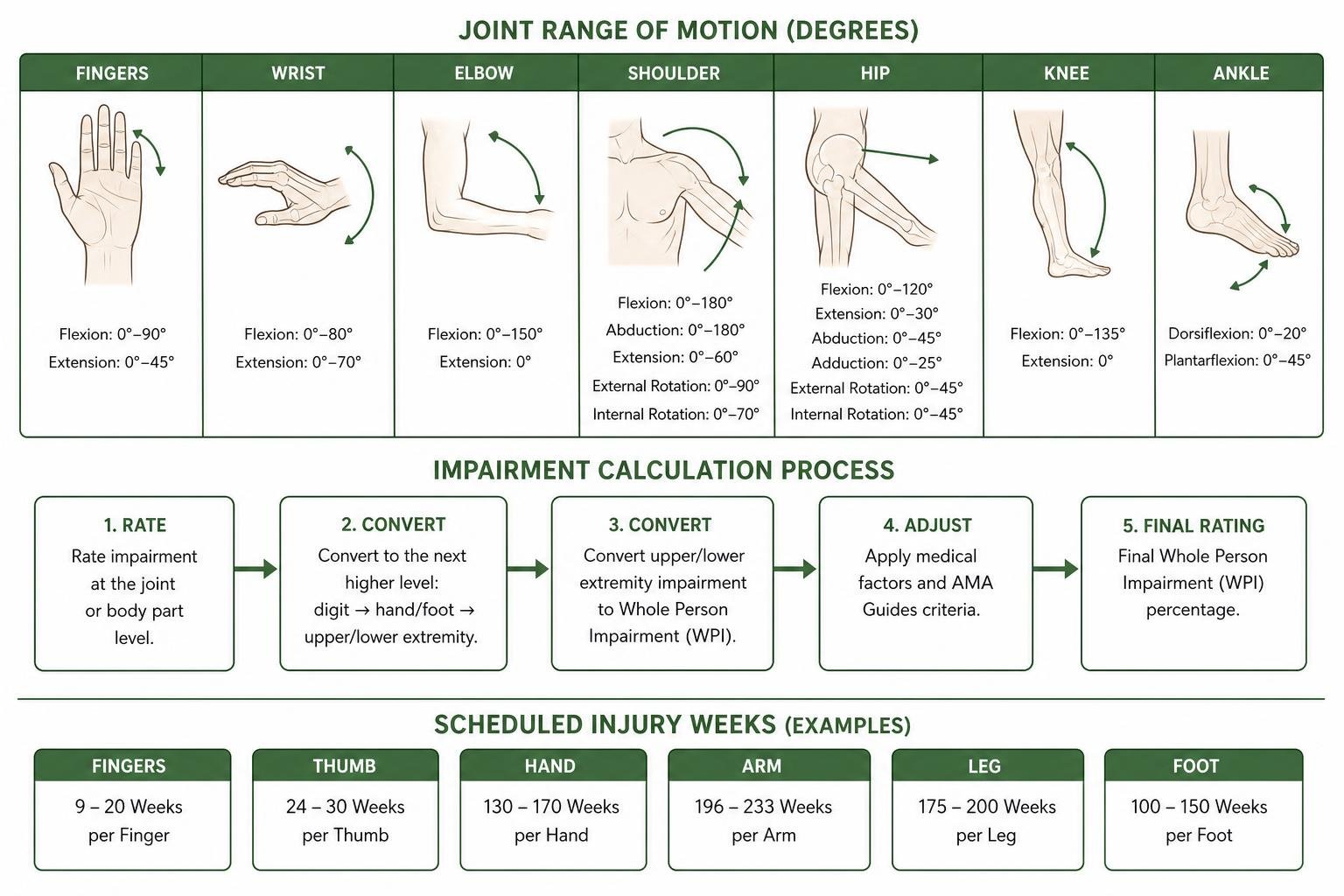
Upper and Lower Extremity Calculations: Range of Motion, Loading, and Conversion
Extremity evaluations follow an upward conversion hierarchy: individual joints or digits are rated, converted to a hand or foot value, then to an upper or lower extremity value, and finally to a Whole Person Impairment (WPI) percentage.
Upper Extremity: Fingers, Hand, Wrist, Elbow, and Shoulder
- Normal Range of Motion Baseline: Normal thumb motion includes 80 degrees at the interphalangeal (IP) joint, 60 degrees at the metacarpophalangeal (MCP) joint, and 90 degrees of radial abduction. Fingers require 90 degrees at the distal interphalangeal (DIP) joint, 100 degrees at the proximal interphalangeal (PIP) joint, and 90 degrees at the MCP joint.
- Loading Rules for Multiple Digits: When an injury damages multiple fingers, simple addition is not used. Doctors calculate the schedule loss of each digit, apply statutory “loading” percentages to account for compound grip weakness, and convert the combined loss into a total hand schedule rating.
- Ankylosis Limits: The total impairment calculated from individual motion losses cannot exceed the statutory percentage assigned for complete joint fusion (ankylosis) in that same position.
Lower Extremity: Hips, Knees, Ankles, and Toes
- Structural and Joint Changes: A total hip arthroplasty (replacement) carries a baseline functional loss (frequently 40% to 50% of the leg), while knee range-of-motion deficits are graded in brackets (e.g., knee flexion limited to 0–60 degrees equals roughly 30% extremity impairment).
- Leg Shortening: True anatomical leg-length discrepancies caused by healed fractures are graded incrementally: a 0.5-inch deficit yields 4%, a 1-inch deficit equals 8%, and a 2-inch deficit reaches 24% extremity impairment.
Step-by-Step Medical Methods for Determining a Workers Compensation Impairment Rating
When an injured worker presents with axial spine trauma or systemic occupational illnesses, physicians follow a distinct diagnostic protocol:
- Spinal Disc Lesions and Decompression: Evaluators classify cervical, thoracic, and lumbar spine injuries based on structural stability, disc herniation, and nerve root involvement (radiculopathy). Any spinal fusion or surgical discectomy establishes an automatic baseline percentage.
- Pelvis, Sacrum, and Coccyx: Pelvic fractures are rated as percentage impairments of the spine unless the hip socket (acetabulum) is compromised, which shifts the rating into lower extremity formulas.
- Combination Formula: When an employee suffers multiple distinct injuries in the same accident, doctors cannot simply add the percentages together (e.g., 20% + 20% does not equal 40%). Instead, they utilize the Combined Values Chart:
The physician takes the largest impairment value first, subtracts it from 100%, and applies the secondary impairment percentage only to the remaining whole-person capacity. For example, a 20% impairment combined with another 20% impairment would equal 36%, not 40%.
- Psychiatric and Occupational Disease Ratings: For complex psychological claims, specialized frameworks like the Psychiatric Impairment Rating Scale evaluate functional impairment across daily living, social interaction, and vocational domains (ranging from Class 1 at 0–3% up to Class 5 at >60%). Similar objective criteria apply when navigating occupational disease claims.
Federal and State Claims: EEOICPA Part E, PPD Schedules, and Payout Rules
Your impairment rating translates into actual financial compensation depending on whether your claim falls under a federal statute or state workers’ compensation law.
| Program / System | Benefit Calculation Basis | Monetary Rate / Formula | Statutory Caps / Rules |
|---|---|---|---|
| Federal EEOICPA (Part E) | Whole Person Impairment (WPI) % | $2,500 per 1.0% of impairment | $250,000 maximum cap (excludes medical care); 2-year waiting rule |
| State PPD / IIBs (e.g., Illinois/Texas) | Scheduled vs. Unscheduled Body Part | Percentage of Average Weekly Wage (AWW) (e.g., 70% of AWW for set weeks) | Capped by state maximum weekly rates; 5% discount if paid lump-sum |
EEOICPA Part E Impairment Benefits and the Two-Year Rule Exceptions
Under Part E of the Energy Employees Occupational Illness Compensation Program Act (EEOICPA), covered employees who contract toxic illnesses receive impairment awards calculated at $2,500 per percentage point of whole-person impairment. For example, a 15% whole-person rating results in a $37,500 cash payout ($2,500 × 15). The absolute statutory maximum payable for combined impairment and wage-loss under Part E is $250,000.
Claimants can seek an increased impairment rating if their condition worsens, but federal rules impose a standard two-year waiting period between evaluations. However, there are four critical exceptions where you can bypass the two-year rule immediately:
- You are diagnosed with a brand-new accepted covered illness.
- Your accepted condition has progressed to a terminal status.
- The condition has caused a substantial, catastrophic detrimental effect on your daily living circumstances.
- Your initial evaluation resulted in a 0% rating and you now exhibit measurable physical loss.
State PPD Schedules, Wage Multipliers, and Impairment Income Benefits (IIBs)
In state workers’ compensation systems, permanent partial disability is frequently administered as Impairment Income Benefits (IIBs) or Scheduled Loss of Use awards:
- Weekly Benefit Multipliers: In many statutory systems, every 1% of permanent impairment entitles the worker to 3 weeks of Impairment Income Benefits, paid at roughly 70% of your pre-injury Average Weekly Wage (AWW). If you receive a 10% rating, you receive 30 consecutive weeks of payments starting the day after you reach MMI.
- Scheduled Body Parts: States assign a set number of weeks to specific anatomical regions (e.g., thumb = 75 weeks, arm = 240 weeks, back/person as a whole = 300 to 500 weeks). A 20% loss of use of an arm entitles you to 20% of 240 weeks (48 weeks of pay).
- Lump Sum Settlements: If you and the insurance company agree to settle your permanency rating in a single upfront lump-sum payment, state laws often apply a statutory discount (such as a 5% reduction) to account for the present value of money. Before accepting an insurer’s settlement offer, consulting an experienced workers’ comp settlement attorney ensures that your future medical rights and weekly rates are properly calculated.
Common Pitfalls and How to Protect Your Claim
The impairment rating process is fraught with administrative landmines. Insurance carriers frequently send injured workers to Independent Medical Examiners (IMEs) who downplay range-of-motion restrictions or attribute permanent deficits to pre-existing conditions.

When an insurer attempts to undercut your rating or cut off your medical benefits prematurely, review our comprehensive manual on handling claim denials under updated 2026 workers’ comp rules to protect your rights.
How to Challenge or Increase an Inaccurate Workers Compensation Impairment Rating
If an evaluating physician issues a lowball impairment rating, you do not have to accept it. You can aggressively contest the findings by taking the following legal actions:
- Obtain an Independent Second Opinion: Your treating physician or an independent, board-certified medical specialist can perform a comprehensive counter-evaluation adhering strictly to the required edition of the AMA Guides.
- Audit Goniometer and Objective Measurements: Many rushed IME doctors “eyeball” joint motion rather than taking the mandatory three distinct goniometric measurements required by medical standards. Exposing procedural shortcuts invalidates their low rating.
- File a Pre-Recommended Decision Challenge: In federal and administrative proceedings, you can submit formal written objections demonstrating that the rating physician omitted accepted body parts, misapplied surgical tables, or failed to evaluate secondary radiculopathy.
Navigating Deadlines, Form EN-11A, and Contract Medical Consultants (CMCs)
Procedural missteps can derail an otherwise valid impairment claim:
- Physician Qualifications: The doctor performing your rating must hold active board certification in their medical specialty and should ideally possess credentialing through the American Board of Independent Medical Examiners (ABIME) or the American Academy of Disability Evaluating Physicians (AADEP).
- Form EN-11A Submission: Under federal claims, claimants submit Form EN-11A to designate whether they want their own qualified physician or a government-appointed Contract Medical Consultant (CMC) to conduct the evaluation. While CMCs provide streamlined reviews (typically within 21 days), their assessments rely strictly on existing medical records.
- Strict Timelines: Missing a response window—such as failing to submit updated Activities of Daily Living (ADL) forms within 60 days—can result in an immediate administrative claim denial. You can avoid costly procedural errors by filing workers’ comp claims without missing statutory deadlines.
Frequently Asked Questions About Impairment Ratings
What is the average whole-body impairment rating for injured workers?
Across multi-state statistical studies, the average whole-body impairment rating is 6.5%. The median is lower, with 50% of all claims receiving an impairment rating of 4% or less, while 95% of all claims receive 20% or less. High ratings above 20% are typically reserved for severe, multi-level spinal surgeries, joint replacements, or catastrophic crush injuries.
When can I request a re-evaluation before the two-year waiting period?
Under federal EEOICPA rules and similar administrative workers’ compensation provisions, you can bypass the standard two-year waiting rule if:
- You receive approval for a newly accepted work-related medical condition.
- Your existing accepted illness becomes terminal.
- Your condition experiences severe deterioration with documented substantial detriment to your basic life functions.
- Your initial baseline rating was officially rated at 0%.
Does having surgery automatically increase my permanent impairment rating?
Yes, in nearly all medical rating schedules, undergoing surgery increases your permanent impairment baseline. Data demonstrates that claims involving surgery average ratings 2 percentage points higher than non-surgical claims (7.2% vs. 5.0%). Under both the AMA Guides and state rating schedules, surgical joint repairs (such as arthroplasty, discectomy, or fusion) carry mandatory minimum baseline ratings to account for permanent structural alteration.
Conclusion
Your workers’ compensation impairment rating is far more than a simple medical footnote—it is the single most powerful mathematical variable determining the financial value of your permanent disability benefits. A single percentage point difference can translate into thousands of dollars in lost support while you adjust to life with a lasting injury.
At Cullotta Bravo Law Group, we have stood beside injured workers across Illinois—including Aurora, Chicago, Naperville, and Joliet—for over 35 years. We combine compassionate, client-centered care with aggressive legal advocacy to ensure that insurance carriers and medical examiners treat you with dignity and respect. If you need help challenging an unfair impairment rating or securing the maximum payout you deserve under the law, contact our team today for dedicated Illinois workers’ compensation legal representation.