

Workers Compensation Law: Your Basic Rights After a Work Injury
Workers compensation law gives many employees a no-fault path to medical care and partial wage replacement after a job-related injury or illness. You usually do not need to prove your employer caused the injury. But you do need to act quickly: report the injury, get appropriate medical care, preserve records, and file the required claim forms before state deadlines expire.
Workers’ compensation can cover:
- Medical treatment related to the work injury
- Payments for lost income while you cannot work
- Permanent disability benefits for lasting limits
- Vocational rehabilitation or job-retraining support in some cases
- Death and burial benefits for eligible surviving family members
Coverage, payment amounts, doctor-choice rules, and filing deadlines vary widely by state and job type. Private-sector employees generally use their state workers’ compensation system, while federal employees and certain specialized workers may fall under a federal program administered by the U.S. Department of Labor.
I am Peter Cullotta, founding partner of Cullotta Bravo Law Group, and I have spent more than 35 years representing injured people in workers compensation law and personal injury matters. The sections below explain who may qualify, what to do after an injury, and how to protect your claim if an insurer disputes it.
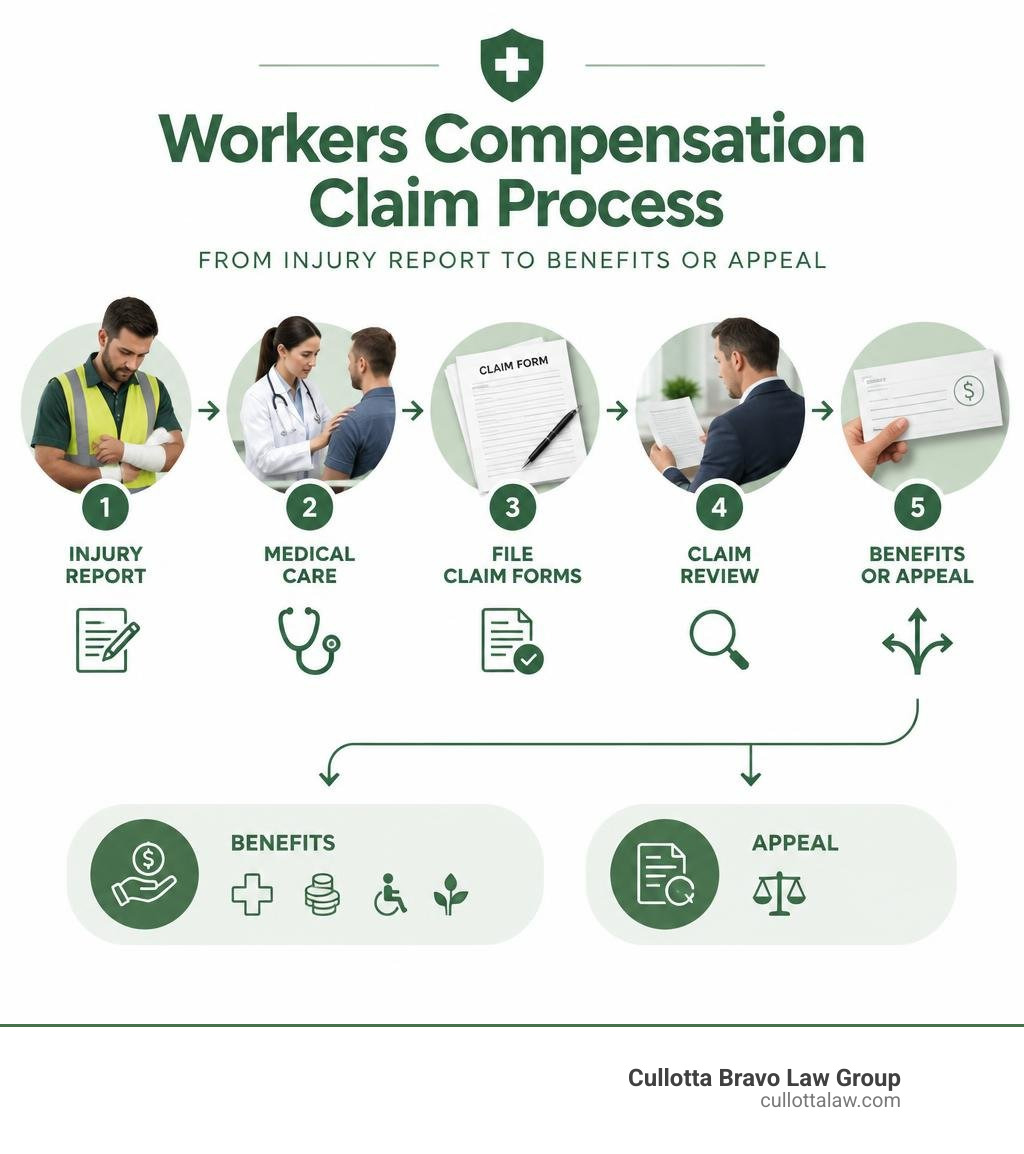
Core Protections Under Workers Compensation Law

When an unexpected injury happens on the job, the financial shock can feel just as overwhelming as the physical trauma. The fundamental promise of workers’ compensation is to create a safety net that protects you from economic ruin while you recover. Under this statutory system, an injured employee trades the right to sue their employer in civil court for swift, guaranteed benefits, regardless of who made a mistake.
Understanding the full scope of available recovery starts with demystifying Illinois workers compensation benefits. In general, comprehensive coverage includes:
- Medical Treatment: Full coverage for all reasonable and necessary medical care related to the work injury, including ambulance transit, emergency surgery, prescription medications, physical therapy, and assistive medical devices.
- Wage Replacement: Income support to offset the financial impact of missed paychecks while a physician restricts you from returning to work.
- Vocational Rehabilitation: Professional retraining, educational courses, and job-placement assistance if your physical limitations prevent you from resuming your previous trade.
- Death Benefits: Direct financial assistance and statutory burial costs provided to surviving spouses, dependent children, or financially dependent family members following a fatal workplace accident.
Temporary and Permanent Disability Calculations
Wage replacement benefits are tied to your earnings before the injury occurred. Most statutory frameworks calculate compensation using your Average Weekly Wage (AWW), typically determined by assessing your gross earnings over the 52 weeks preceding the accident.
Disability classifications generally fall into distinct tiers:
- Temporary Total Disability (TTD): Paid while you are completely unable to work during your active recovery period. In many jurisdictions, this equals roughly 66⅔% (two-thirds) of your pre-tax AWW, subject to statutory minimum and maximum caps.
- Temporary Partial Disability (TPD): Paid when you can return to light-duty or part-time work at a lower wage while still recovering. It covers a percentage of the difference between your pre-injury earnings and your current modified pay.
- Permanent Partial Disability (PPD): Awarded once you reach Maximum Medical Improvement (MMI)—the stage where your condition has stabilized and further recovery is unlikely—yet you retain lasting physical limitations, functional impairment, or visible scarring.
- Permanent Total Disability (PTD): Provided when a severe catastrophe leaves a worker permanently unable to perform any reasonable, gainful employment in the labor market.
| Disability Type | Status Requirement | Standard Wage Calculation | Benefit Duration |
|---|---|---|---|
| Temporary Total (TTD) | Completely unable to work during active healing | 66⅔% of pre-injury Average Weekly Wage | Until released to full duty or reaching MMI |
| Temporary Partial (TPD) | Working light duty with reduced hours/pay | 66⅔% of the difference in earnings | Until full earning capacity is restored or MMI |
| Permanent Partial (PPD) | Lasting anatomical loss after reaching MMI | Statutory schedule rating or wage differential | Specific statutory weeks based on body part loss |
| Permanent Total (PTD) | Permanent, total loss of earning capacity | 66⅔% of pre-injury Average Weekly Wage | Lifetime or statutory duration |
Medical Treatment Rights and Doctor Choice
Accessing qualified medical treatment is critical to your physical recovery and the legal strength of your claim. The rules regarding who chooses your treating physician depend heavily on state jurisdiction.
Some states grant injured workers full freedom to select their personal physician, while others allow employers to maintain established Preferred Provider Networks (PPNs) or managed care organizations. When a designated medical network exists, workers are often required to choose from an approved panel of providers unless emergency intervention is needed or the employer grants a formal release.
Insurance carriers frequently attempt to verify the necessity of ongoing treatment by scheduling an Independent Medical Examination (IME). Despite the neutral name, the IME doctor is chosen and paid by the insurer. If disputes arise regarding recommended surgeries or work restrictions, seeking a secondary opinion from an authorized provider preserves your health and your legal rights.
Who Is Covered: Eligibility Across Federal, State, and Private Sectors
Coverage rules are broad, but they are not universal. Most standard private-sector employees are covered from their first day on the job, regardless of whether they work full-time, part-time, or on a seasonal basis. Even undocumented workers are legally entitled to medical and disability benefits under workers’ compensation statutes in many jurisdictions.
For localized insights on how these rules apply in regional employment hubs, review our Aurora workers compensation complete guide.
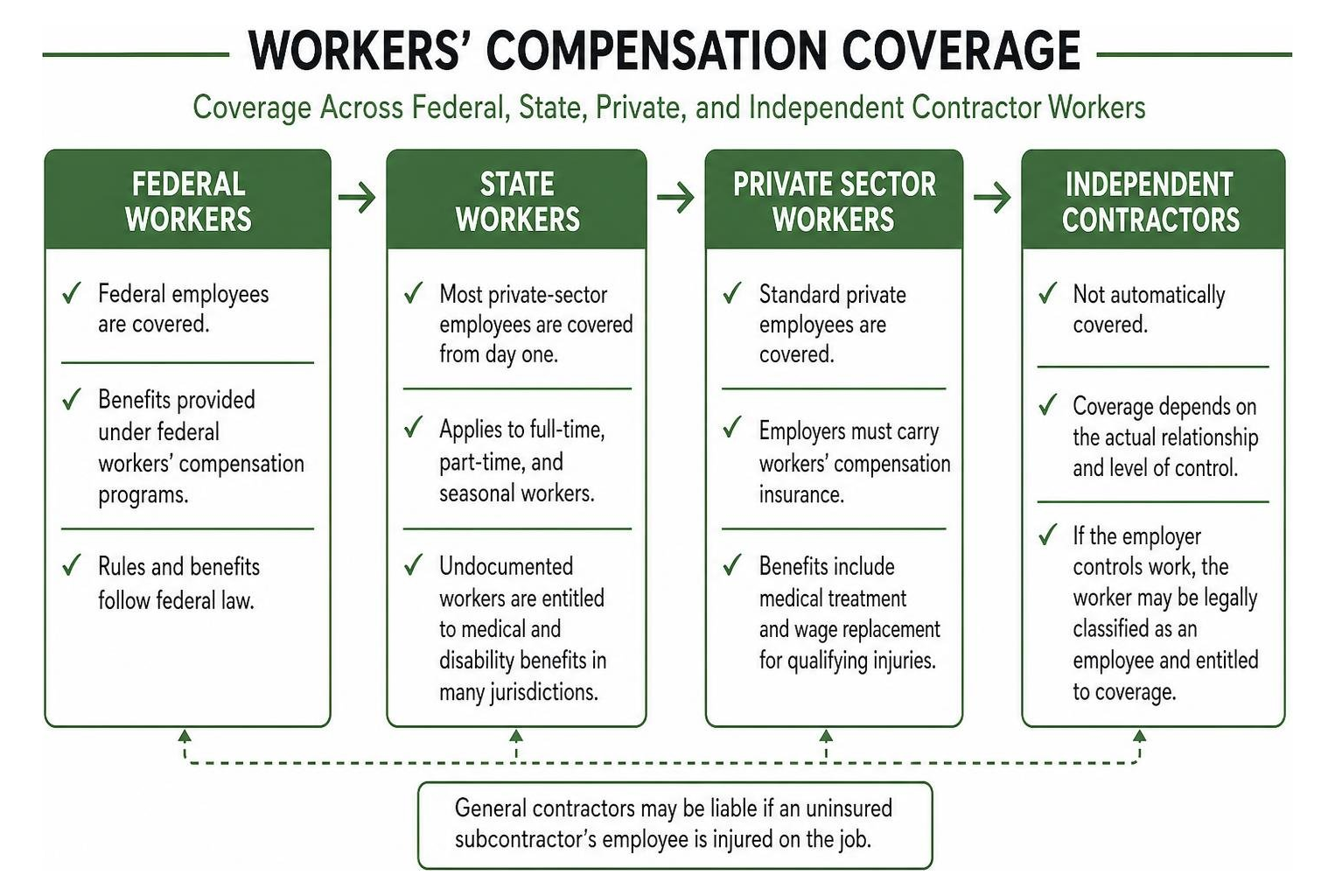
A critical battleground in modern claims involves the misclassification of workers as independent contractors. Companies often label staff as 1099 contractors to avoid paying insurance premiums. However, workers’ compensation commissions evaluate the actual reality of the working relationship—focusing on who controls daily duties, sets schedules, provides tools, and directs operational methods. If an employer exercises substantial control over your labor, you are often legally recognized as a covered employee entitled to full protection.
Additionally, general contractors may be held liable under statutory employer provisions if an uninsured subcontractor’s employee is injured on a job site.
How Federal and State Workers Compensation Law Differs
Not all workers fall under standard state statutes. The federal government maintains dedicated programs overseen by the U.S. Department of Labor’s Office of Workers’ Compensation Programs (OWCP). These specialized federal programs include:
- Federal Employees’ Compensation Program (FECA): Provides wage replacement, medical care, and vocational rehabilitation to civil service employees of the federal government injured in the line of duty.
- Longshore and Harbor Workers’ Compensation Act (LHWCA): Protects maritime employees injured on navigable waters of the United States or adjoining piers, wharves, dry docks, and terminals.
- Federal Black Lung Program: Extends monthly compensation and medical treatment to coal miners totally disabled by pneumoconiosis arising out of coal mine employment.
- Energy Employees Occupational Illness Compensation Program (EEOICPA): Delivers benefits to individuals who developed illnesses from exposure to toxic substances and radiation while working in the nuclear weapons industry.
For all other private and public municipal workers, claims proceed through state-specific bodies established under legislation like the ILLINOIS WORKERS’ COMPENSATION ACT 820 ILCS 305, which governs dispute resolution, carrier obligations, and standard rate tables within state boundaries.
Special Coverage Rules for Hazardous and Complex Occupations
Certain workplace conditions give rise to complex medical claims that require rigorous documentation:
- Catastrophic Head Trauma: Severe impacts on industrial sites or falling objects demand extensive diagnostic work, which we detail in the essential guide to navigating workers comp for brain injuries.
- Repetitive Motion Disorders: Injuries that develop gradually over time due to continuous, job-related physical strain—such as carpal tunnel syndrome, tendonitis, or spinal disc degeneration—qualify for full benefits under the law governing repetitive stress injury claims.
- Occupational Diseases: Toxic exposures, airborne contaminants, and chronic occupational illnesses are covered if medical evidence establishes that the working environment was a primary contributing factor.
- Statutory Presumptions for First Responders: Many states maintain legal presumptions that specific conditions—such as heart disease, respiratory ailments, or specific cancers developed by firefighters and police officers—are directly work-related.
- Disaster Clean-Up Provisions: Unique statutory articles, such as New York’s Article 8-A, were created specifically to ensure medical monitoring and lifetime disability compensation for workers exposed to toxins during World Trade Center rescue and recovery operations.
Employer Obligations and Legal Compliance Requirements
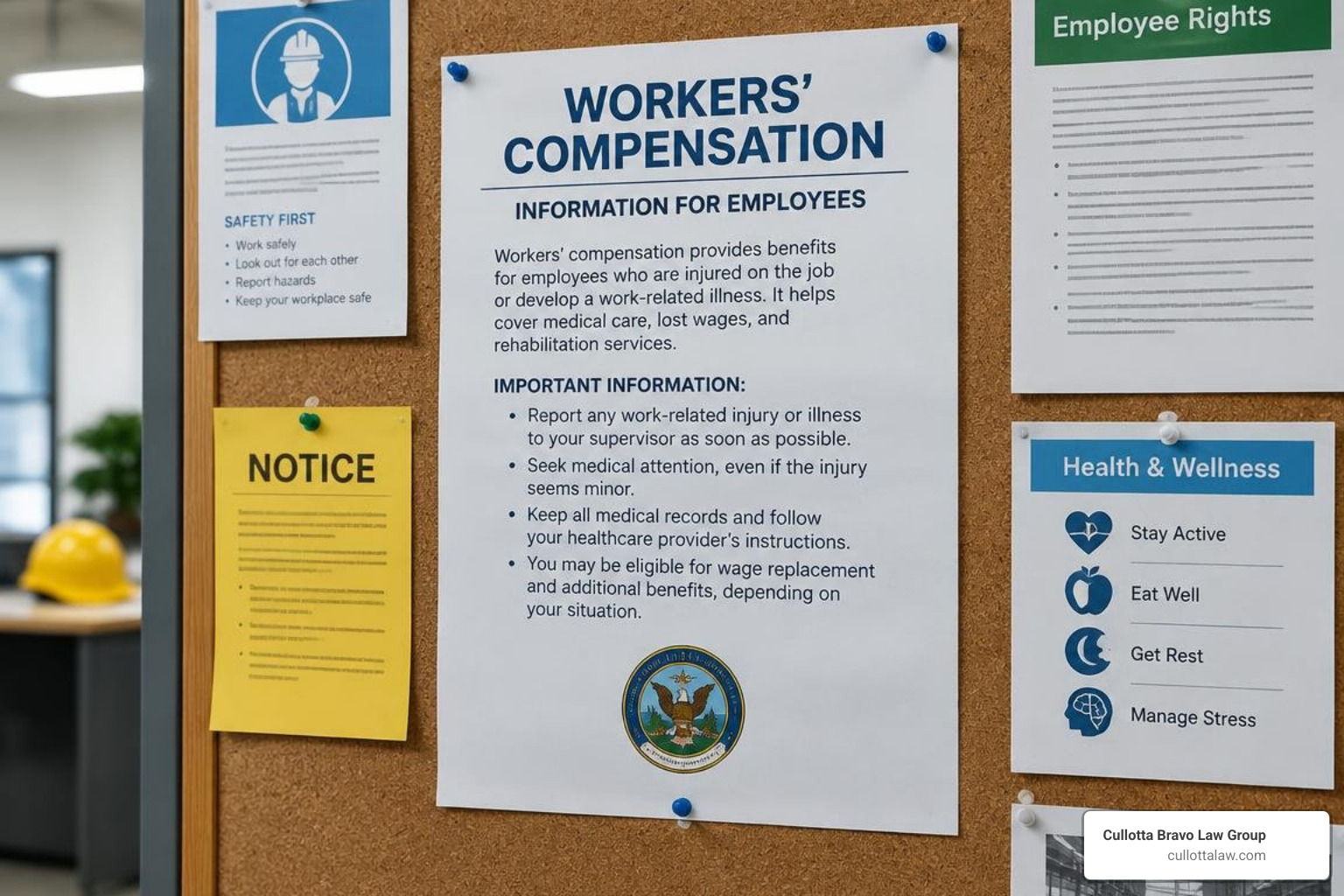
Employers are legally obligated to maintain active workers’ compensation coverage for their workforce, either by securing a policy through a licensed commercial carrier, participating in an approved group pool, or obtaining state authorization to operate as a qualified self-insurer.
State regulatory boards, such as those established under statutory models like the Workers’ Compensation Law in New Jersey, require employers to conspicuously post informational notices in prominent employee breakrooms or job sites. These postings must detail the insurance carrier’s identity, policy numbers, and explicit instructions on how an injured employee files a claim.
Reporting Timelines and Non-Compliance Penalties
When an accident takes place, employers are strictly prohibited from concealing the event or discouraging staff from pursuing benefits. Their affirmative statutory obligations include:
- Maintaining Accurate Injury Logs: Logging all workplace accidents, illnesses, and near-miss incidents in compliance with state occupational safety standards.
- Timely Carrier and State Reporting: Submitting formal employer first reports of injury to their insurance carrier and state administrative agency within statutory deadlines.
- Filing Prompt Responses: Upon receiving notification of an injury, carriers must either begin issuing temporary disability payments or deliver a formal written notice detailing why the claim is being contested.
Failing to carry compulsory insurance or failing to report incidents triggers severe enforcement actions. State commissions can issue immediate stop-work orders, levy daily statutory fines running into tens of thousands of dollars, and hold business owners individually liable for all medical bills and disability awards. Where an employer unlawfully operates without insurance, injured workers can frequently seek recovery through dedicated state Uninsured Employer Funds.
Steps to File a Claim and Protect Your Rights
Protecting your legal entitlement to benefits requires methodical action immediately following an accident. Familiarizing yourself with key legal terminology through workers comp lawyer terms demystified helps you navigate the claims process with confidence.
Follow these essential steps to preserve your claim:
- Seek Immediate Medical Care: Prioritize your physical health by visiting an emergency facility or authorized doctor. Explicitly tell the medical staff that your injury occurred while performing your job duties so it appears in your initial treatment charts.
- Provide Formal Written Notice: Notify your direct supervisor or safety department in writing as soon as humanly possible, detailing the date, time, location, and precise mechanism of injury.
- Document the Scene and Retain Records: Photograph any defective equipment, physical hazards, or environmental factors that contributed to the incident. Keep copies of every medical note, off-work slip, and employer communication.
- File an Official Claim Form: Confirm that a formal application for adjustment of claim is submitted to your state workers’ compensation agency before the statutory filing deadline closes.
Navigating Appeals Under Workers Compensation Law
If an insurance carrier refuses to pay medical bills or terminates your temporary disability checks, you are not out of options. Carriers frequently deny legitimate claims using pretextual arguments—such as alleging that the injury was pre-existing, that you failed to report it in time, or that the accident did not occur within the course of employment.
To understand why insurers dispute valid cases and how to fight back, consult our denied workers comp guide 2026.
The appeal process typically advances through structured administrative phases:
At every stage of an appeal or negotiation, partnering with an aggressive workers comp settlement attorney ensures your wage losses are calculated accurately and medical evidence is presented effectively.
State-Specific Variations in Reporting Deadlines
Workers’ compensation laws are strictly enforced by state statutes of limitations. Missing a notice or formal filing window can permanently destroy your right to recover benefits, even for catastrophic workplace injuries.
Legislative statutory frameworks, such as the Texas Workers’ Compensation Act (89th Legislature, 2025), reflect how states codify exact timelines, dispute resolutions, and benefit calculations for injured workers.
Key procedural deadlines include:
- Injury Notice Windows: The timeframe to alert your employer ranges from as few as 10 to 30 days in many jurisdictions, up to 45 days in Illinois. Failing to provide timely notice can jeopardize your claim.
- Formal Agency Filing Limits: The statute of limitations for filing a formal claim petition with the state commission is commonly between 1 and 3 years from the injury date, or within a set period after the last compensation payment was made.
- Occupational Illness Windows: For diseases or repetitive wear, the clock generally starts running on the date you knew, or reasonably should have known, that your medical condition was caused by your job.
Frequently Asked Questions About Workers’ Compensation
Can I choose my own doctor after an on-the-job injury?
Your ability to choose your own physician depends entirely on the laws of the state where your claim is filed. Some jurisdictions allow employees to seek care from any licensed physician they choose. Other states permit employers to establish Preferred Provider Programs (PPPs) or managed care organizations, restricting non-emergency care to an approved list of providers unless you submit a formal request to change doctors. Emergency room visits and urgent trauma treatment are universally exempt from network restrictions.
What should I do if my workers’ compensation claim is denied?
If your claim is denied, do not panic. Review the formal written denial notice carefully to identify the specific grounds cited by the insurance carrier. Request a complete copy of your personnel file, incident reports, and relevant medical records. You must then file a formal petition or application for hearing with your state workers’ compensation commission before the appellate deadline expires. Because administrative hearings involve complex rules of evidence, medical testimony, and statutory interpretation, securing seasoned legal representation is critical to reversing an improper denial.
Are repetitive trauma and occupational diseases covered?
Yes. Workers’ compensation coverage extends beyond sudden, violent accidents to encompass conditions that develop gradually over time. Repetitive motion injuries (such as carpal tunnel syndrome, rotator cuff tears, or chronic spinal disc herniations) and occupational illnesses (such as chemical exposure, lung disease, or toxic poisoning) are compensable if medical evidence shows that your workplace duties were a major contributing cause. The legal “date of injury” for these claims is typically determined as the date the condition manifested, the date it required medical care, or the date it forced you to stop working.
Conclusion
Navigating the aftermath of a severe workplace accident requires a clear understanding of your statutory rights, benefit entitlements, and strict filing deadlines. Workers’ compensation laws were designed to protect your livelihood, but insurance carriers frequently exploit complex administrative rules to minimize payouts or deny legitimate claims outright.
At Cullotta Bravo Law Group, we have spent over 35 years aggressively defending injured workers across Aurora, Chicago, Naperville, Joliet, and throughout Illinois. We believe in treating every client with the utmost dignity while tenaciously fighting for the full medical coverage, wage replacement, and multi-million dollar recoveries they deserve. If you or a family member was hurt on the job, protect your rights with Cullotta Bravo Law Group today for experienced legal guidance.