

Real Estate Contract Drafting Starts With Clear Terms
Real estate contract drafting starts with a written agreement that names the parties, identifies the property, and states the price, deposit, and closing date. Set clear deadlines for inspections, financing, appraisal, and title review. Spell out when a party can cancel, what happens to the deposit, and what each party must do before closing. For an Illinois property, check applicable disclosure rules and have a qualified real estate attorney review the agreement before signing.
I’m Peter Cullotta, a trial lawyer with over 35 years of experience representing injured people. In this guide to Real estate contract drafting, I bring a litigator’s focus to clear terms and the disputes vague language can cause.

Know your Real estate contract drafting terms:
Essential Elements in Real Estate Contract Drafting
Drafting a bulletproof agreement requires strict adherence to contract law fundamentals. Under the Statute of Frauds, every contract for the sale of real property must be in writing and signed by the parties to be legally enforceable. Oral promises or handshake agreements regarding land transactions cannot stand up in court.
To establish an ironclad foundation, several core components must be explicitly drafted:
- Mutual Assent (Offer and Acceptance): There must be an unambiguous meeting of the minds regarding all essential terms.
- Identification of the Parties: Full legal names of all buyers and sellers must be stated, including marital status or entity designations (e.g., LLC, corporation).
- Legal Property Description: A street address alone is frequently insufficient. A complete legal description—including lot numbers, subdivision names, and Permanent Index Numbers (PIN)—prevents boundary misunderstandings.
- Purchase Price and Consideration: The exact financial consideration must be stated clearly, outlining initial deposits, loan balances, and cash due at closing.
- Earnest Money Escrow: The agreement must state who holds the earnest money deposit (such as an escrowee or brokerage), how it is held in trust, and the precise conditions under which it is credited or refunded.
When investors begin crafting your property sale agreement, applying proven principles from resources such as Transactional Drafting: Introduction to Contract Drafting and Transactional Practice – Open Textbook Library ensures that operational rights, covenants, and closing obligations are stated with precision.
Core Contingencies: Financing, Inspection, and Appraisal
Contingencies act as essential safety valves. Without carefully defined escape clauses, an investor risks losing substantial earnest money or facing a lawsuit for specific performance.
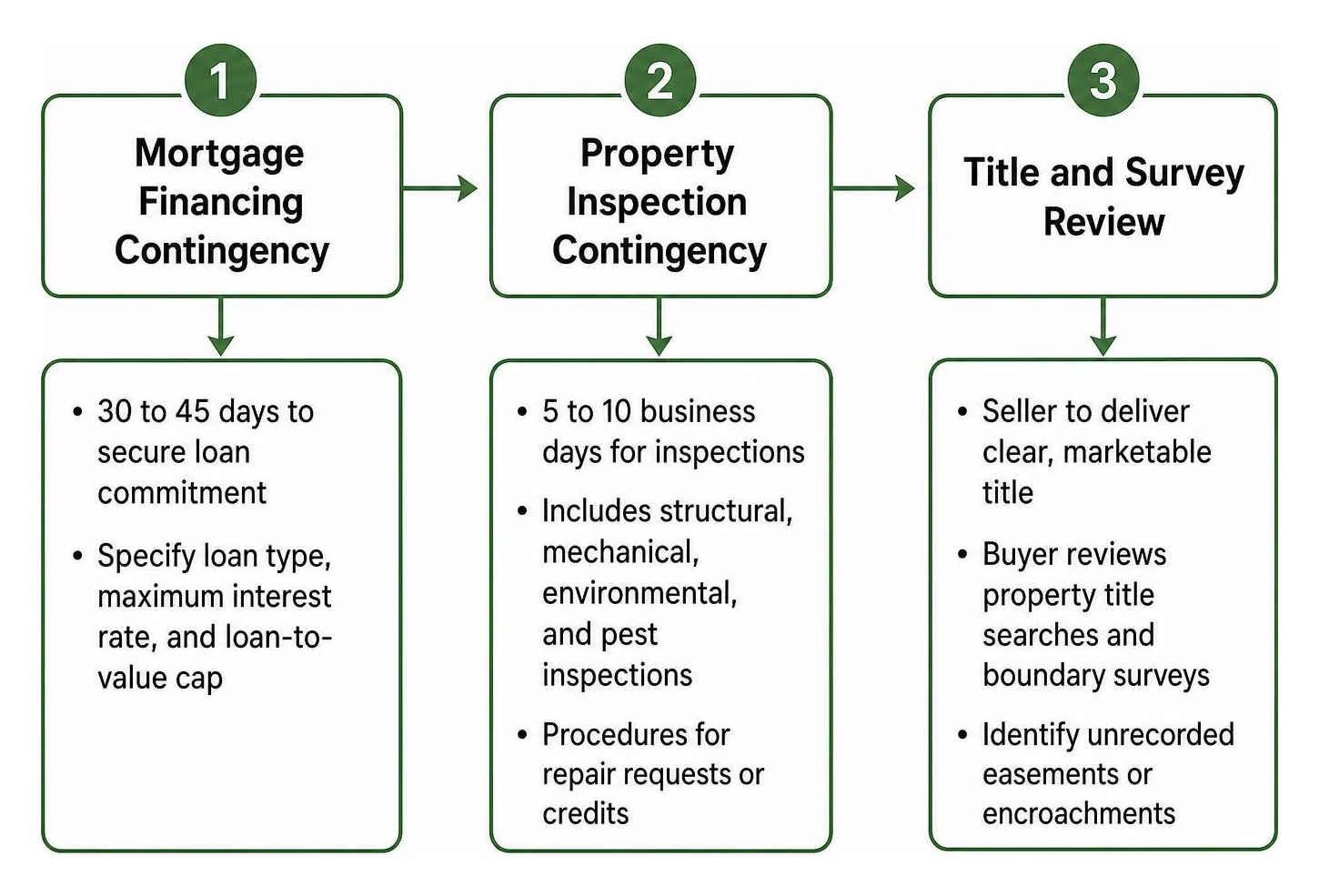
- Mortgage Financing Contingency: Sets a realistic timeframe (typically 30 to 45 days) for securing a formal loan commitment, detailing loan types, maximum interest rates, and loan-to-value caps.
- Property Inspection Contingency: Grants the buyer a defined period (typically 5 to 10 business days) to perform structural, mechanical, environmental, and pest inspections, along with clear procedures for requesting repairs or credits.
- Appraisal Contingency: Protects the buyer if the property appraises below the agreed purchase price, establishing rights to renegotiate or terminate.
- Title and Survey Review: Requires the seller to deliver clear, marketable title and allows buyers adequate time to review property title searches and boundary surveys to identify any unrecorded easements or encroachments.
State Disclosures and Local Statutory Compliance
Real estate contracts do not exist in a vacuum; they must comply with state and municipal mandates. In Illinois, standard regional contracts such as the MULTI-BOARD RESIDENTIAL REAL ESTATE CONTRACT 6.0 incorporate required statutory protections.
Drafters must integrate mandatory disclosures, including the Illinois Residential Real Property Disclosure Report, the Illinois Radon Awareness Act disclosures, and the federal Lead-Based Paint Hazard Reduction Act disclosure for properties constructed prior to 1978. In northern Illinois communities—such as Aurora, Chicago, Naperville, and Joliet—contracts must also account for local municipal transfer taxes, certificate of occupancy requirements, and point-of-sale inspection ordinances.
How to Structure Different Types of Real Estate Agreements
Different transaction structures require tailored drafting approaches to allocate risk appropriately between the parties.

- Residential Purchase Agreements: Focus heavily on consumer disclosures, standard mortgage financing terms, residential fixtures, and home inspection rights.
- Commercial Real Estate Contracts: Involve complex due diligence periods, environmental reviews (Phase I/II assessments), tenant estoppel certificates, rent roll verifications, and zoning compliance provisions. When handling commercial transactions, working with an experienced commercial real estate attorney helps ensure that standard templates such as the Commercial Contract_CC-5xx framework are adapted to local Northern Illinois property laws.
- Contract for Deed (Installment Sales): Allows the seller to retain legal title while the buyer gains equitable title and possession, requiring strict default cure provisions, property tax allocation clauses, and insurance requirements.
- Assignment Contracts: Commonly used by wholesalers, these agreements assign purchase rights to an end buyer. They require clear assignability clauses, escrow terms, and explicit disclosures that the assignor holds equitable interest rather than legal title.
| Agreement Type | Primary Purpose | Key Risk Considerations | Critical Drafting Provisions |
|---|---|---|---|
| Residential Purchase | Sale of 1-4 family dwellings | Financing default, undisclosed physical defects | Statutory disclosures, inspection timelines, mortgage contingencies |
| Commercial Purchase | Commercial, retail, or industrial property | Environmental liabilities, zoning restrictions, lease defaults | Due diligence windows, tenant estoppels, representations and warranties |
| Assignment Contract | Transferring equitable purchase rights | Non-performance by end buyer, unapproved assignment clauses | Assignment fees, non-refundable deposits, earnest money transfer terms |
Permissible Form Filling vs. Unauthorized Practice of Law
In real estate transactions, licensed real estate brokers frequently assist with paperwork, but their drafting authority is legally limited. Real estate brokers are permitted only to fill in the blanks on standard, attorney-approved, pre-printed form contracts.
When an individual modifies contractual language, strikes out core legal clauses, or writes custom legal terms that redefine the legal rights and obligations of the parties, that conduct crosses the line into the unauthorized practice of law. Custom riders, complex post-closing escrow agreements, and non-standard contingencies should always be drafted by licensed legal counsel to maintain legal validity and prevent costly disputes.
Step-by-Step Strategies to Prevent Drafting Pitfalls and Ambiguities
Litigation frequently arises from poorly drafted contracts. Courts interpret agreements using the “four corners doctrine,” meaning judges look strictly at the written text rather than oral statements made during negotiations.

To draft contracts that withstand judicial scrutiny:
- Use Plain, Direct Language: Avoid unnecessary legalese. Clear language prevents misinterpretation.
- Employ Consistent Modal Verbs: Use “shall” or “must” for mandatory obligations, “may” for discretionary rights, and “shall not” for prohibitions. Inconsistent verb choices create confusion regarding whether a duty is optional or mandatory.
- Specify Exact Delivery Methods: Define what constitutes valid legal notice (e.g., email transmission to designated counsel) and establish when notice is deemed received.
Investors seeking guidance from From Contract To Keys The Buyers Guide To Legal Support benefit from having enforceable milestones established long before the closing date arrives.
Avoiding Ambiguity and Pitfalls in Real Estate Contract Drafting
Ambiguities in legal contracts generally fall into two categories:
- Patent Ambiguity: Unclear or contradictory wording visible directly on the face of the contract (such as listing a purchase price of “$450,000” in numerals but writing “Four Hundred Thousand Dollars” in words).
- Latent Ambiguity: Language that appears clear on its face but creates conflicting interpretations when applied to real-world facts (such as referencing “the garage parcel” when the property includes two separate garage structures).
In addition, drafters must clarify timeline calculations. State whether deadlines are based on calendar days or business days, and specify precise cut-off times (such as 5:00 p.m. local time). When multiple documents are involved, ensure that addenda and riders explicitly state which provision controls in the event of a conflict.
Remedies, Default Clauses, and Breach of Contract Damages
A well-drafted real estate agreement establishes clear remedies if either party defaults.
- Liquidated Damages: Often limited to the forfeiture of the buyer’s earnest money deposit, providing an agreed financial remedy for seller compensation if the buyer walks away without legal justification.
- Specific Performance: An equitable remedy through which a court orders a defaulting seller to complete the conveyance of the unique property to the buyer.
- Compensatory and Consequential Damages: Direct monetary awards designed to cover financial losses caused by a breach of contract.
- Injunctive Relief: Court orders used to maintain the status quo or prevent improper property transfers while a dispute is resolved.
To understand how courts enforce these provisions, explore the complete legal guide to resolving residential and commercial property disputes.
Attorney Review, Negotiation, and Legal Costs Explained
Standard Northern Illinois contracts regularly incorporate an attorney review clause. This clause grants legal counsel for both buyer and seller a designated period (typically five business days from the contract acceptance date) to review, approve, negotiate, or propose modifications to the terms.
During this window, real estate attorneys clarify ambiguous clauses, negotiate necessary repair requests or financial credits, adjust tax proration calculations, and correct title defects. Understanding the exact cadence of timing your closing when to bring in the legal pros prevents unexpected closing delays.
Legal Costs and Value of Professional Real Estate Contract Drafting
Engaging legal counsel to draft or review a property agreement is an investment in risk mitigation. Professional fee data illustrates the typical market costs for transactional real estate legal services:
- The average cost for a lawyer to draft a real estate contract is $800 on a flat fee basis.
- The average cost for an attorney to review a real estate contract is $630 on a flat fee basis.
- Across standard purchase agreements, the overall average flat fee rate is $690.
- Standard hourly rates for real estate attorneys range from $250 to $350 per hour.
National contract platform data shows that independent attorneys handling real estate contract projects maintain high client satisfaction ratings, averaging 4.74 out of 5 stars across hundreds of verified transactions. Securing the best real estate lawyers in Aurora on a budget provides dependable protection against expensive post-closing liabilities.
Frequently Asked Questions About Real Estate Contract Drafting
What is the average cost to have a lawyer draft or review a real estate contract?
On a flat fee basis, having an attorney draft a standard real estate purchase contract averages $800, while a thorough contract review averages $630. If billed hourly, real estate legal rates generally range between $250 and $350 per hour, depending on transaction complexity.
Can a real estate broker write custom legal clauses into a purchase contract?
No. Licensed real estate brokers may only fill in factual information on pre-printed, attorney-approved standardized forms. Drafting novel legal language, striking substantive clauses, or creating custom legal riders constitutes the unauthorized practice of law and can jeopardize the enforceability of the agreement.
What damages can be recovered in a real estate contract breach lawsuit?
Depending on the contract terms and the nature of the breach, remedies can include the retention or return of earnest money deposits as liquidated damages, court-ordered specific performance to compel the sale, actual compensatory damages for financial losses, or complete contract rescission.
Conclusion
A well-crafted contract is the ultimate safeguard for any real estate transaction. By eliminating ambiguous language, setting enforceable contingency deadlines, and ensuring full compliance with state and local disclosure laws, you protect your capital and your property rights.
At Cullotta Bravo Law Group, we leverage over 35 years of trial and transactional experience to protect our clients across Aurora, Chicago, Naperville, Joliet, and throughout Northern Illinois. Whether you are structuring an acquisition, negotiating critical terms, or reviewing purchase agreements, our team provides the dedicated legal support you need. Contact us today to explore our comprehensive real estate legal services and safeguard your real estate investments.