

How to Buy Lots for Sale Without Costly Surprises
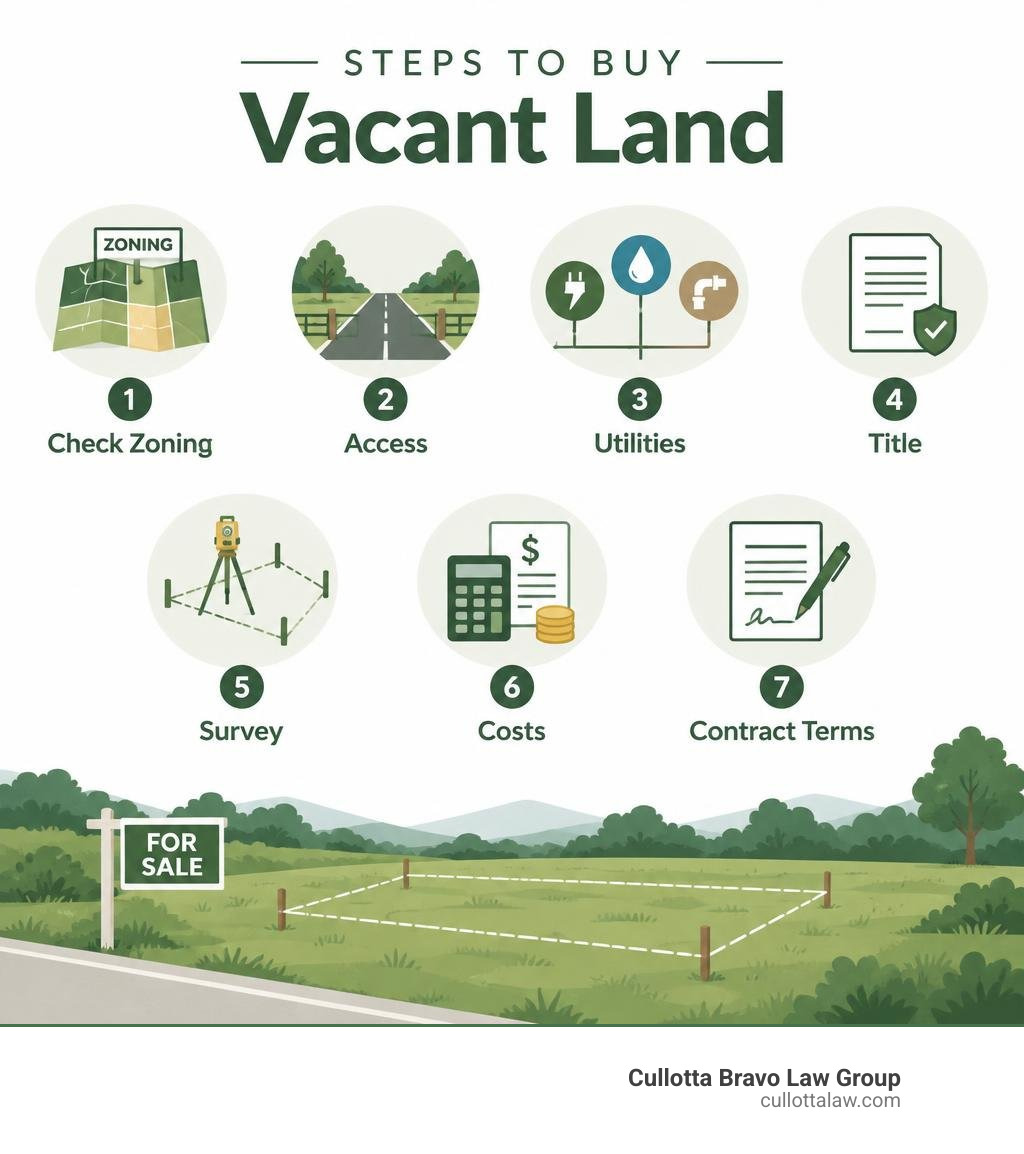
Before you buy a lot, check whether you can use it as planned. Confirm the zoning and legal access, ask which utilities are connected rather than merely available nearby, and review the title and boundary survey. Add taxes, HOA fees, site work, permits, and possible septic or flood costs to your budget. Make your offer contingent on those checks so you have time to investigate before closing.
A low price per acre does not always mean a better deal. A small lot with utility connections may be easier to build on than a larger parcel that needs new infrastructure or zoning approval.
I’m Peter Cullotta, founding partner of Cullotta Bravo Law Group and a trial lawyer with over 35 years of experience handling complex legal disputes. For buyers comparing lots for sale, the practical place to start is with the checks that can change what the land is worth to you.
Relevant articles related to lots for sale:
Evaluating Lots for Sale: Urban Infill vs. Suburban and Rural Acreage
When evaluating raw dirt, top-line list prices rarely tell the complete story. The true financial commitment depends on location density, infrastructure readiness, municipal utility access, and local zoning limitations. Across the national real estate landscape in October 2026, land buyers encounter drastically different equations when weighing compact urban infill sites against sprawling suburban parcels or rural acreage.
To understand why a tiny parcel can command millions per acre while an expansive tract costs a fraction of that figure, consider how price per acre shifts across distinct property profiles:
| Property Location | Lot Size (Acres) | List Price | Price Per Acre | Zoning Designation | Utility & Site Status |
|---|---|---|---|---|---|
| Raleigh, NC | 0.04 | $250,000 | $6,250,000 | Planned Development (PD) | Fully connected taps, driveway apron, flood-cleared |
| Bronx, NY | 0.055 | $275,000 | $5,000,000 | R3A Residential | Active paved surface, interim parking cash flow |
| Charleston, SC | 0.25 | $415,000 | $1,660,000 | R-4 Residential | Wooded parcel, access driveway, municipal utility access |
| Des Moines, WA | 0.37 | $550,000 | $1,486,486 | Single-Family Res. | On-site water/sewer/electric, completed topo survey |
| Port St. Lucie, FL | 0.23 | $140,000 | $608,696 | RS-2 Residential | Road frontage, utilities available at street |
| Lake City, FL | 11.33 | $525,000 | $46,460 | A-1 Agricultural | Unimproved raw land, interstate frontage, unserviced |
Urban Infill Value and Immediate Utility Access
Urban infill lots sit inside established municipal borders where roads, emergency services, and utility mains already exist. These parcels carry massive price tags per square foot because they eliminate months—or even years—of municipal utility negotiations and site work.
For instance, an infill site at 1618 Ellen Dawson Way Lot 52, Raleigh, NC 27603 | MLS# 10166149 | Raleigh Realty is listed at $250,000 for just 0.04 acres (1,742.4 square feet). While that equates to an eye-watering $6,250,000 per acre, the lot comes pre-equipped with active water and sewer taps, underground power, curb and gutter infrastructure, a finished driveway apron, and pre-approved plans for homes up to 2,000 square feet.
Similarly, an urban parcel like the Vacant Land in Bronx for $275,000 MLS #980071 spans only 0.055 acres ($5,000,000 per acre), yet its Throggs Neck location and R3A zoning offer immediate utility connections alongside an existing parking operation that produces $2,000 to $2,500 per month in gross revenue. In tight urban markets, you are paying a premium for turnkey site readiness and density rather than physical square footage.
Suburban Expansions and Rural Acreage Potential
Moving outward into suburban rings and unincorporated rural corridors changes the development equation. Suburban lots often bridge the gap between municipal infrastructure and individual site preparation. A suburban building parcel at $140,000 · 3349 SW Port St Lucie Boulevard, Port St. Lucie, FL 34953 | Karim Cherradi provides 0.23 acres (10,019 square feet) zoned RS-2 for $140,000 (roughly $608,696 per acre). It offers high-traffic street frontage and nearby municipal hookups, making it an accessible mid-tier option for custom residential builders.
At the premium end of the suburban spectrum, custom view lots—such as the 0.37-acre parcel at 27-xxx 10th Ave S, Des Moines, WA 98198 | MLS #2513810 listed at $550,000 ($1,486,486 per acre)—combine Puget Sound views with completed topography surveys and active on-site utilities.
By contrast, large rural tracts offer scale and long-term land-banking potential at a dramatically lower unit price. The 11.33-acre parcel at 1449 SE October Rd, Lake City, FL 32025 | MLS #O6408505 lists for $525,000, which comes out to just $46,460 per acre. While its A-1 agricultural zoning and strategic position 1.8 miles from an Interstate 75 interchange make it an enticing blank canvas for developers, unlocking that value requires substantial capital outlays for rezoning, environmental reviews, civil engineering, and infrastructure installation.
Step 1: Navigating Zoning Classifications and Land Use Restrictions
Before falling in love with a piece of ground, you must determine what the local municipality legally permits you to construct on it. Zoning regulations dictate allowable building uses, maximum square footage, height restrictions, lot coverage percentages, and mandatory setback lines. We always urge buyers to master the fundamentals of how to find and buy vacant land for sale near you by pulling municipal zoning records early in the search process.

Interpreting Zoning Codes for Residential Lots for Sale
Standard residential zoning classifications establish strict physical boundaries for your prospective build. For example, a 0.25-acre parcel at 0 Lindberg St, Unit LOT 10A, Charleston, SC 29412 | MLS #26023835, listed at $415,000, carries an R-4 residential zoning classification.
Under R-4 standards, any custom design must strictly respect established setback minimums:
- Front setback: 20 feet from the property line
- Side setbacks: 5 feet of clearance on each side
- Rear setback: 10 feet of clearance from the back boundary
These setbacks determine your usable “building envelope.” A quarter-acre lot might look spacious at first glance, but once you carve out 20 feet in front, 10 feet in back, and 5 feet on either side, your actual foundation footprint becomes much more defined.
Rezoning, Subdividing, and Planned Developments
If you plan to split a larger parcel into multiple building sites or alter how the land is used, you will encounter the complex municipal subdivision and rezoning process. Properties located within Planned Development (PD) districts, such as the Raleigh parcel on Ellen Dawson Way, operate under tailored master plans that mandate specific architectural guidelines and density caps while bypassing standard Euclidean zoning hurdles.
Conversely, converting agricultural acreage—such as the 11.33-acre A-1 tract in Lake City—into a multi-lot single-family subdivision or mixed-use commercial center requires formal rezoning applications, traffic impact studies, public hearings, and municipal board approvals. Knowing how to subdivide your land without the legal headache protects you from purchasing acreage under assumptions that the local zoning board might ultimately reject.
Step 2: Assessing Infrastructure, Utilities, and Site Feasibility
A buildable lot requires more than legal permission; it requires physical infrastructure. Bringing essential utilities to an unserviced parcel can quickly double your site development budget if you fail to account for connection points, soil conditions, and municipal tap fees.

On-Site Utilities vs. Off-Grid Site Preparation
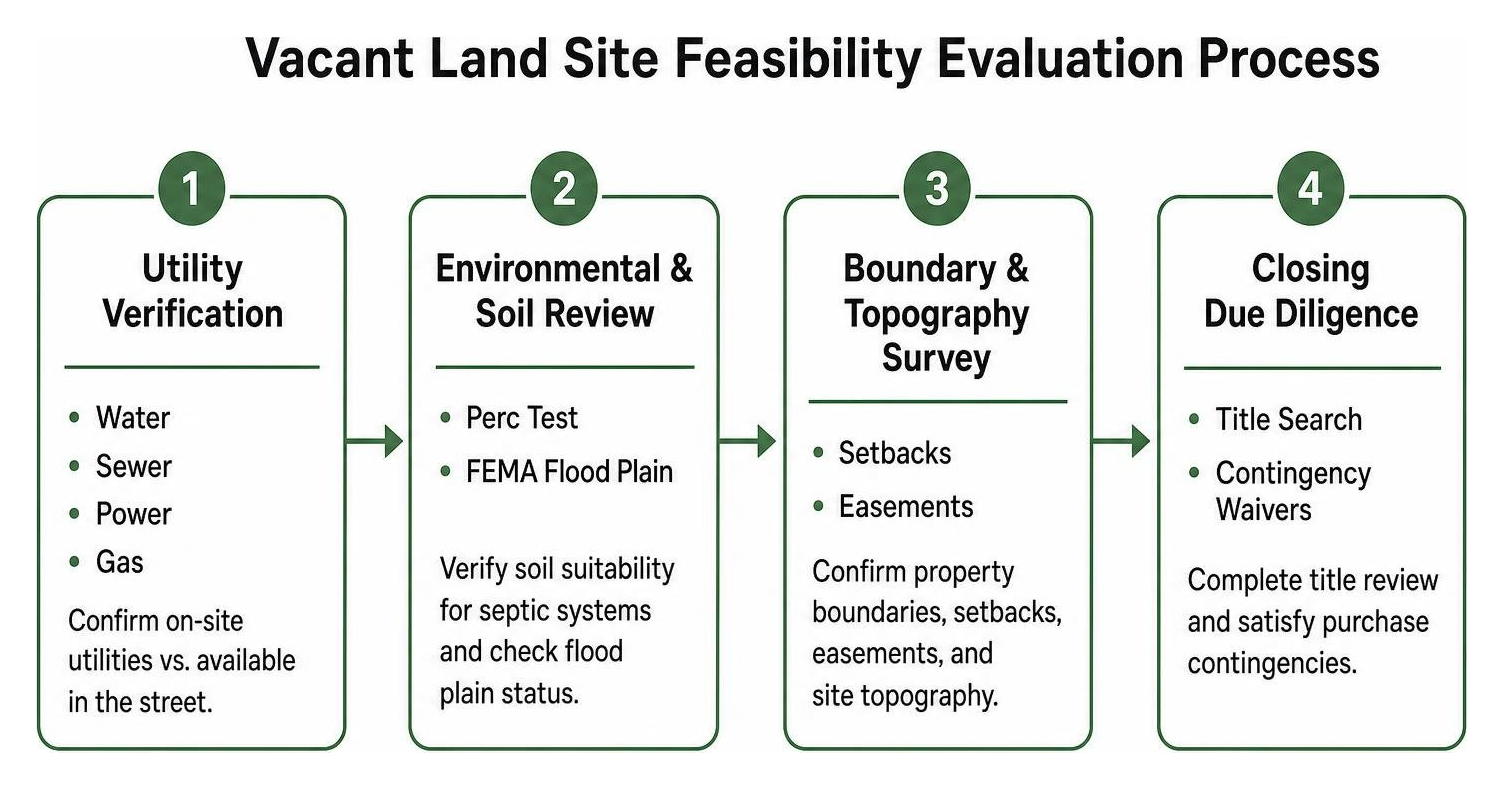
When evaluating listings, distinguish between utilities that are on-site versus those merely available in the street. Connecting to lines running directly through a parcel is straightforward. Extending municipal water, public sewer, natural gas, or three-phase electric lines hundreds of feet down a public roadway requires engineering permits, trenching, road repairs, and substantial impact fees.
When municipal sewer is unavailable, you must install an on-site septic system. This makes a passing soil percolation (“perc”) test a mandatory purchase condition. If the soil has poor drainage characteristics or sits over high bedrock, an engineered mound system can add tens of thousands of dollars to your initial site preparation budget.
Topography Surveys, Flood Zones, and Environmental Due Diligence
Never buy vacant land without a modern boundary and topography survey. In Des Moines, WA, the listed 0.37-acre property includes an already completed boundary and topographic survey, saving the purchaser weeks of administrative lead time and surveyor fees. Using our ultimate checklist for real estate ensures you verify elevation grades, slope stability, and municipal easements before waiving contingencies.
Floodplain classifications also govern your ability to secure financing and building permits:
- FEMA Flood Zone Checks: Ensure the building envelope sits outside high-risk Special Flood Hazard Areas (SFHAs) or obtain a formal FEMA Letter of Map Revision (LOMR), as demonstrated on the Raleigh infill lot.
- Elevation Certificates: Determine the finished floor height required by local building codes to prevent catastrophic flood losses.
- Wetland Delineations: Confirm that protected runoff corridors or federal wetlands do not restrict your buildable acreage.
- Title & Easement Searches: Review recorded utility easements and right-of-way access paths by consulting our guide to property title searches and boundary surveys.
Step 3: Uncovering Hidden Costs and Structuring the Purchase Agreement
Acquiring vacant land carries ongoing carrying costs and closing obligations that differ markedly from standard residential home purchases.
Analyzing Market Trends and Negotiation Strategies for Lots for Sale
Vacant land typically experiences longer marketing cycles than finished homes. Tracking days on market (DOM) and listing price histories reveals seller motivation and local market liquidity:
- Des Moines, WA (0.37 Acres): Active for 69 days at $550,000. It previously traded for $385,000 in September 2023, reflecting a 42.9% gain over three years driven by Puget Sound view premiums and ready-to-build utility infrastructure.
- Port St. Lucie, FL (0.23 Acres): On the market for 131 days, undergoing a 12.5% price cut from $160,000 down to $140,000, signaling softening suburban speculative demand.
- Raleigh, NC (0.04 Acres): On the market for 131 days at $250,000, reflecting careful buyer evaluation of micro-lot infill dimensions.
When crafting your purchase terms, review how to draft your property sale agreement to incorporate price adjustments that reflect mandatory site clearing, tap fees, and necessary infrastructure upgrades.
Managing Escrow, Due Diligence Contingencies, and Closing Timelines
Vacant land contracts must never follow standard 30-day “as-is” closing templates. You need an extended feasibility study contingency—typically 30 to 60 days—granting you the legal right to conduct soil borings, environmental reviews, utility capacity studies, and zoning confirmations.
Protecting your earnest money deposit requires structured contract contingencies. Working with an experienced legal team ensures you understand the buyer’s guide to legal support from the moment your offer is drafted. Furthermore, understanding when to bring in real estate legal counsel ensures that title commitments, municipal liens, and deed restrictions are cleared long before escrow closes.
Frequently Asked Questions About Buying Vacant Lots
What are the most common hidden costs when buying vacant land?
The most overlooked expenses include municipal utility tap fees, tree clearing and stump removal, grading and storm-water management, environmental perc testing, professional boundary surveys, and annual property taxes. For instance, annual property taxes range from $1,499 on the Port St. Lucie lot to $3,301 on the Charleston parcel, which must be carried throughout your design and construction phases.
How does zoning determine whether I can build immediately or subdivide?
Zoning defines your property’s baseline legal use, minimum lot size, maximum structure height, and setback boundaries. If your parcel is already zoned for your intended use (such as R-4 or RS-2 for single-family residences) and meets minimum road frontage rules, you can apply directly for building permits. If you plan to split a tract into multiple parcels, you must undergo a formal municipal subdivision review to satisfy local road dedication, drainage, and density rules.
Can an unimproved lot generate income before construction begins?
Yes. Certain urban and suburban parcels offer interim revenue streams that offset holding costs. For example, the 0.055-acre parcel in the Bronx operates as an active parking facility generating $2,000 to $2,500 per month in gross income—delivering an estimated 8.7% to 10.9% annual return on its $275,000 purchase price while the owner finalizes architectural drawings and development permits. Rural tracts can similarly be leased for agricultural grazing or timber management.
Conclusion: Partner with Legal Experts Before Closing on Your Land
Transforming an unimproved parcel of land into a thriving custom home or profitable development project requires careful planning, exhaustive site diligence, and clear contractual protections. Overlooking a single unrecorded easement, failing to verify utility tap availability, or misinterpreting local setback lines can derail your construction timeline and result in substantial financial losses.
At Cullotta Bravo Law Group, we bring over 35 years of dedicated legal experience to protecting our clients’ real estate investments across Illinois. Our team meticulously examines title commitments, reviews municipal zoning regulations, drafts protective due diligence contingencies, and navigates complex closing requirements to safeguard your capital at every stage of the transaction. Before you sign a land purchase agreement or waive your feasibility rights, protect your investment by connecting with our experienced real estate legal team for comprehensive counsel.