

What to Do After a Work Injury in Joliet
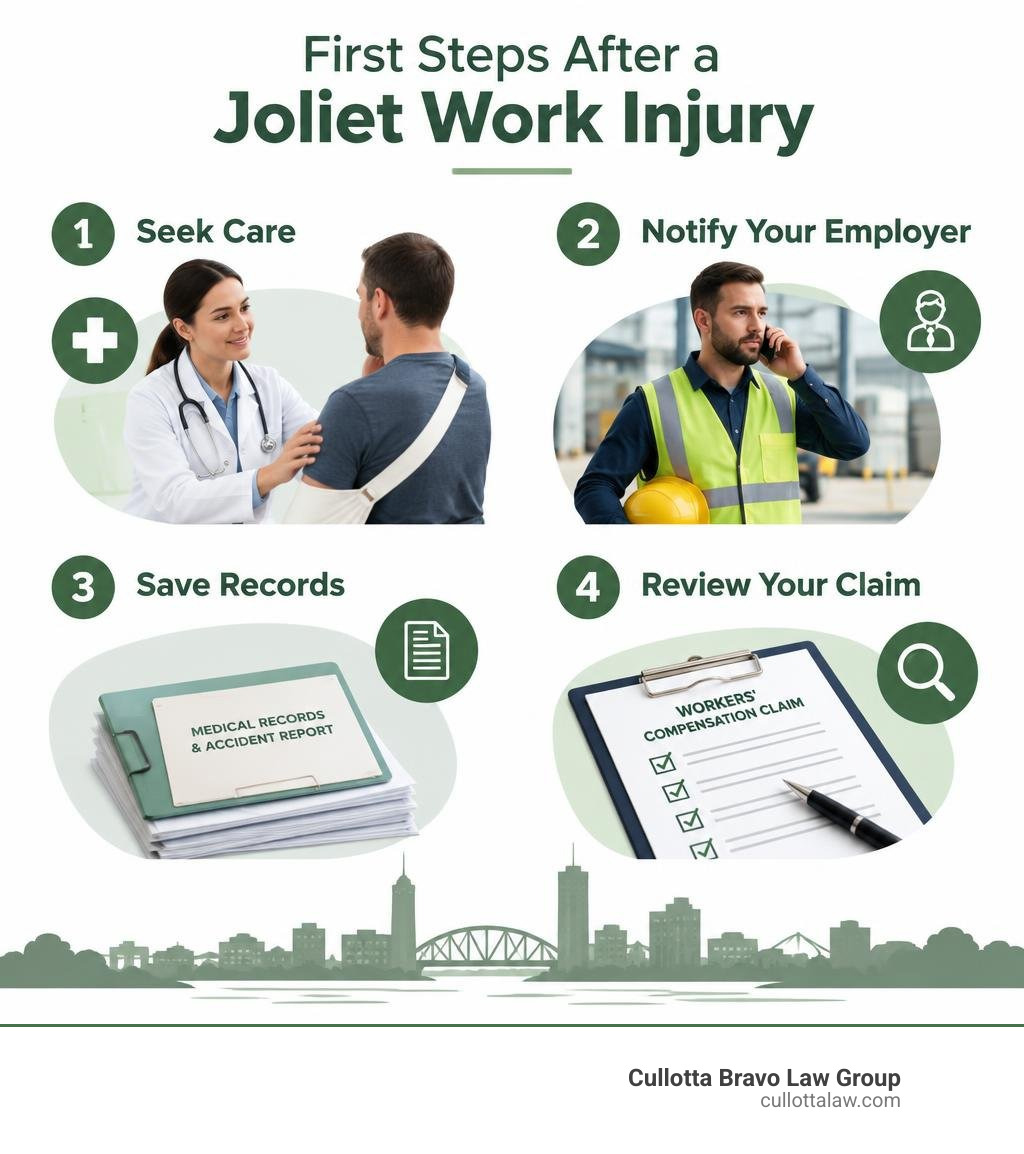
Get medical care, tell your employer about the injury as soon as possible, and keep copies of your medical records and any accident report. Illinois workers generally must notify their employer within 45 days. A Joliet work injury lawyer can help you file a workers’ compensation claim, address denied benefits, and check whether someone other than your employer may also be responsible.
You do not need to know what your claim is worth before asking for help. The first step is to protect your health and preserve the facts while they are fresh.
I’m Peter Cullotta, founding partner of Cullotta Bravo Law Group and a trial lawyer with more than 35 years of experience in injury and workers’ compensation cases across Chicagoland. If you’re looking for a Joliet work injury lawyer, this guide will help you understand your next steps and what to look for in legal help.
Joliet work injury lawyer further reading:
Workplace Injuries in Joliet and Your Legal Rights

Joliet serves as one of the most vital logistics and industrial hubs in the Midwest. With major shipping corridors like I-80 and I-55, sprawling intermodal freight yards, and extensive manufacturing plants, thousands of hardworking people clock in every day across Will County. Unfortunately, work environments also mean severe workplace accidents happen regularly.
Across Illinois, over 50,000 non-fatal workplace injuries and illnesses occur in the private sector annually, with manufacturing, logistics, and construction accounting for a major share. These incidents result in an average of 20 lost workdays per case, disrupting family finances and stability. In Will County alone, more than 2,500 workplace injuries are reported in a single year, with the highest concentration occurring in transportation and warehousing, according to data from the U.S. Bureau of Labor Statistics.
When an injury occurs, understanding your rights makes all the difference between struggling with unpaid bills and getting the full financial recovery you deserve.
| Benefit Category | Illinois Workers’ Compensation Claim | Third-Party Personal Injury Lawsuit |
|---|---|---|
| Fault Requirement | No-fault system (no need to prove employer negligence) | Must prove negligence by a third party |
| Medical Expenses | 100% of reasonable and necessary medical care | Covered as part of overall compensatory damages |
| Lost Wages | Two-thirds (66 2/3%) of average weekly wage (TTD) | 100% of past and future lost earnings |
| Pain and Suffering | Not available under statutory workers’ comp | Available for physical pain, emotional distress, and loss of normal life |
| Who You Claim Against | Employer’s workers’ comp insurance carrier | Negligent third parties (subcontractors, drivers, equipment makers) |
Common Work Accidents Across Will County Industries
Because of Joliet’s unique industrial footprint, we see a wide range of job-related trauma. High-risk sectors include freight terminals, fabrication shops, chemical refineries, and busy commercial construction corridors.
The most frequent injury patterns involve:
- Transportation and Heavy Equipment Accidents: Forklift rollovers, loading dock collapses, and commercial vehicle collisions in crowded intermodal freight facilities.
- Machinery and Industrial Entanglements: Assembly line malfunctions, lack of safety guards, and pinch-point crushes causing severe fractures or amputations.
- Falls From Heights and Same-Level Slips: Falls from scaffolding, ladders, or slick warehouse concrete floors leading to spinal trauma and orthopedic injuries.
- Overexertion and Repetitive Tasks: Chronic physical wear and tear, such as a debilitating repetitive stress injury affecting joints, shoulders, or the spine.
- Head and Brain Trauma: Concussions or severe traumatic brain injuries caused by falling cargo, structural collapses, or sudden impacts.
Understanding Your Statutory Employee Protections
Under the Illinois Workers’ Compensation Act, employees have clear legal rights that employers and insurance companies cannot simply ignore. If you get hurt on the job, you do not have to prove that your boss did anything wrong. The system is designed to provide prompt financial relief regardless of fault.
Your baseline statutory protections include:
- Complete Medical Coverage: All reasonable and necessary medical treatments, surgeries, physical therapy, prescription medications, and assistive devices required to relieve the effects of your injury.
- Temporary Total Disability (TTD): If your physician takes you off work completely, or gives you physical restrictions your employer cannot accommodate, you are entitled to TTD payments equal to two-thirds of your average gross weekly wage.
- Permanent Partial Disability (PPD): If your injury results in permanent impairment, loss of function, or disfigurement, you are entitled to compensation based on statutory schedules.
- Vocational Rehabilitation: If you cannot return to your prior trade due to physical limitations, your employer’s insurer must pay for retraining or career placement services.
Familiarizing yourself with how Illinois workers compensation benefits operate ensures that insurance adjusters do not shortchange your payouts or cut off your medical care prematurely.
How a Joliet Work Injury Lawyer Navigates the Claims Process

Filing a claim might sound simple on paper, but insurance carriers frequently minimize payouts, delay authorization for surgeries, or argue that your condition was pre-existing. Navigating the Illinois Workers’ Compensation Commission (IWCC) requires adherence to statutory guidelines, strict deadlines, and clear procedural steps.
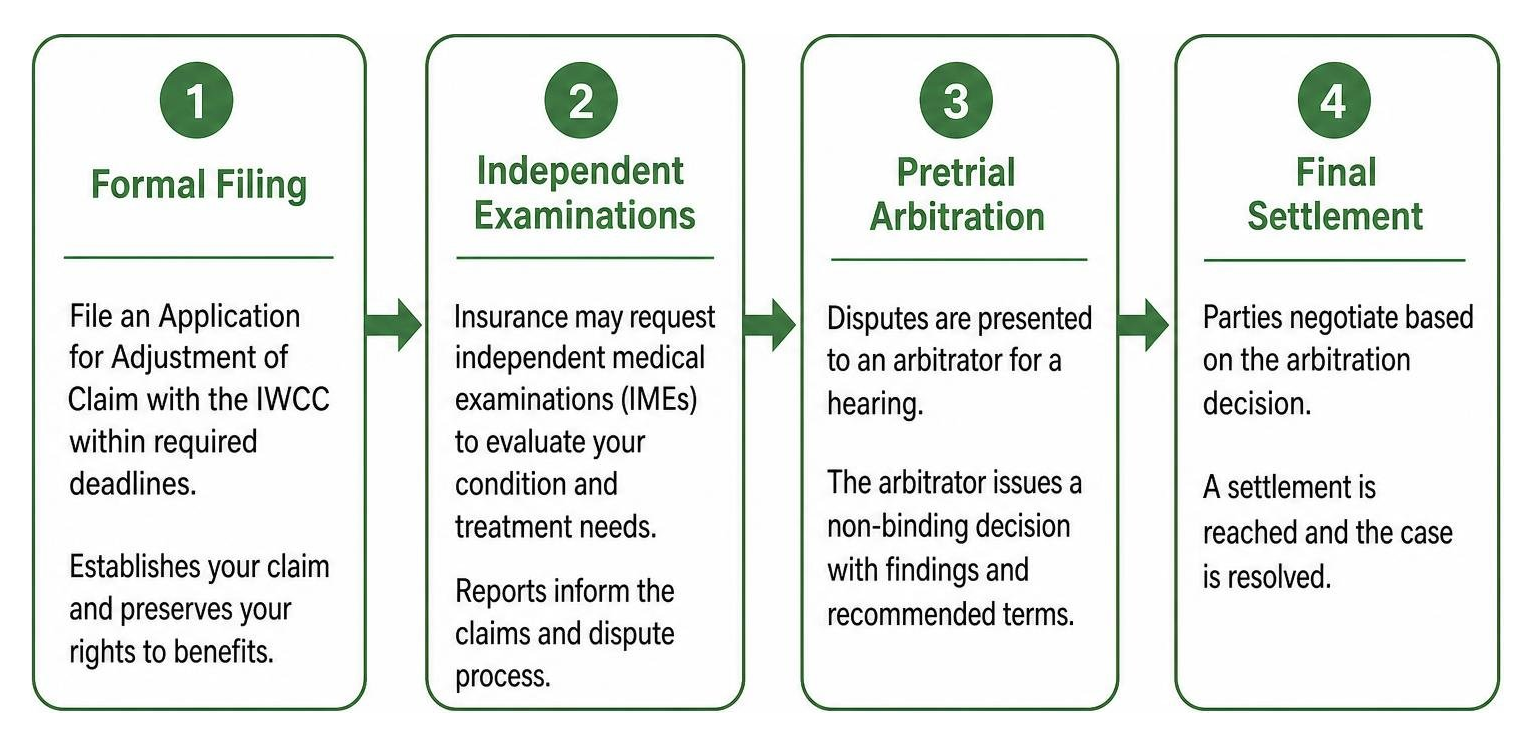
Strict timelines apply. Do not let the statute of limitations expire before securing your claim. In Illinois, you must formally file an Application for Adjustment of Claim with the IWCC within three years from the date of the accident, or within two years from the last workers’ comp payment you received—whichever is later.
Gathering Critical Evidence and Medical Documentation
A successful workers’ compensation case rests on verifiable facts. Insurance adjusters look for any inconsistency to deny benefits. We build an evidentiary record right from the start by securing:
- Official incident logs and internal company accident reports.
- Recorded statements from coworkers, eyewitnesses, or safety personnel.
- Surveillance footage from warehouse security cameras or loading bays.
- Detailed diagnostic scans (MRIs, CT scans, X-rays) and contemporaneous treating notes.
- Complete payroll records to accurately compute your true Average Weekly Wage (AWW), including mandatory overtime and bonuses.
- Expert medical opinions addressing medical causation and functional capacity limits.
How a Joliet Work Injury Lawyer Fights Denied Claims and Retaliation
When an insurer issues a denied workers comp claim, they hope you will simply walk away. Common denial excuses include claiming you missed the notification deadline, arguing the injury occurred outside working hours, or sending you to an insurance-friendly doctor for an “Independent Medical Examination” (IME) that downplays your condition.
We counter these tactics by:
- Filing emergency 19(b) petitions before the IWCC to compel the insurer to pay immediate TTD wages and authorize crucial surgeries.
- Deposing treating physicians to refute biased IME reports.
- Presenting evidence at formal arbitration hearings before an IWCC arbitrator.
- Protecting you against unlawful employer retaliation. Under Illinois law, an employer cannot fire, demote, harass, or reduce your hours simply because you exercised your right to file a claim.
Third-Party Liability and Maximizing Your Financial Recovery
While workers’ comp is your primary remedy against your direct employer, it is often not the only avenue of compensation. Many workplace accidents involve negligent third parties who do not work for your company.
When an outside party contributes to your injury, you can pursue a separate personal injury lawsuit in civil court alongside your workers’ compensation claim.
Differentiating Workers’ Comp from Personal Injury Claims
Under the “exclusive remedy” rule, you generally cannot sue your direct employer for pain and suffering in exchange for guaranteed no-fault benefits. However, that immunity does not protect outside third parties.
Partnering with a top Joliet personal injury lawyer allows you to run dual claims simultaneously. In a civil lawsuit, you can recover 100% of your lost income (rather than two-thirds), compensation for past and future pain and suffering, emotional distress, and loss of a normal life. This dual approach maximizes your total financial recovery.
Evaluating Settlement Value and Case Timelines
Every injury case has unique factors that determine its financial value and resolution timeline. About 70% of Illinois claims involve temporary total disability, with medical costs alone averaging $15,000 per claim. While minor claims may settle for around $25,000, catastrophic injuries, permanent disabilities, or third-party liability cases regularly reach six- and seven-figure totals.
Factors influencing your settlement value include:
- The permanence and severity of your physical impairment.
- Your pre-injury earnings compared to your post-injury earning capacity.
- Future medical care costs, including repeat surgeries or ongoing prescriptions.
- Whether you can return to your previous occupation.
Working alongside a skilled workers comp settlement attorney ensures you do not accept an undervalued lump-sum offer that closes out your rights to necessary future medical treatments. Straightforward claims may resolve in several months, while complex disputes involving disputed surgeries or third-party litigation can take between 12 and 24 months to reach a favorable settlement or verdict.
Key Factors When Choosing Legal Representation
Hiring the right legal counsel can dramatically alter the trajectory of your recovery. You need an attorney who not only understands Illinois statutory law inside and out, but who also knows how local employers, regional insurers, and Will County arbitrators handle dispute resolution.
What to Look for in a Joliet Work Injury Lawyer
When evaluating law firms, consider these essential qualifications:
- Local Experience in Will County: Look for lawyers who regularly handle cases at the Illinois Workers’ Compensation Commission and the Will County Circuit Court in Joliet.
- Trial Readiness and Resources: Insurance carriers know which firms settle quickly for cheap payouts and which ones are fully prepared to take claims to arbitration and trial.
- Client-Centered Communication: You deserve responsive advocates who answer your calls, keep you informed of developments, and treat you with dignity.
- A Proven Track Record: Review their history with complex workers’ comp and personal injury litigation.
Taking the time to research your options before choosing a workers compensation attorney ensures your case receives the dedication and skill it demands.
Legal Fees and Contingency Pricing Explained
One of the biggest concerns injured workers face is cost. Fortunately, Illinois law structures workers’ compensation legal fees to protect employees:
- Contingency Fee Model: You pay nothing out of pocket. Your lawyer only collects a fee if they successfully recover benefits or secure a settlement for you.
- Statutory Fee Caps: By Illinois law, attorney fees in standard workers’ compensation claims are capped at 20% of the recovered compensation.
- Free Case Reviews: Initial consultations are completely free, allowing you to get clear legal guidance without any financial risk.
Frequently Asked Questions About Joliet Work Injury Claims
How long do I have to report a work injury in Illinois?
You must give notice to your employer within 45 days of the date of the accident. While oral notification to a supervisor or safety manager meets the baseline statutory requirement, giving written notice via email or a signed incident report is much safer. For cumulative injuries like repetitive strain, the clock starts when you knew or reasonably should have known that the condition was work-related.
What should I do if my employer retaliates against me for filing a claim?
Retaliation is illegal. Section 4(h) of the Illinois Workers’ Compensation Act strictly prohibits employers from firing, threatening, demoting, or discriminating against employees for exercising their workers’ compensation rights. If you experience retaliation, document every conversation, save emails, and inform your attorney immediately. You may have grounds for a separate civil lawsuit for retaliatory discharge, which allows for punitive damages.
Can I sue my employer directly for a work injury in Joliet?
In the vast majority of cases, no. Under the exclusive remedy rule, you cannot sue your direct employer in civil court for negligence in exchange for receiving no-fault workers’ comp benefits. However, exceptions exist if your employer intentionally caused you harm. More commonly, you can file civil lawsuits against negligent third parties (such as outside contractors, property owners, or equipment manufacturers) while maintaining your workers’ comp claim against your employer.
Conclusion
A sudden work injury can upend your livelihood, but you do not have to carry the financial and legal burden alone. At Cullotta Bravo Law Group, we have spent over 35 years providing aggressive representation and compassionate support to injured workers and their families throughout Chicagoland, including Aurora, Chicago, Naperville, and Joliet.
Whether you need help filing an initial claim, overcoming an unfair denial, or exploring third-party liability to maximize your financial recovery, we are ready to stand up for your rights. Contact a dedicated Joliet injury lawyer today for a free, confidential consultation.