

Illinois Workers’ Compensation Filing Deadlines at a Glance
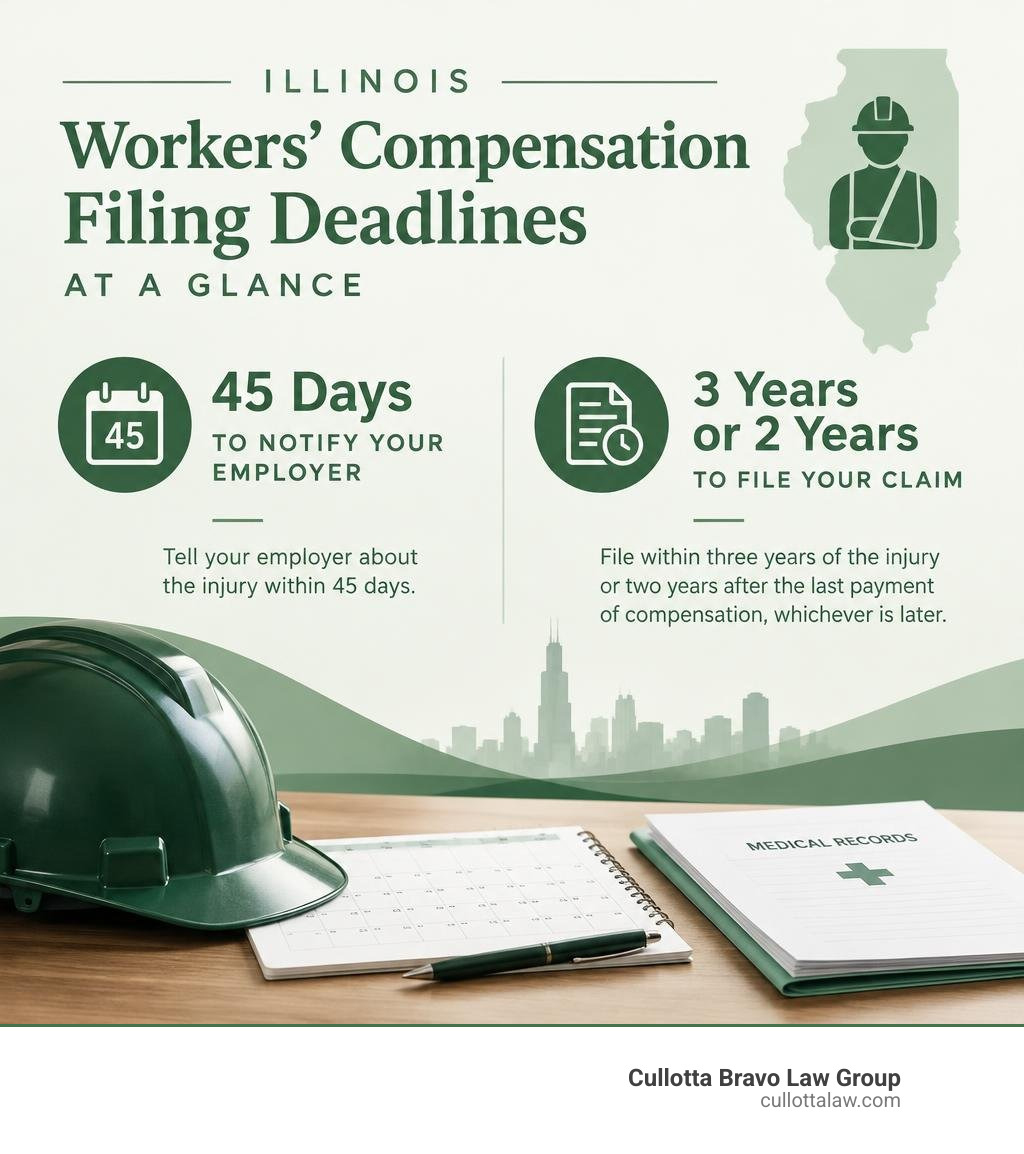
In Illinois, you generally must file a workers’ compensation claim within three years of the injury or two years after the last payment of compensation, whichever is later. You must also tell your employer about the injury within 45 days. Reporting it at work is not the same as filing a claim: to protect your rights, file an Application for Adjustment of Claim with the Illinois Workers’ Compensation Commission.
I’m Peter Cullotta, founding partner of Cullotta Bravo Law Group, and I’ve represented injured people for more than 35 years. I help workers understand the illinois workers compensation statute of limitations and take action before a missed deadline puts their benefits at risk.
Illinois workers compensation statute of limitations further reading:
- Illinois car accident statute of limitations
- Illinois premises liability statute of limitations
- Illinois wrongful death statute of limitations
Understanding the Illinois Workers Compensation Statute of Limitations
Navigating the aftermath of a workplace accident can be overwhelming. While focusing on recovery and medical treatment, many injured employees assume that telling a supervisor or HR manager is all it takes to lock in their benefits. Under the ILLINOIS WORKERS’ COMPENSATION ACT 820 ILCS 305 , strict statutory time limits govern every stage of a claim.
The core framework for filing a claim is established in Section 6(d) of the Act. This statute creates a dual-trigger limitation period that protects workers while establishing clear boundaries for employers and their insurance carriers. Understanding how these rules operate is essential for demystifying Illinois workers compensation benefits and securing the wage replacement and medical coverage you deserve.
| Stage / Requirement | Legal Time Limit | Statutory Trigger | Key Exception / Nuance |
|---|---|---|---|
| Employer Notice | 45 Days | Date of the workplace accident | 90 days for radiological exposure; gradual injuries run from discovery date |
| General Claim Filing | 3 Years | Date of injury / accident | Must be formally filed with the IWCC, not just reported internally |
| Extended Claim Filing | 2 Years | Date of the last benefit payment | Applies if medical bills or TTD were paid past the accident date |
| Asbestos Exposure | 25 Years | Date of last occupational exposure | Accommodates lengthy latency periods for disease manifestation |
| IWCC Appeal to Circuit Court | 20 Days | Date of receipt of IWCC decision | Strict jurisdictional window; requires proper bond and summons filing |
The 45-Day Employer Notification Rule
Before reaching the formal statutory filing window with the state, you must satisfy the mandatory employer notification rule. Section 6(c) of the Act mandates that you provide notice of your accident to your employer no later than 45 days after the incident occurs.
While the statute permits oral or written notification, providing written notice—via email, text message, or formal workplace incident report—creates an indisputable paper trail. Your notice should clearly state:
- The exact date, time, and location of the accident
- How the injury happened
- The specific body parts affected
- Any immediate medical care received
Failing to give proper notice within 45 days is a fatal defect for most claims. If the employer does not receive notice within this window, they can move to dismiss your claim entirely, barring you from receiving temporary total disability (TTD) or medical payments, regardless of how severe your injuries are. The primary statutory exception applies to radiological exposure cases, where workers are granted 90 days after the date of suspected exposure to provide notice.
The Three-Year Accident Rule vs. Two-Year Last Payment Rule
Once notice is provided, the overarching statutory clock for formal filing begins. Under Section 6(d), you must formally file an Application for Adjustment of Claim with the Illinois Workers’ Compensation Commission (IWCC) within:
- Three years from the exact date of the accident; or
- Two years from the date of the last payment of compensation—whichever date is later.

The two-year rule frequently comes into play when an employer’s insurance company voluntarily pays temporary total disability (TTD) benefits or covers ongoing medical treatment for an extended period. In Illinois, voluntary payments of medical bills or disability benefits count as “compensation.”
This principle was established in key appellate case law, including LEGRIS v. INDUSTRIAL COMMISSION (2001) | FindLaw . In Legris, the employer paid medical expenses over several years following a work injury. The court affirmed that medical benefit payments qualify as compensation under Section 6(d), extending the statutory filing deadline to two years from that final payment date. Whether handling an initial claim or negotiating a workers comp settlement, tracking every payment voucher and medical disbursement is crucial to calculating your exact filing window.
Deadlines for Specific Workplace Injury and Claim Types

Not all workplace injuries happen in a single, sudden moment. The law accounts for diverse medical conditions by establishing distinct deadlines under the Illinois Workers’ Compensation Act and the companion Illinois Workers’ Occupational Diseases Act (820 ILCS 310). Reviewing the ultimate guide to workers compensation eligibility helps clarify how specific medical conditions fit into these distinct legal categories.
How the Illinois Workers Compensation Statute of Limitations Applies to Traumatic vs. Occupational Injuries
Traumatic injuries occur from a discrete, identifiable event—such as a fall from scaffolding, a motor vehicle collision, or machinery malfunction. For these sudden accidents, calculating the deadline is straightforward: the three-year clock starts on the calendar date the accident occurred. This holds true even for complex physical trauma, such as when navigating workers comp for brain injuries.
In contrast, repetitive stress injuries (like carpal tunnel syndrome, degenerative disc disease, or joint breakdown) and work-induced psychological harm develop gradually. When handling stress at work and mental health workers compensation claims, the traditional “date of accident” does not apply.
Instead, Illinois courts use the manifestation date—the date on which the injury and its relationship to employment become plainly apparent to a reasonable person. This is typically established when:
- The worker seeks medical care and receives a definitive diagnosis linking the condition to their job duties; or
- The physical condition deteriorates to the point that the employee can no longer perform their regular work duties.
The 45-day notice window and the statutory filing timeline run from this manifestation date rather than the first day the worker felt minor discomfort.
Time Limits for Fatal Accidents, Asbestosis, and Latent Exposure Claims
Special rules apply when toxic exposures or fatal incidents occur:
- Fatal Accidents: If an employee dies as a result of a workplace injury, their surviving dependents (such as a spouse or minor children) must file a claim for death benefits within three years of the injury date, or within two years of the last compensation payment made to the worker prior to death, whichever is later. If no prior compensation was paid, the claim must be filed within three years of the date of death.
- Asbestosis and Mesothelioma: Because conditions caused by asbestos inhalation often take decades to present symptoms, claims under the Occupational Diseases Act can be filed within 25 years after the date of the employee’s last occupational exposure to asbestos.
- Radiation and Other Latent Toxins: Injuries caused by ionizing radiation or prolonged chemical toxicity have extended filing windows—often running up to 25 years from the last exposure date, or within three years from the date the worker knew or reasonably should have known of the disease and its occupational cause.
Special Filing Rules: Loaning Employers, Uninsured Companies, and Appeals

Workplace liability can involve multiple business entities, third-party contractors, or uninsured employers. The law includes specific procedural rules to ensure injured employees are protected in complex employment arrangements, including specific considerations when handling workers compensation for truck drivers in Aurora and logistics workers across the state.
Borrowed Employees and Joint Employer Liability Under Section 1(a)4
In modern logistics, warehousing, construction, and manufacturing, businesses routinely utilize staffing agencies or temp firms. Under Section 1(a)4 of the Act, Illinois law addresses these dynamics through “loaning” and “borrowing” employer rules:
- Loaning Employer: The temporary agency or staffing firm that pays the employee.
- Borrowing Employer: The client company that directs and supervises the employee’s day-to-day physical work.
Both the loaning and borrowing employers are jointly and severally liable for workers’ compensation benefits. Crucially, the statute dictates that timely filing an Application for Adjustment of Claim against either the loaning or borrowing employer is deemed timely filing against all liable parties. This prevents staffing companies and client facilities from pointing fingers at one another until the statutory clock expires.
Claims Involving Uninsured Employers and State Benefit Funds
Under Illinois law, employers in extra-hazardous industries (such as construction, excavation, transportation, and manufacturing) are automatically subject to the Act and must carry workers’ compensation insurance or obtain state approval to self-insure.
When an employer fails to carry mandatory insurance, the state imposes severe penalties:
- Civil fines ranging from $500 to $2,500 per day of non-compliance, with a mandatory minimum fine of $10,000.
- Immediate stop-work orders issued by the Illinois Department of Insurance.
- Criminal misdemeanor or felony charges for knowing non-compliance.
- For non-payment of premiums based on work situs, civil penalties of up to $1,000 per day (capped at $50,000 per project) under Section 6(d), enforceable up to one year past the expiration of the statutory limitation period.
If you are injured while working for an uninsured employer, you can still seek recovery through the Injured Workers’ Benefit Fund (IWBF). To secure compensation from the IWBF, you must file a formal application with the Commission and name both the uninsured employer and the State Treasurer (as ex-officio custodian of the IWBF) within the standard statutory deadlines.
IWCC Application for Adjustment of Claim and Circuit Court Appeals
Filing internal incident paperwork with your employer does not toll the statutory clock. To protect your legal rights, you must file a formal Application for Adjustment of Claim directly with the IWCC. Once filed, your case is assigned to an Arbitrator in the appropriate hearing zone (such as Chicago, Joliet, or Geneva).
If an employer refuses to authorize necessary surgery or pay owed TTD benefits, your attorney can file a Section 19(b) or 19(b-1) petition for an emergency immediate hearing. If either party disputes the Arbitrator’s final decision, successive legal steps include:
- Commission Review: An appeal must be filed with the three-member Commission panel within 30 days of receiving the Arbitrator’s decision.
- Circuit Court Appeal: If the Commission’s ruling is contested, you have a strict 20-day jurisdictional window from the date you receive the Commission’s final order to file a lawsuit in the appropriate Circuit Court.
Missing that 20-day Circuit Court window deprives the court of jurisdiction, making fighting denied workers comp claims significantly more difficult.
Critical Exceptions, Tolling Provisions, and Consequences of Missing Deadlines
While the statutory limits in the Act are strictly enforced, certain recognized legal exceptions will pause (“toll”) the clock. Having the key qualities of top work injury lawyers fighting for denied claims on your side ensures these statutory tolling exceptions are raised properly before an Arbitrator.
Key Exceptions That Can Toll the Illinois Workers Compensation Statute of Limitations
The Handbook013013 letter size provided by the IWCC and governing case law recognize specific scenarios that toll the statutory limitation period:
- Minors (Under 18 Years of Age): If an injured employee is a minor at the time of the workplace accident, the statutory filing clock does not begin running until they reach the age of majority (18 years old), provided they do not have a legally appointed guardian acting on their behalf.
- Mental Incompetency: If a severe workplace injury—such as a catastrophic traumatic brain injury or coma—renders a worker mentally incapable of managing their legal affairs, the statute is tolled until legal competency is restored or a formal guardian or conservator is appointed.
- Employer Fraud and Equitable Estoppel: If an employer or its insurer intentionally misleads an injured worker—for example, falsely promising that a formal claim was filed on their behalf or deceptively paying partial wage benefits under the guise of an approved settlement to run out the clock—the doctrine of equitable estoppel prevents the employer from asserting a statute of limitations defense.
- Failure to Post Required Notices: Employers are legally required to post notices of workers’ rights under the Act in visible workplace areas. In limited circumstances, gross failure to provide required statutory notices or intentional concealment of wage records can impact statutory defense arguments.
What Happens If You Miss the Filing Deadline?
Failing to file your claim within the statutory deadline brings severe, permanent legal consequences. In Illinois workers’ compensation law:
- Complete Jurisdictional Bar: The IWCC loses the legal authority (jurisdiction) to hear your case.
- No Revivals: Unlike certain contract disputes, an expired workers’ compensation claim cannot be revived, renegotiated, or forgiven due to simple neglect or lack of legal knowledge.
- Total Loss of Financial Benefits: You permanently forfeit your right to past and future TTD wage replacement, permanent partial disability (PPD) settlements, vocational rehabilitation, and reimbursement for outstanding or future medical bills.
When the deadline passes without an Application for Adjustment of Claim on file, all legal leverage against the employer and insurance carrier is lost.
Frequently Asked Questions About Illinois Workers’ Comp Time Limits
When does the statute of limitations clock start ticking for repetitive stress injuries?
For repetitive strain injuries (such as tendonitis, cubital tunnel, or chronic back degradation), the clock starts on the manifestation date. This is the date the worker first knew, or reasonably should have known, that their physical condition was caused or aggravated by their job tasks. This is typically established when a doctor formally provides an occupational diagnosis or when the pain forces the employee to miss work or alter duties.
Does receiving group health insurance payments extend my workers’ comp filing deadline?
Generally, payments made purely under a non-occupational group health insurance policy do not automatically extend the two-year payment rule under Section 6(d). However, under Section 8(j) of the Act, if an employer or group insurer pays medical expenses or disability benefits for an injury that is later established to be work-related, those payments may be credited under the Act and, in specific factual situations, can trigger arguments regarding payment tolling or equitable estoppel.
Can an employer be legally barred from using the statute of limitations defense?
Yes. Under the doctrine of equitable estoppel, an employer or insurance carrier is legally barred from using the statute of limitations as a defense if their affirmative, deceptive conduct caused the worker to delay filing. Examples include telling an employee they do not need to file with the state because “the company has handled everything,” making unfulfilled promises of settlement, or threatening termination if a state claim is submitted.
Conclusion
Understanding the deadlines that govern workplace injury claims in Illinois is essential to protecting your health, your family’s financial security, and your future. Whether you are dealing with a sudden accident, an occupational illness, or an insurance adjuster delaying your benefits, staying ahead of notice requirements and formal filing windows ensures your rights remain intact.
At Cullotta Bravo Law Group, we have spent more than 35 years providing aggressive, dedicated legal representation to injured workers across Aurora, Chicago, Joliet, Naperville, and throughout Illinois. We treat every client with dignity, fighting to recover the full compensation they deserve under the law.
If you have questions about your workplace injury timeline or want to ensure your claim is properly protected, review the statutes of limitation on accidents in Illinois or contact our experienced legal team today for a comprehensive, confidential case evaluation.