

How Illinois Permanent Disability Ratings Become PPD Awards
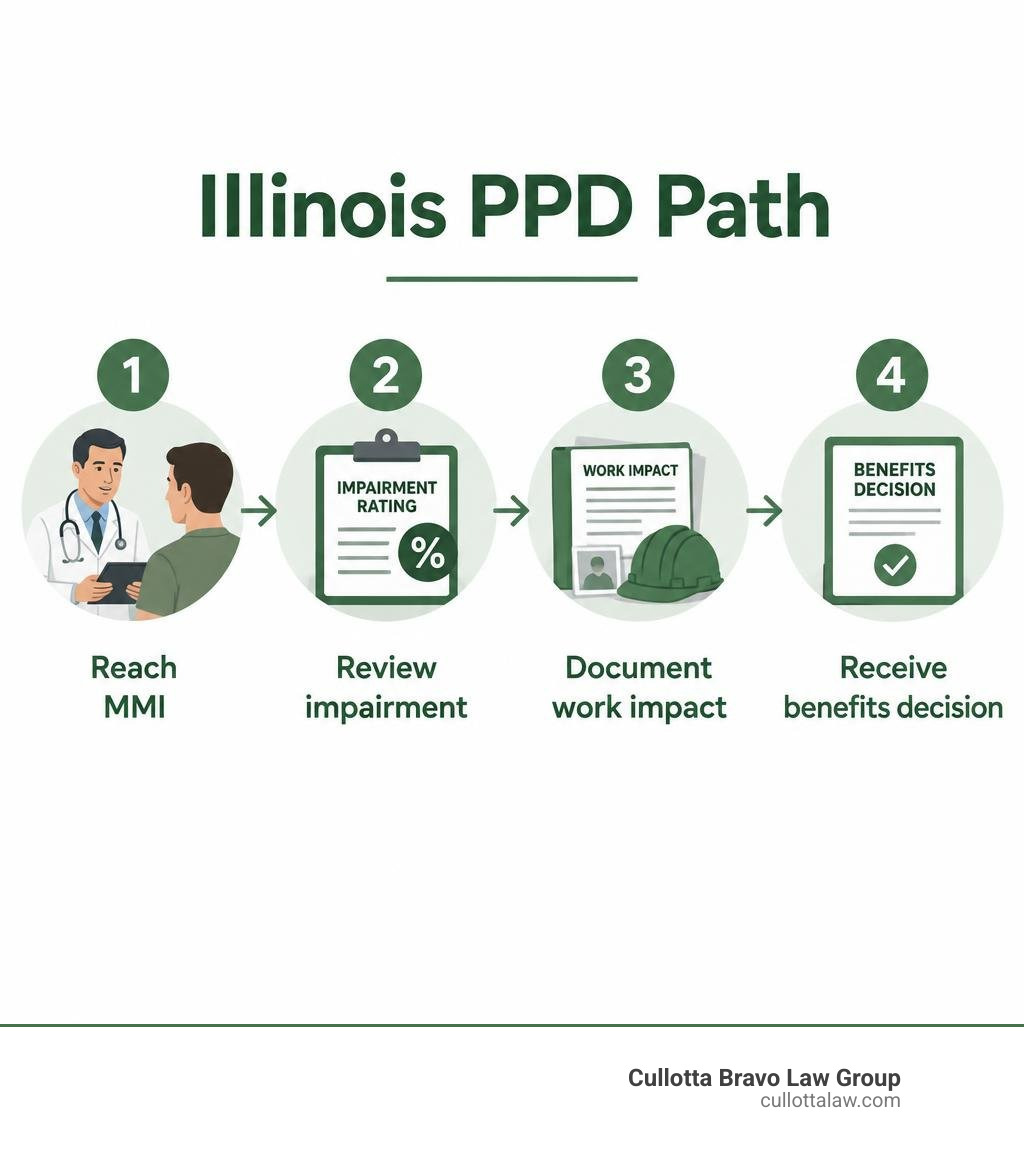
To understand a permanent disability rating in Illinois, start when your doctor says your work injury has reached maximum medical improvement (MMI). Review the doctor’s impairment rating, then gather records showing how the injury affects your work. The Illinois Workers’ Compensation Commission weighs that rating alongside your occupation, age at injury, future earning capacity, and treating medical records to decide a permanent partial disability (PPD) award. The doctor’s percentage alone does not set your benefits.
I’m Peter Cullotta, founding partner of Cullotta Bravo Law Group, and I’ve represented injured workers for over 35 years. If you’re researching permanent disability rating illinois, I’ll walk you through how a medical assessment becomes a benefits decision.
Similar topics to permanent disability rating illinois:
How a Permanent Disability Rating in Illinois Is Determined

A permanent disability rating is not a single number pulled from a magic chart by an insurance adjuster. In Illinois, determining your final award is a legal-medical process governed by the Illinois Workers’ Compensation Act, specifically under Section 820 ILCS 305/8.1(b).
Before any rating can occur, you must achieve Maximum Medical Improvement (MMI). MMI means your condition has stabilized and cleared the acute healing phase—no further medical treatment or surgery is reasonably expected to substantially restore physical function. Once your treating physician or an independent medical examiner declares you at MMI, any remaining physical limitation is classified as a permanent impairment.
Understanding workers compensation impairment ratings step by step helps clarify how medical findings translate into financial recovery. Under Illinois law, the Illinois Workers’ Compensation Commission (IWCC) uses a statutory five-factor test to establish your final disability award:
- A formal medical impairment report based on the American Medical Association (AMA) Guides.
- Your occupation at the time of the workplace accident.
- Your age at the time you were injured.
- Your future earning capacity and diminished earning potential.
- Evidence of disability corroborated by treating medical records, functional capacity evaluations, and physical therapy notes.
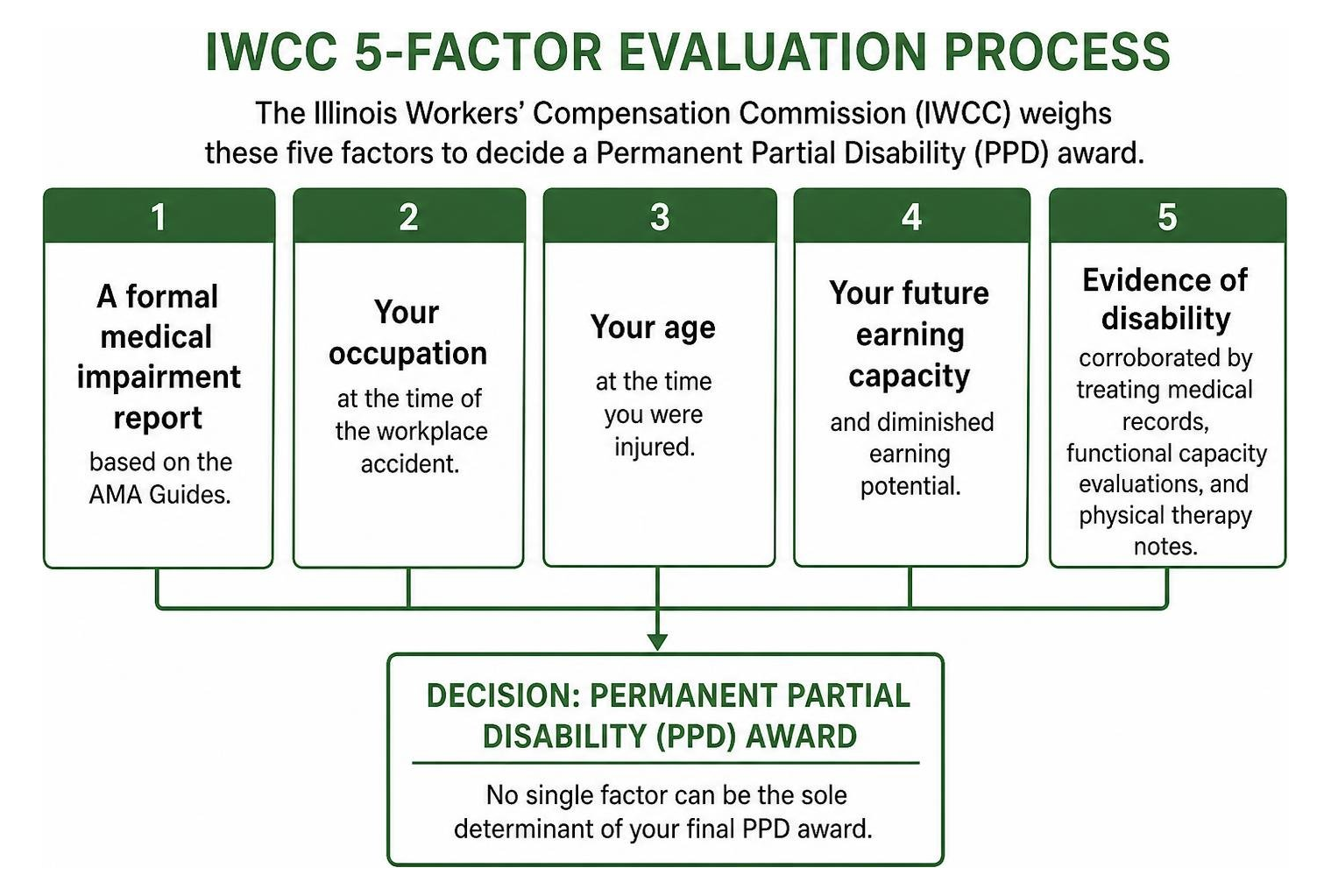
Crucially, Illinois law explicitly mandates that no single factor—including the doctor’s numeric impairment score—can be the sole determinant of your final PPD award.
How AMA Guides Shape Your Permanent Disability Rating Illinois Report
For injuries occurring on or after September 1, 2011, physician impairment ratings must comply with the most current edition of the AMA Guides to the Evaluation of Permanent Impairment (the 6th Edition).
The AMA Guides establish a Permanent Partial Impairment (PPI) score using a methodology called Diagnosis-Based Impairment (DBI). Rather than relying entirely on subjective pain descriptions, an evaluating physician follows a structured diagnostic grid:
- Class Assignment (CDX): The physician identifies your primary structural diagnosis (e.g., a lumbar disc herniation with radiculopathy or a meniscal tear).
- Grade Modifiers: The baseline impairment class is then adjusted upward or downward using objective clinical findings:
- Functional History (GMFH): Evaluates daily activity limitations and validated symptom scores.
- Physical Examination (GMPE): Incorporates measurable deficits such as loss of range of motion, muscle weakness, or measurable tissue atrophy.
- Clinical Studies (GMCS): Factors in diagnostic imaging, MRIs, CT scans, and electromyography (EMG) nerve conduction studies.
While insurers often treat these clinical calculations as the definitive measure of a case, scholarly research and legal analysis of AMA Guides in Illinois disability evaluations highlight that a purely anatomical impairment percentage frequently fails to capture the true vocational disruption experienced by an injured worker.
Vocational Factors That Adjust Your Permanent Disability Rating in Illinois
An anatomical loss affects every worker differently. A 5% whole-person impairment due to a torn rotator cuff might cause minimal career interruption for an office-based accountant, but that exact same injury can permanently end the career of a union carpenter, pipefitter, or warehouse laborer.
When evaluating your claim, IWCC arbitrators actively weigh your vocational context against the statutory criteria for workers compensation eligibility:
- Age at Injury: Younger workers face decades of compounded future earnings disruption, while older workers near retirement may face near-impossible hurdles when attempting to retrain for sedentary occupations.
- Occupational Demands: Arbitrators analyze whether your permanent restrictions prevent you from meeting the medium, heavy, or very heavy physical demand levels of your pre-injury trade.
- Diminished Earning Capacity: If your permanent physical restrictions prevent you from earning your pre-accident wage, your case value increases substantially beyond a simple schedule calculation.
- Corroborating Medical Records: Longstanding treatment notes, documented medication dependencies, and physical therapy progress reports carry significant evidentiary weight alongside any formal one-time examination.
Calculating PPD Payouts: Four Illinois Benefit Categories
Once permanent impairment and vocational impact are established, your financial compensation is calculated using your Average Weekly Wage (AWW). Under Illinois law, your standard weekly PPD benefit rate equals 60% of your gross Average Weekly Wage calculated over the 52 weeks prior to the injury date.
These payments are subject to statutory minimums and maximums published biannually by the state. You can review the current maximums via the official Illinois Workers’ Compensation Commission benefit rate schedules. Gaining a clear overview of Illinois workers compensation benefits helps ensure you understand which of the four statutory PPD categories applies to your situation:
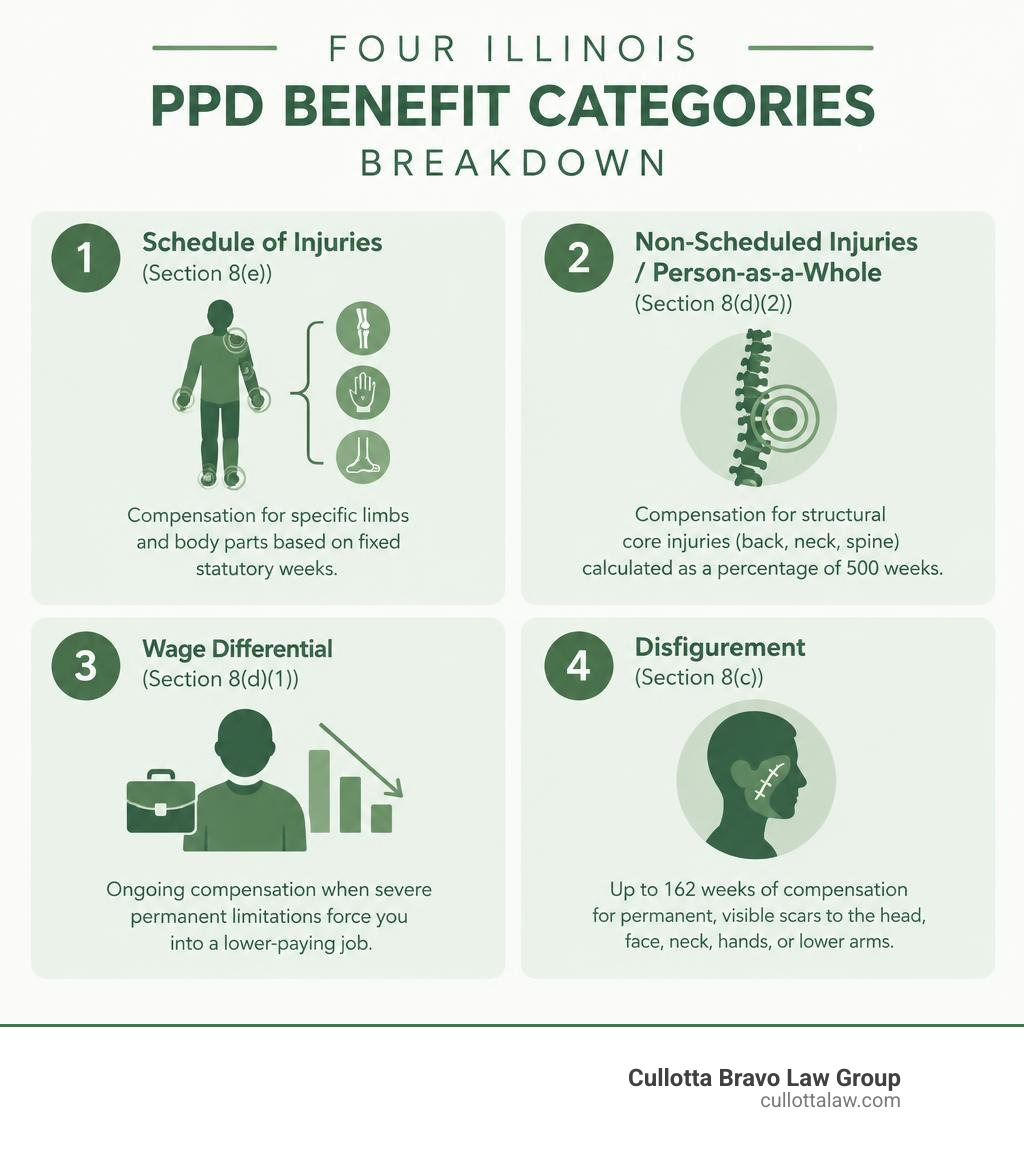
- Schedule of Injuries (Section 8(e)): Compensation for specific limbs and body parts based on fixed statutory weeks.
- Non-Scheduled Injuries / Person-as-a-Whole (Section 8(d)(2)): Compensation for structural core injuries (back, neck, spine) calculated as a percentage of 500 weeks.
- Wage Differential (Section 8(d)(1)): Ongoing compensation when severe permanent limitations force you into a lower-paying job.
- Disfigurement (Section 8(c)): Up to 162 weeks of compensation for permanent, visible scars to the head, face, neck, hands, or lower arms.
Scheduled Member Losses vs. Person-as-a-Whole Injuries
Most workplace injuries to extremities fall under Section 8(e), which assigns a specific number of statutory weeks to each body part. Unscheduled injuries (such as spinal fusions, cervical herniations, and shoulder or hip joint capsule injuries) fall under Section 8(d)(2) and are evaluated against a baseline of 500 weeks for the “person as a whole.”
To calculate your payout under Section 8(e) or 8(d)(2), multiply the statutory weeks by your percentage of loss of use, then multiply that result by your weekly PPD rate:
PPD Payout = Statutory Weeks × Disability Percentage × 60% Average Weekly Wage
| Body Part / Member | Statutory Weeks (Injuries on/after June 28, 2011) | Example: 15% Permanent Loss (at $600/wk PPD Rate) |
|---|---|---|
| Thumb | 76 Weeks | 11.4 Weeks = $6,840.00 |
| Index Finger | 43 Weeks | 6.45 Weeks = $3,870.00 |
| Hand | 205 Weeks | 30.75 Weeks = $18,450.00 |
| Arm (Standard) | 253 Weeks | 37.95 Weeks = $22,770.00 |
| Arm (Amputation at Shoulder) | 323 Weeks | 48.45 Weeks = $29,070.00 |
| Foot | 155 Weeks | 23.25 Weeks = $13,950.00 |
| Leg (Standard) | 215 Weeks | 32.25 Weeks = $19,350.00 |
| Eye | 162 Weeks | 24.3 Weeks = $14,580.00 |
| Hearing Loss (Both Ears) | 215 Weeks | 32.25 Weeks = $19,350.00 |
| Carpal Tunnel (Repetitive Trauma) | Capped at 28.5 to 57 Weeks | 15% of 28.5 Wk Base = $2,565.00 |
| Person as a Whole (Spine / Neck) | 500 Weeks Max | 75 Weeks = $45,000.00 |
For official statutory schedules and historic injury thresholds, consult the official Illinois PPD schedule of body parts.
Wage Differential and Disfigurement Awards
When a serious workplace injury leaves permanent restrictions that prevent you from resuming your regular trade, a scheduled week payout might not adequately replace your real-world financial loss. In these scenarios, Section 8(d)(1) Wage Differential benefits provide an alternative remedy.
Under Section 8(d)(1), your benefit equals two-thirds (66.67%) of the gross difference between what you would currently earn in your pre-injury career and what you are capable of earning in post-injury suitable employment.
Example: If an injured worker earned $1,500/week as an industrial ironworker, but permanent spinal restrictions limit them to a light-duty retail dispatch job paying $600/week, the wage gap is $900/week. The wage differential award is two-thirds of $900, yielding $600/week.
For injuries occurring on or after September 1, 2011, wage differential awards are paid for five years from the award date or until the worker reaches age 67, whichever occurs later.
Additionally, Section 8(c) provides up to 162 weeks of compensation for serious and permanent disfigurement to the face, neck, head, chest above the armpits, hands, or arms. When settling complex cases involving Social Security Disability coordination, practitioners must also account for federal guidelines on Illinois workers compensation offset calculations to structure settlement language properly.
Disputing an Impairment Rating and Navigating the IWCC Settlement Process

Insurance carriers routinely retain Independent Medical Examination (IME) doctors who provide low impairment scores or assert that you have made a complete recovery without lasting disability. You are not required to accept an insurer’s low rating.
If an insurance company prematurely terminates benefits or attempts to underpay your permanency rating, you can challenge their evaluation before an IWCC arbitrator. Navigating these dispute procedures requires a clear strategy, as outlined in the official IWCC handbook for injured employees. Injured workers must follow proper procedural steps for filing workers compensation claims to preserve all medical and financial rights.
Challenging Low Insurance Doctor Ratings
In the landmark case Continental Tire of the Americas, LLC v. Illinois Workers’ Compensation Comm’n, the Illinois Appellate Court ruled that arbitrators are not bound to follow an employer’s AMA impairment rating, even if the injured worker does not introduce an opposing AMA report. Because the impairment report is only one of five statutory factors, arbitrators have the legal authority to award disability benefits based on credible treating records and vocational impact.
To challenge an adverse insurance rating:
- Obtain a Treating Physician Rebuttal: Your treating doctor can document functional limitations, range of motion deficits, and job restrictions that contradict the insurer’s IME exam.
- Demonstrate Vocational Losses: A vocational expert can show how permanent physical restrictions eliminate access to your primary employment market.
- Review Statutory Reporting Requirements: Legal practitioners examine whether the insurer’s doctor strictly complied with Section 8.1b guidelines, as detailed in recent analysis of AMA impairment rating requirements in Illinois.
- Prepare for Trial: If an insurance company refuses to negotiate reasonably, taking effective action when facing a denied workers comp claim allows an arbitrator to evaluate all five statutory factors in a formal hearing.
CompFile Procedures and Settlement Finalization
All modern Illinois workers’ compensation proceedings, motions, and settlement contracts are filed electronically through the IWCC CompFile system.
When resolving a permanency claim, you must observe strict procedural rules:
- Statute of Limitations: You must file an Application for Adjustment of Claim within three years of your injury date, or two years from the last payment of temporary disability or medical benefits, whichever is later. Protect your claim by understanding the Illinois workers comp statute of limitations.
- Regulated Attorney Fees: By statute, claimant attorney fees in Illinois are strictly capped at 20% of the disputed compensation recovered.
- Settlement Structures: A settlement contract can be executed as a lump-sum closure (which typically ends future medical benefits in exchange for higher cash value) or an installment award (which can leave open rights for future medical needs).
Frequently Asked Questions About Illinois Disability Ratings
Can an IWCC arbitrator base a PPD award solely on an AMA impairment rating?
No. Under Section 820 ILCS 305/8.1(b), the Illinois Workers’ Compensation Commission is legally prohibited from relying solely on an AMA impairment rating. Arbitrators must weigh the impairment report alongside your pre-injury occupation, age at injury, future earning capacity impact, and corroborating treating medical records.
When does an injured worker become eligible to receive PPD benefit payments?
You become eligible for PPD payments once you achieve Maximum Medical Improvement (MMI) and your Temporary Total Disability (TTD) payments conclude. In Illinois, initial permanency payments or settlement negotiations typically begin within 14 to 30 days after your doctor issues final permanency restrictions and impairment ratings.
How do surgeries and extended recovery times impact an impairment score?
According to national workers’ compensation benchmark studies by the National Council on Compensation Insurance (NCCI), claims involving major surgery average whole-body impairment ratings approximately two percentage points higher than non-surgical claims (7.2% vs. 5.0%), rising to an average of 11.3% for three or more procedures. Similarly, claims taking more than two years to reach MMI average a 9.1% to 11% impairment rating, compared to 4.4% for claims reaching MMI within 90 days.
Conclusion: Securing Fair Compensation for Permanent Workplace Injuries
Receiving an impairment rating from a physician is a key step, but it is not the final word on your workers’ compensation settlement. An arbitrary medical percentage does not capture the daily reality of lost strength, chronic pain, or career disruption.
At Cullotta Bravo Law Group, we have spent over 35 years advocating for injured workers across Aurora, Chicago, Naperville, and Joliet. We know how insurance carriers use lowball IME reports to undervalue claims, and we understand how to present all five statutory factors to maximize your recovery.
If you have questions about your disability rating or need guidance on a settlement contract, contact our team to speak with a dedicated Illinois workers compensation attorney for a comprehensive, no-obligation case evaluation.