

How to Find Motor Vehicle Accident Lawyers Near Me in Aurora
When you search for motor vehicle accident lawyers near me in the Aurora area, start with attorneys licensed in Illinois who handle car crash claims. Ask who will work on your case, whether they have trial experience, and how fees and case costs are paid. Get the terms in writing before you sign.
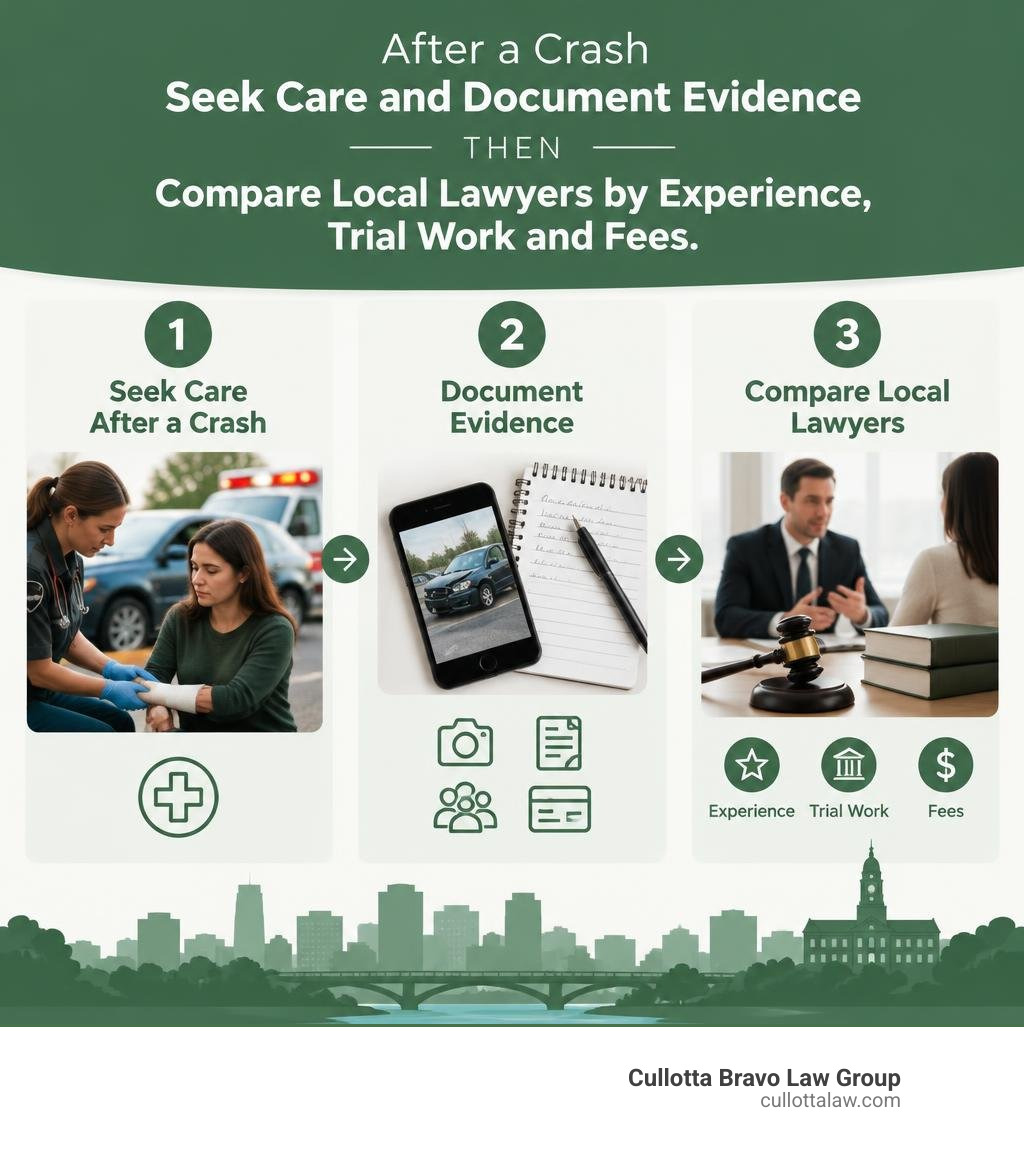
If you were just injured, seek medical care, report the crash, and save photos, witness details, and insurance information. Those steps can protect your health and help a lawyer assess your claim.
I’m Peter Cullotta, founding partner of Cullotta Bravo Law Group, and I’ve represented injured people across Chicagoland for more than 35 years. My advice on choosing motor vehicle accident lawyers near me comes from handling injury claims through negotiation, mediation, arbitration, and trial.
Similar topics to motor vehicle accident lawyers near me:
1. Immediate Actions: Protecting Your Health and Legal Rights After a Crash
The moments directly following a collision can define the outcome of your physical recovery and financial stability. Adrenaline surges after impact, frequently masking severe soft-tissue trauma, concussions, or internal bleeding. You might feel fine at the scene, only to wake up the next morning unable to turn your neck.
Your immediate priority must always be safety and health. Check yourself and your passengers for injuries, and call 911 immediately so emergency medical personnel and law enforcement dispatch to the scene. An official police collision report is indispensable when establishing liability against negligent motorists.
Understanding how to safeguard your car accident legal rights begins right at the scene. Exchange names, contact information, driver’s license numbers, and insurance policy details with all involved drivers. Never apologize or discuss fault with anyone on-site—polite remarks like “I’m sorry, I didn’t see you” are routinely weaponized by insurance carriers to diminish your payout.
If you are physically able, take comprehensive photos and videos of all vehicles, skid marks, broken glass, traffic signals, and weather conditions. Speak with neutral bystanders and collect their contact details before they leave. Following the collision, initiate the car accident insurance claim process promptly, keeping detailed logs of every interaction and following the official guidance outlined in the State Dept of Insurance Advises What To Do After an Accident.
Documenting Crash Scene Evidence and Black Box Data

Physical evidence at an accident scene begins disappearing the moment tow trucks clear the road. Tire marks wash away in the rain, debris is swept aside, and vehicle damage can be repaired or altered. Modern vehicles contain Event Data Recorders (EDRs), commonly known as “black boxes,” which capture critical pre-impact telemetry such as vehicle speed, throttle position, braking status, steering angles, and seatbelt usage.
Preserving this electronic data is crucial, especially in disputed liability cases or multi-vehicle pileups. For instance, in collisions requiring insights from a rear-end accident lawyer, black box telemetry can definitively disprove a tailgating driver’s claim that you stopped abruptly without working brake lights. Our team moves quickly to issue formal spoliation letters, preventing insurance companies and vehicle owners from destroying or resetting this vital digital evidence.
Avoiding Recorded Statements and Early Settlement Traps
Within hours or days of a collision, the at-fault driver’s insurance adjuster will likely reach out. They often sound remarkably warm, empathetic, and eager to help. Make no mistake: insurance adjusters are trained corporate negotiators whose primary metric of success is closing claims for the lowest possible amount.
Adjusters will ask for a recorded statement under the guise of “speeding up your claim.” They use carefully phrased questions designed to make you downplay your injuries or accept partial responsibility. You are under no legal obligation to provide a recorded statement to the other party’s insurance company.
Adjusters also frequently send quick, lowball settlement offers before you have completed medical treatment. Accepting an early check releases the insurer from all future liability. If your back injury later requires surgery or extensive physical therapy, you will be left paying those bills entirely out of your own pocket.
2. Key Criteria to Evaluate When Searching for Motor Vehicle Accident Lawyers Near Me
Selecting legal representation after a serious collision should never come down to the first billboard you see on the highway. Across Illinois, thousands of attorneys handle injury claims, but their depth of trial experience and courtroom readiness vary significantly.
Reviewing a comprehensive guide to finding top car accident attorneys can help you evaluate law firms effectively. Nearly 96% of personal injury cases settle before trial, but the best settlement offers are consistently achieved by law firms with a proven track record of trying cases in court. When insurance companies know an attorney is ready and willing to take a case to a jury verdict, their settlement offers increase substantially.
You can also use respected legal directories to Find the Top Personal Injury Lawyers Near You and verify their peer review ratings, disciplinary histories, and verified client testimonials.
Why Working with Local Motor Vehicle Accident Lawyers Near Me Maximizes Claim Value
National settlement mills handle thousands of files simultaneously, treating clients like numbers on an assembly line. In contrast, local counsel offers distinct advantages that directly impact your recovery. Finding experienced Car Accident Attorneys by State & City ensures your legal team has daily experience navigating the local courtrooms, judges, and procedural nuances in your specific jurisdiction.
Local attorneys understand the unique driving hazards of regional transit corridors, hazardous intersections, and municipal maintenance issues. They maintain established relationships with local medical specialists, accident reconstructionists, and court personnel. Most importantly, local representation means you can meet your attorney face-to-face to discuss your case, review strategy, and prepare for depositions without being routed through an impersonal remote call center.
Trial Readiness, Case Track Records, and Contingency Fees
Our firm brings more than 35 years of aggressive litigation experience to the table, fighting to secure justice and dignity for injured clients. We have built our reputation on achieving multi-million dollar settlements in complex car crash and personal injury disputes.
Reputable personal injury firms operate on a no-fee-unless-we-win contingency model. This means you pay zero upfront costs or hourly fees. Your legal team advances all litigation expenses—such as court filing fees, expert witness retainers, and medical record duplication costs—and is only compensated through an agreed-upon percentage of the final settlement or jury verdict.
| Feature | Contingency Fee Agreement | Hourly Retainer Agreement |
|---|---|---|
| Upfront Retainer | $0 out-of-pocket | $5,000 to $15,000+ upfront |
| Ongoing Hourly Billing | None | $350 – $750+ per hour billed monthly |
| Case Investigation Costs | Advanced by law firm | Paid out-of-pocket by client as incurred |
| Financial Risk | Attorney assumes financial risk | Client assumes all financial risk |
| Attorney Incentive | Aligned with maximizing total recovery | Tied to total hours billed |
| Fee Due if Case Loses | $0 attorney fees | Full hourly fees must be paid |
3. Determining the Value of Your Motor Vehicle Accident Claim
No two car crashes result in identical financial or physical impacts. Calculating the true value of your case requires an exhaustive analysis of both economic losses and non-economic damages:
- Past and Future Medical Expenses: Hospital bills, surgical fees, emergency transport, physical therapy, prescription medications, and long-term in-home care.
- Lost Earnings and Diminished Capacity: Proving and recovering car accident lost wages covers missed time at work, lost benefits, and permanent reductions in your future earning capacity.
- Non-Economic Damages: Properly calculating pain and suffering damages accounts for physical discomfort, emotional trauma, sleep disruption, loss of consortium, and reduced enjoyment of life.
- Property Loss and Diminished Value: Vehicle repair or actual cash value replacement costs, rental car expenses, and loss of market value for repaired vehicles.
How Comparative Negligence and No-Fault Rules Impact Recovery
Legal liability rules directly dictate how much compensation an injured driver can collect. States adhere to different fault frameworks:
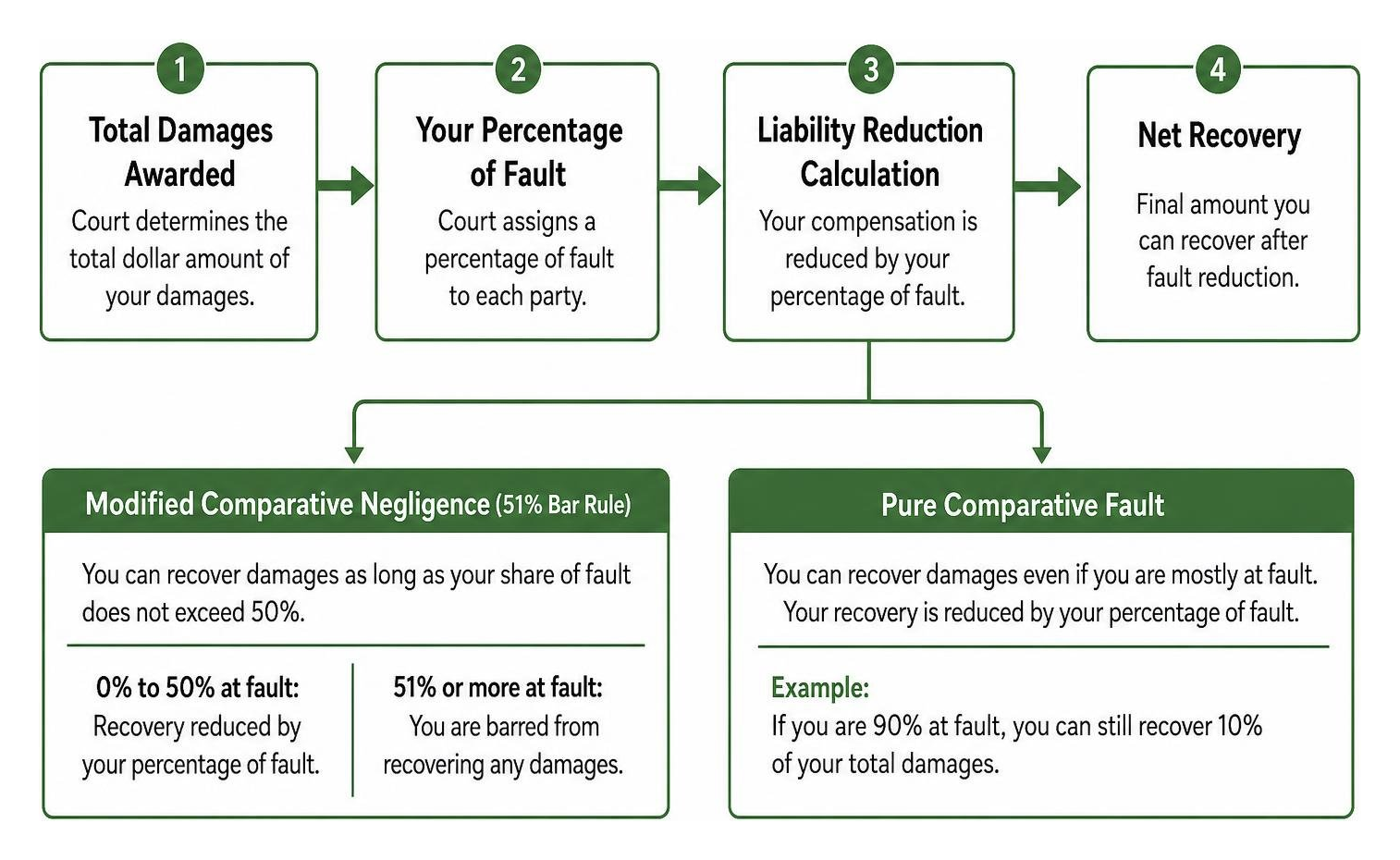
Under a modified comparative negligence system (such as the 51 percent bar rule), an injured person can recover damages as long as their share of fault does not exceed 50%. However, their final recovery is reduced in direct proportion to their assigned fault. If you are awarded $100,000 but found to be 20% responsible for the collision, your net recovery will be $80,000. If you are found 51% or more at fault, you are barred from recovering any damages from the other party.
In contrast, under pure comparative fault models, claimants can recover damages even if they are 90% at fault (recovering 10% of their total losses). In no-fault insurance states, drivers must first look to their mandatory Personal Injury Protection (PIP) coverage for initial medical bills and wage losses, stepping outside the no-fault system only when their medical expenses or injuries meet strict statutory thresholds.
4. Navigating Claim Timelines, Uninsured Drivers, and Deadlines
Resolving a motor vehicle collision claim involves a structured sequence of legal steps:
- Investigation and Evidence Collection: Securing police reports, witness statements, black box data, traffic footage, and medical treatment records.
- Medical Plateau / Maximum Medical Improvement (MMI): Waiting until your physicians can fully project your future recovery and ongoing care requirements.
- Comprehensive Demand Package: Presenting an itemized settlement demand to the insurance adjuster detailing liability and damages.
- Negotiation and Mediation: Engaging in settlement discussions to reach maximum value.
- Litigation Filing and Discovery: Filing a formal complaint, serving subpoenas, conducting depositions, and exchanging evidence under court supervision.
- Trial Verdict: Presenting the case before a judge and jury if the defense refuses a fair settlement.
Handling Uninsured and Underinsured Motorist (UM/UIM) Policies
A common nightmare for crash victims is discovering that the driver who hit them has no car insurance or carries only state minimum liability limits that barely cover an initial emergency room visit.
Knowing the protocols for handling an uninsured hit-and-run driver allows you to pursue compensation through your own Uninsured Motorist (UM) or Underinsured Motorist (UIM) coverage. These policies step into the shoes of the at-fault driver, providing coverage for your bodily injuries, medical bills, and lost income up to your policy limits. Even though you are dealing with your own insurer, UM/UIM claims can quickly become adversarial, making dedicated legal advocacy essential.
Critical Statutes of Limitations and Government Entity Deadlines
Every state imposes strict statutory deadlines for personal injury claims. Missing your statute of limitations injury claim deadline permanently eliminates your right to seek financial recovery in court, regardless of how catastrophic your injuries may be.
While standard personal injury lawsuits often have a multi-year filing window (and wrongful death claims have distinct statutory limits), accidents involving government entities operate under far more restrictive rules. If your crash involved a municipal vehicle, public transit bus, or roadway maintenance truck, state tort immunity laws frequently require filing a formal written notice of claim within an accelerated timeframe (such as 182 days or one year).
5. Step-by-Step Guide to Retaining Legal Counsel
When you are ready to secure legal help, you can use trusted attorney directories to Find a Personal Injury Lawyer Now and schedule formal case evaluations.
Before your consultation, gather all crash-related documents:
- Official police accident reports and exchange forms
- Photos and videos of vehicle damage, injuries, and the accident scene
- Emergency room discharge summaries, diagnostic imaging reports, and medical bills
- Auto insurance declarations pages for all household vehicles
- Pay stubs and tax records documenting time missed from work
- Contact logs of any conversations with insurance adjusters
Key Consultation Questions for Motor Vehicle Accident Lawyers Near Me
During your initial consultation, ask direct questions to evaluate the firm’s fit for your case:
- “Will you personally handle my case, or will it be passed off to a junior associate or case manager?”
- “How many car accident cases have you taken to trial before a jury?”
- “What is your contingency fee percentage, and how are advanced litigation expenses handled if the case is not successful?”
- “What is your realistic valuation of my claim, and what potential challenges do you anticipate?”
- “How frequently will your team provide updates regarding my case status?”
Frequently Asked Questions About Motor Vehicle Accident Representation
How much does it cost to hire an auto accident lawyer?
Hiring a car accident lawyer typically costs nothing out of pocket. Personal injury lawyers operate on a contingency fee agreement, meaning legal fees are deducted as an agreed-upon percentage from the final settlement or court verdict. If your attorney does not recover compensation for you, you owe no attorney fees.
What should I do if the insurance company offers a quick settlement?
Do not sign releases or cash settlement checks without having an attorney review the agreement. Early offers are almost always lowball figures made before the full extent of your long-term medical needs is known. Once you sign a release, you forfeit all rights to seek additional compensation.
How long does a motor vehicle accident lawsuit take to resolve?
Straightforward claims where liability is clear and medical treatment is brief often settle within four to nine months. Complex cases involving severe injuries, disputed fault, commercial policies, or full-scale court litigation can take 12 to 24 months or longer depending on court docket schedules and discovery timelines.
Conclusion
A serious car crash can disrupt your physical health, emotional well-being, and financial stability in an instant. Navigating insurance negotiations while recovering from painful injuries places an unfair burden on you and your family.
For more than 35 years, our team at Cullotta Bravo Law Group has provided aggressive legal representation, treating every client with the dignity and respect they deserve while relentlessly pursuing multi-million dollar recoveries. If you or a loved one has been injured in a collision, contact Cullotta Bravo Law Group’s personal injury attorneys today for a dedicated, no-obligation case evaluation.