

Find a Local Workers’ Comp Attorney Who Fits Your Case
Start with attorneys licensed in your state who handle workers’ compensation claims. Compare their hearing experience, fees, and how often you’ll speak with the attorney handling your case. Before you call, get medical care, report your injury to your employer in writing, and save your medical records and wage information. Reporting and filing deadlines vary by state, so ask about yours right away.
I’m Peter Cullotta, a trial lawyer with more than 35 years of experience helping injured people, including workers with compensation claims, across the Chicagoland area. If you need trusted workmans comp attorneys near you, this guide will help you compare local lawyers and know what to ask before you hire one. For a broader overview of how the claims process works, the workers compensation law framework varies by state, so local counsel is essential.

Helpful local resources:
Introduction
Workplace accidents happen in seconds, but the financial, physical, and emotional fallout can last for years. When you suffer an injury on the job, your primary focus should be on healing, not decoding bureaucratic insurance paperwork or worrying about how you will pay your mortgage. Navigating the statutory claims process requires taking swift action: seeking immediate medical evaluation, providing proper notice to your employer, and understanding the legal standards that dictate your benefits.
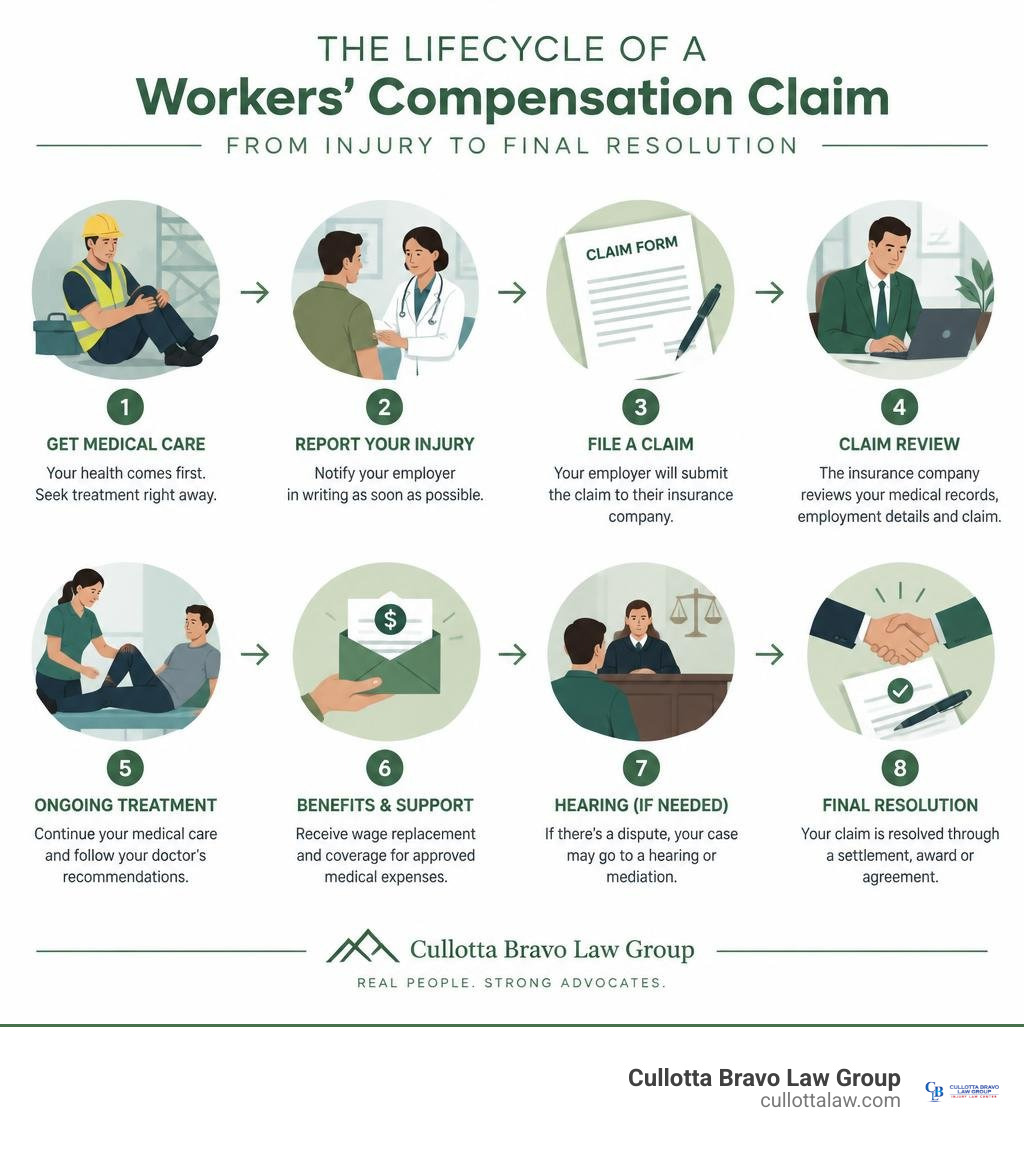
Securing legal counsel early can prevent the costly errors that lead to claim denials, delayed medical procedures, and inadequate settlement offers. This is why finding experienced workmans comp attorneys near you is critical as soon as an accident occurs to protect your rights.
How to Evaluate Workmans Comp Attorneys Near You
Selecting the right legal advocate directly impacts your physical recovery and financial security. Not all law firms handle injury claims with the same level of care or litigation rigor. Many injured workers look online only to end up at high-volume settlement mills that treat files like numbers on an assembly line. When evaluating workmans comp attorneys near you, focus on identifying licensed local counsel who understands your state’s workers’ compensation system, not just a call center that forwards your information.

Reputable lawyers operate on a contingency fee model, meaning you pay no win no fee representation costs upfront. If your lawyer does not recover money for you, you do not owe attorney fees. However, you must look beyond fee structures and assess an attorney’s courtroom readiness, local reputation, and commitment to clear client communication.
| Feature | Local Boutique Law Firm (e.g., Cullotta Bravo Law Group) | High-Volume Settlement Mill |
|---|---|---|
| Attorney Access | Direct communication with seasoned trial attorneys | Case passed to non-attorney case managers |
| Case Strategy | Tailored to maximum statutory recovery & third-party claims | Geared toward fast, lower-value administrative settlements |
| Litigation Willingness | Ready to file formal petitions and go to trial | Frequently settles early to avoid arbitration/court |
| Fee Structure | Standard statutory contingency fee | Standard statutory contingency fee |
| Local Knowledge | Deep familiarity with regional hearing officers and venues | Generic call-center operations with rotating counsel |
Key Credentials to Look for in Workmans Comp Attorneys Near You
When vetting legal counsel, ensure the firm focuses substantially on work injury litigation. A lawyer who primarily handles basic real estate transactions or corporate contracts will lack the tactical skills required to challenge aggressive insurance defense lawyers.
Look for attorneys with decades of trial experience and high standing with state bar associations. Understanding how to choose workplace injury lawyers involves reviewing their history of multi-million dollar recoveries and their ability to explain complex statutory terms without confusing jargon. A qualified advocate should help you demystify legal terms so you understand every phase of your case.
Comparing Settlement Track Records and Fee Structures
Settlement values are governed by strict statutory benefit schedules, your average weekly wage, and the permanency of your disability. A skilled workers comp settlement attorney evaluates whether a lump-sum settlement or ongoing payments best serve your future medical and financial needs.
Insurance companies offer fast, low-ball settlements hoping you will sign away rights to future medical care before understanding the full scope of your injury. Experienced counsel calculates the true lifetime value of your claim, including vocational retraining, future surgical needs, and permanent impairment ratings, fighting to secure maximum compensation.
Critical Steps to Protect Your Claim Immediately After a Workplace Injury
The actions you take in the immediate hours and days following a job site injury determine whether your claim is approved or denied.

To protect your legal standing, complete the following process:
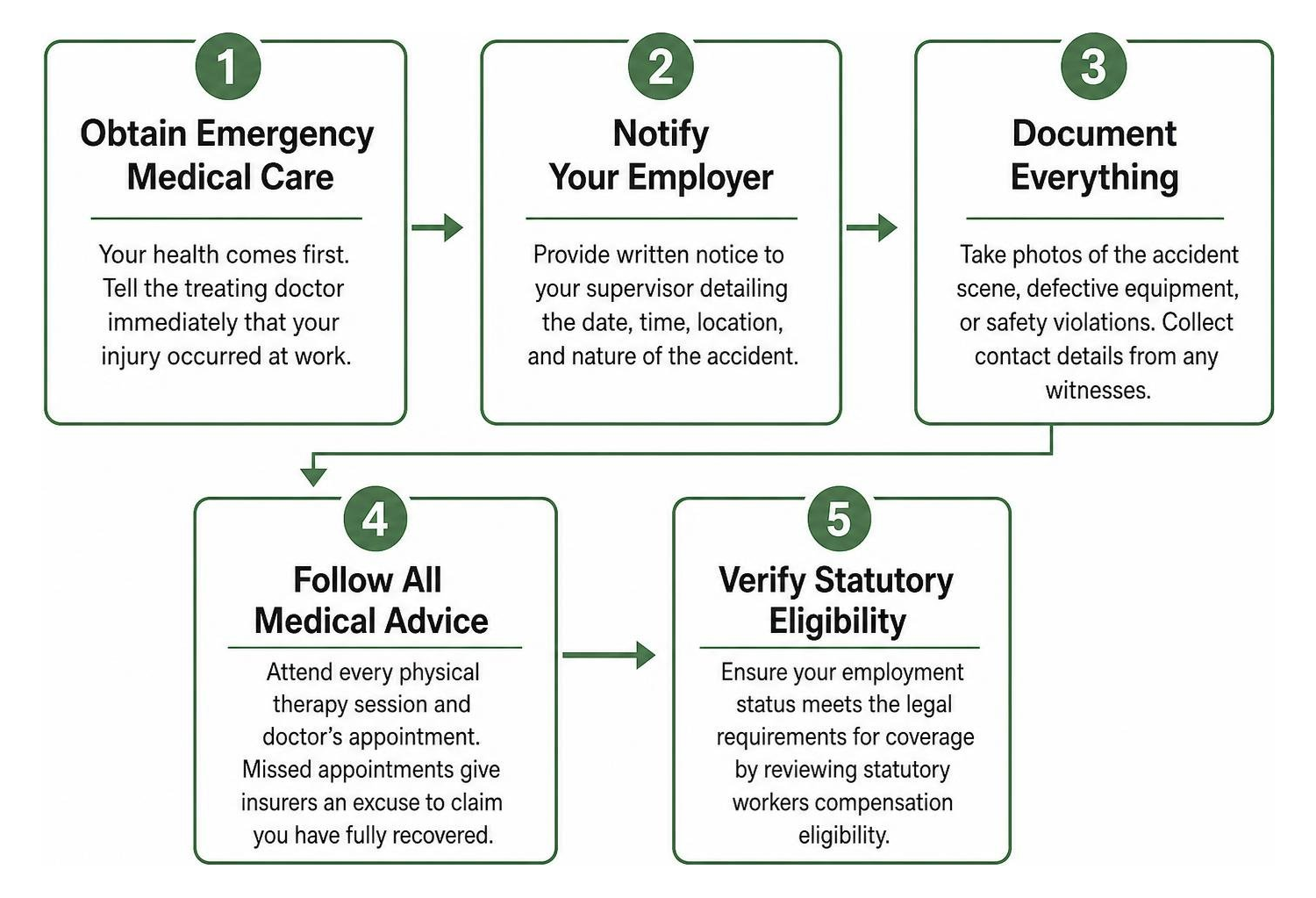
- Obtain Emergency Medical Care: Your health comes first. Tell the treating doctor immediately that your injury occurred at work so it is recorded in the official diagnostic notes.
- Notify Your Employer: Provide written notice to your supervisor detailing the date, time, location, and nature of the accident.
- Document Everything: Take photos of the accident scene, defective equipment, or safety violations. Collect contact details from any witnesses.
- Follow All Medical Advice: Attend every physical therapy session and doctor’s appointment. Missed appointments give insurers an excuse to claim you have fully recovered.
- Verify Statutory Eligibility: Ensure your employment status meets the legal requirements for coverage by reviewing statutory workers compensation eligibility.
Reporting Deadlines and Managing Employer Communications
Statutory deadlines for notifying an employer of an injury are strict. In many jurisdictions, including Illinois, you must formally notify your employer within 45 days of the accident, though reporting it within 30 days or immediately is best practice. The Illinois Workers’ Compensation Commission provides public information about the state claim process, but legal advice about your specific deadline should come from a licensed attorney. Waiting too long creates suspicion and provides insurance adjusters with legal grounds to deny your claim.
Always provide written notice and keep a time-stamped copy for your records. Avoid casual conversations with insurance adjusters before consulting counsel. Never allow an insurer to take a recorded statement without your lawyer present.
Injuries that develop over time require equal diligence. When dealing with a repetitive stress injury such as carpal tunnel syndrome or degenerative spinal disc damage, the clock begins the day you knew-or reasonably should have known-that your condition was caused by your work duties.
Authorized Doctor Rules and Securing Medical Evidence
Rules regarding which medical providers you can see vary by state:
- Employer Medical Networks: Some states allow employers or their insurance carriers to maintain an approved Preferred Provider Program (PPP). In these systems, you may be required to choose a doctor from their established network.
- The Two-Doctor Rule: In Illinois, if the employer does not have an approved PPP, you generally have the right to select up to two treating physicians of your own choice, along with any specialists they refer you to, covered entirely by workers’ comp.
- Independent Medical Examinations (IMEs): Insurers frequently demand that you attend an exam with a doctor they hire. These physicians are paid by the insurance company and often look for ways to attribute your injury to pre-existing conditions.
Solid medical documentation is essential, especially when dealing with complex, life-altering conditions like traumatic brain injuries. Clear diagnostic imaging, specialist opinions, and precise physical therapy notes form the foundation of your legal recovery.
Types of Benefits and Calculating Your Total Financial Recovery
Workers’ compensation is designed to cover your medical costs and replace a portion of the wages you lose while unable to perform your regular duties.
Understanding Illinois workers compensation benefits helps ensure the insurance company is calculating your weekly checks accurately based on your actual earnings, including regular overtime.
| Benefit Category | Qualification Requirements | Standard Payment Structure / Statutory Limits |
|---|---|---|
| Medical Expenses | All reasonable, necessary medical care related to the injury | 100% covered; no co-pays or deductibles for authorized care |
| Temporary Total Disability (TTD) | Employee is completely unable to work during recovery | 66 2/3% (two-thirds) of Average Weekly Wage (AWW) |
| Temporary Partial Disability (TPD) | Working light duty at reduced hours or a lower wage | 66 2/3% of the difference between pre- and post-injury earnings |
| Permanent Partial Disability (PPD) | Permanent loss of function or body part impairment | Calculated via statutory schedules, wage differential, or person-as-a-whole |
| Vocational Rehabilitation | Unable to return to previous occupation due to restrictions | Covers costs for job retraining, education, and career placement |
Workers’ Comp Benefits vs. Third-Party Personal Injury Lawsuits
Workers’ compensation is a “no-fault” system. You do not need to prove your employer was careless or negligent to receive medical and wage benefits. In exchange, the law generally shields your employer from direct civil lawsuits for pain and suffering.
However, many workplace injuries are caused by negligent third parties. When a separate individual or company causes your accident, you can pursue both a workers’ compensation claim and a civil personal injury lawsuit.
Common third-party scenarios include:
- Motor Vehicle Collisions: A negligent driver hits your work truck while you are making deliveries.
- Defective Machinery: A machine malfunctions due to poor manufacturing or inadequate safety guards.
- General Contractor / Subcontractor Negligence: A different subcontractor drops materials or leaves unsafe scaffolding on a shared construction site.
Pursuing personal injury claim assistance alongside your workers’ compensation case unlocks damages not available through workers’ comp alone, including compensation for physical pain, emotional suffering, and total loss of normal life enjoyment.
Overcoming Claim Denials and Appealing Insurance Decisions
Receiving a claim denial letter is frustrating, but it is not the end of your case. Insurance carriers frequently issue denials in the hopes that injured workers will walk away from their benefits.
If your claim is denied, you have the legal right to file a formal appeal through your state’s workers’ compensation commission. To navigate this process, consult our denied workers comp guide 2026 to understand the administrative steps required to overturn improper insurance rulings.
Why Insurers Deny Legitimate Claims and How to Fight Back
Insurance companies rely on predictable tactics to dispute valid injury claims:
- Alleging Missed Deadlines: Claiming you failed to report the accident to your supervisor within the statutory notice window.
- Disputing Course of Employment: Arguing the accident happened outside working hours or off company property.
- Blaming Pre-Existing Conditions: Stating your back, neck, or joint pain is solely the result of natural aging or a prior accident. Under the law, if a workplace incident aggravates or accelerates a pre-existing condition, it is fully compensable.
- Lack of Objective Medical Evidence: Claiming your diagnostic tests do not show a clear, measurable physical injury.
Overcoming these defenses requires the advocacy of work injury lawyers fighting denied claims who can gather medical depositions, subpoena company safety logs, and present indisputable proof of your injury.
When to Hire Workmans Comp Attorneys Near You for Formal Hearings
You should hire an attorney immediately if your claim is denied, your checks are late, or your employer’s insurer refuses to authorize surgery recommended by your doctor.
Resolving disputed claims before an administrative arbitrator requires filing a formal Application for Adjustment of Claim. An experienced injury attorney manages every legal phase: conducting depositions of medical experts, presenting evidence at 19(b) emergency hearings to reinstate benefits, and cross-examining company witnesses.
Frequently Asked Questions About Workers’ Compensation Claims
Can my employer fire or retaliate against me for filing a workers’ compensation claim?
No. State laws strictly prohibit employers from firing, demoting, harassing, or retaliating against workers for exercising their workers’ compensation rights. If an employer fires you or cuts your hours because you reported an injury or filed a claim, you may have grounds for a retaliatory discharge lawsuit that allows for substantial punitive and compensatory damages.
What is the deadline for filing a formal claim after an injury?
While you must report your injury to your employer within 30 to 45 days, you typically have up to three years from the date of the accident—or two years from the last date a workers’ compensation benefit payment was made—to file a formal Application for Adjustment of Claim with the state commission. Missing this statute of limitations permanently bars you from recovering compensation.
Can I pursue compensation for work-related mental stress or PTSD?
Yes, but the evidentiary standards are high. Workers who experience severe psychiatric trauma resulting from a sudden physical injury—such as an explosion or severe machinery accident—can claim benefits for related mental health conditions like PTSD. Pure mental-stress claims without a physical injury are more complex and require proving you were exposed to extraordinary emotional stress beyond the normal conditions of your job. You can learn more about managing workplace stress and mental health claims to see if your situation meets the legal threshold.
Conclusion
A serious workplace injury can disrupt every aspect of your life, but you do not have to confront insurance companies alone. Understanding your rights, meeting reporting deadlines, and securing proper medical evidence are the keys to protecting your financial future.
At Cullotta Bravo Law Group, we bring over 35 years of trial experience to the fight for injured workers across Aurora, Chicago, Naperville, and Joliet. We provide aggressive representation, treat every client with dignity, and have a proven history of multi-million dollar recoveries. Schedule a free consultation with Cullotta Bravo Law Group today to review your case and let us secure the medical benefits and maximum financial recovery you deserve.